 airbrakecompressor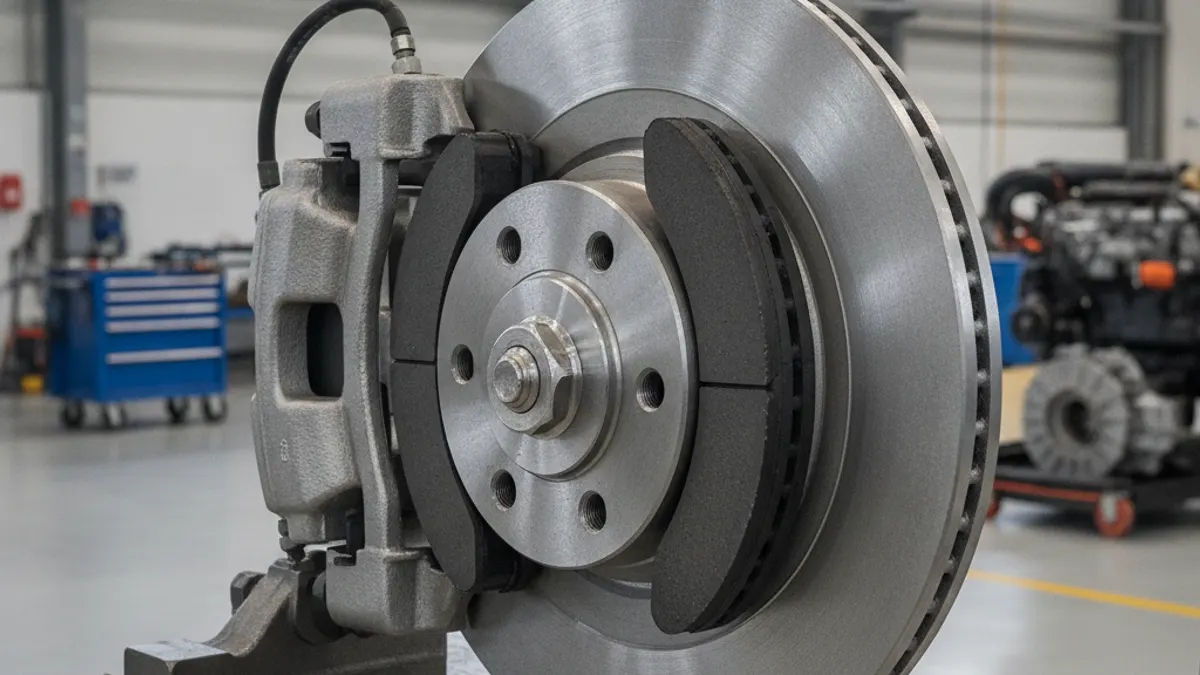
If your truck's brakes grab, chatter or pulse, the fault is almost always in the foundation brake, not in the air supply. Oil- or grease-soaked lining, glazed lining, and out-of-round or cracked drums account for most of it; worn S-cam bushings, flat-spotted cam rollers, worn anchor pins and weak return springs account for most of the rest. Confirm the air side first: the governor should cut out around 120-135 psi and cut back in around 100-110 psi, a fully charged system should sit near 120 psi, and the low-air warning should clear well above its roughly 60 psi trigger. If pressure builds and holds like that, the compressor and control valves are doing their job, and what the driver feels is metal and friction material.
The trap is that all three complaints get written on the same repair order. They are different faults with different fixes, so the first job is to pin down exactly what the driver feels and when.
Grabbing, chattering and pulsing are three different symptoms
- Grabbing — one corner bites far harder than the treadle input calls for. The truck ducks toward that side, and light applications feel like on/off instead of progressive.
- Chattering — a fast, buzzy vibration or stutter you hear and feel through the chassis, usually worst at low speed and light application pressure. Its frequency does not track wheel speed closely.
- Pulsing — a slow, rhythmic surge through the truck that repeats once (or twice) per wheel revolution and slows as the truck slows. On an air brake system you feel it in the chassis and steering, not as hydraulic feedback at the treadle. That timing is the giveaway: it is a rotating part with a high spot.
Quick diagnosis chart
| What the driver reports | Most likely cause | Where to look first |
|---|---|---|
| Hard bite on one corner, truck pulls under light braking | Oil- or grease-contaminated lining | Wheel seal, hub oil level, inside of the drum and shoe faces |
| High-frequency chatter or stutter at low speed | Glazed lining, loose rivets or bond separation, worn anchor pins | Shoe friction surface, rivet heads, anchor pin bushings |
| Slow pulse timed to wheel rotation | Out-of-round, bell-mouthed or heat-cracked drum | Drum inner diameter measured at several points and depths |
| Grab plus notchy, uneven shoe movement | Worn S-cam bushings, seized or flat-spotted cam roller | Cam head, rollers, spider bushings, return springs |
| Trailer grabs before the tractor sets | Mismatched friction material, out-of-adjustment slacks, relay valve crack pressure | Trailer foundation brakes, pushrod stroke, relay valve |
| Chatter only in the last few feet of a stop, ABS lamp activity | ABS cycling on a marginal sensor or damaged tone ring | Sensor gap and retention, tone ring teeth, wiring |
| Grab or chatter only on the first stops of a cold, damp morning | Surface rust or moisture film on the drums | Normally clears after two or three light applications |
The causes, in the order a technician should check them
Contaminated lining
A leaking wheel seal, an overfilled hub, or grease pushed past a failed seal during a lube service puts oil on the friction face. Contaminated lining does not simply stop working — it behaves erratically, holding at one temperature and snatching at another, which is exactly what a driver calls "grabbing." Pull the drum and look: a dark, wet-looking, streaked friction surface and oil tracking on the backing plate confirm it. Friction material is porous, so degreasing, sanding or "burning it off" with a few hard stops does not restore it. Fix the seal and replace the lining.
Glazed or overheated lining
Long grades taken on the service brakes, dragging brakes, or a trailer doing more than its share bakes the resin at the friction surface into a hard, shiny skin. Glazed lining has a low, unstable coefficient of friction and a tendency to stick-slip — the classic chatter. Blue or straw discoloration on the drum and a mirror finish on the shoe tell the story. Address the cause as well: correct adjustment, a properly working retarder or engine brake, and balanced tractor/trailer braking.
Drum condition
Drums go out of round from heat cycling, run bell-mouthed from repeated hard use, and develop heat checks that turn into radial cracks. Measure the inner diameter at several clock positions and at both the open and closed ends. The discard diameter is cast or stamped into the drum — typically on the order of 0.080 to 0.120 in over nominal depending on the part — and that stamped figure is the only number that counts. Any crack that reaches through the friction surface means the drum is scrap, not a machining candidate. This is the same failure family behind a truck that shakes when braking, and there is more on measurement limits in the truck brake drums guide.
A drum already near its discard diameter should be replaced, not turned. Machining removes the mass that absorbs heat, and a thin drum will go out of round again within a few thousand miles.
Cam, roller and anchor wear
In an S-cam foundation brake, the cam has to roll the shoes out smoothly and let them come back. Worn camshaft bushings let the shaft walk, flat-spotted rollers that no longer rotate make the shoes step out instead of glide, and worn anchor pins or bushings let the shoe rock in its bore. Any of the three produces grab or chatter that no amount of lining replacement will cure. Check camshaft radial play, roller rotation by hand, shoe rock at the anchor end, and return springs that are stretched, rusted or broken.
Adjustment and balance
Uneven pushrod stroke across an axle makes one brake do the work first — that reads as a grab and a pull. Measure applied stroke with the system charged, using an application of roughly 90 to 100 psi with the engine off, and compare sides. They should be within about 1/4 in of each other and well inside the readjustment limit for the chamber type (commonly around 2 in for a standard Type 30 and about 2-1/2 in for the long-stroke version; confirm against the marking on the chamber). Automatic slack adjusters that need constant manual adjustment are failing and should be replaced, not adjusted.
Inspection sequence
- Chock the wheels, build the system to full pressure, and confirm the air side behaves normally before condemning anything mechanical.
- Measure applied pushrod stroke on every wheel end and note side-to-side differences.
- Look for hub oil weeping, grease on the tire sidewall, or wet backing plates.
- Pull the suspect drum. Inspect the friction surface for oil, glaze, scoring, heat checking and cracks.
- Measure lining thickness. Anything under about 1/4 in on drum brakes, or about 1/8 in on air disc pads, is at or past out-of-service condition — replace it.
- Check rivet tightness or bond integrity, rock the shoes at the anchors, spin the cam rollers, and check camshaft play.
- Measure the drum at several points, compare to the stamped discard diameter, and check wheel bearing endplay while the hub is accessible.
Doing the repair so it stays fixed
Replace friction material in axle sets, never one wheel. Both sides must use the same friction grade — mixing a soft block with an aggressive one is a guaranteed pull, and it is one of the most common causes of a "new brakes, still grabbing" comeback. Matched OE-grade brake lining sets sized to the drum and application keep the friction coefficient consistent across the axle.
While the wheel end is open, renew the hardware that caused the fault in the first place: anchor pins and bushings, cam rollers, camshaft bushings, seals, and return springs. Fit new drums rather than turned ones where budget allows, clean the protective coating off new drums, seat the shoes to the drum radius, and set adjustment so stroke is short and equal. Then run a proper burnish — a series of light-to-moderate stops from moderate speed with cooling between them — so the lining beds in without glazing on its first hard application.
What not to do
Do not chase grabbing with adjustment alone; over-adjusting a good brake to mask a contaminated one just adds heat. Do not spray brake cleaner on oiled lining and call it repaired. Do not machine drums past their stamped limit to save a set. And never keep a truck in service with a cracked drum, a broken shoe return spring, or lining below the wear limit — those are out-of-service items on any roadside inspection, and they are the ones that turn a chatter complaint into a runaway.
Need the part, not just the answer?
OE-grade air brake compressors and repair kits, manufactured and tested to commercial-vehicle standards.
Shop VADEN partsPublished by VADEN Original. Product links point to the manufacturer’s official catalogue. Specifications are general — always confirm figures against your vehicle’s service manual.