 airbrakecompressor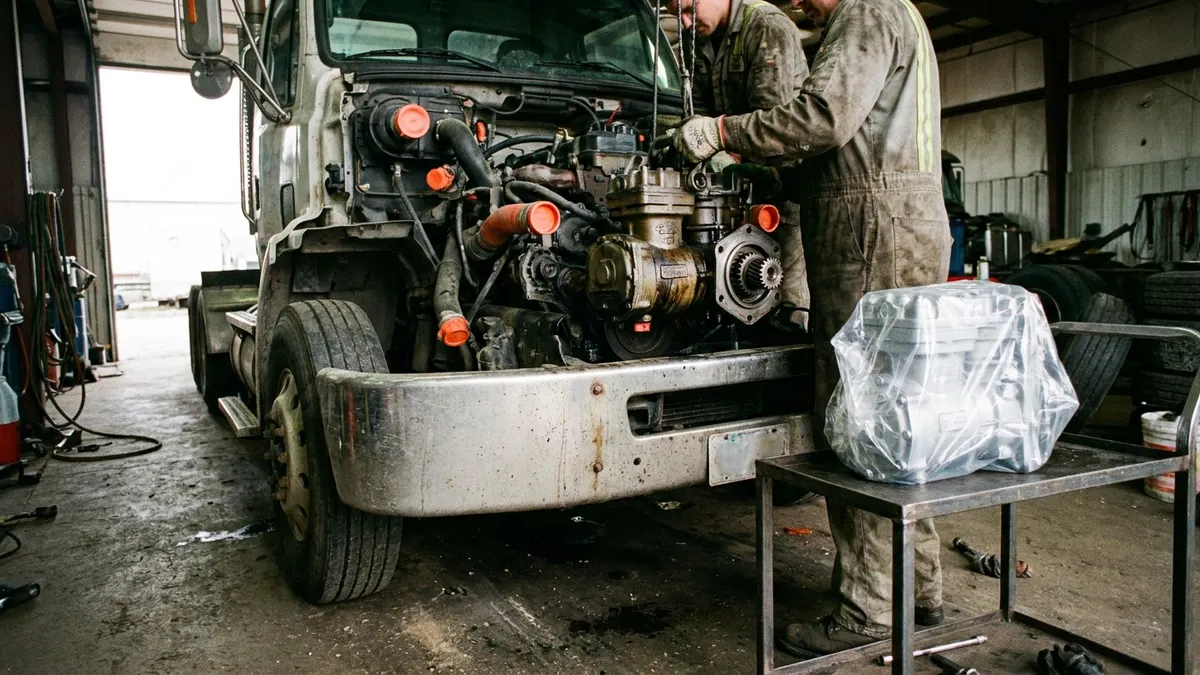
On a Detroit DD13, DD15 or DD16 the air brake compressor is an engine-mounted, gear-driven reciprocating pump that runs off the rear gear train, takes its lubrication from the engine oil circuit and is cooled by engine coolant. It charges the pneumatic brake system only — there is no hydraulic brake circuit on these chassis. Ordering the right one comes down to three things: which engine family the truck actually has, the number stamped on the unit you are removing, and whether the drive gear, cooling and inlet arrangement on the replacement match what came off. If you want the fundamentals of the pump itself first, start with how an air brake compressor works.
DD13, DD15 and DD16 are one family with three displacements
The DD engines are the North American designations of Daimler's heavy-duty engine platform, so they share architecture, accessory drive concept and part-numbering logic. That is a trap at the parts counter: a compressor released against one family often looks almost identical to the one on another, while the drive gear, port orientation or cooling detail differs just enough to be wrong.
| Engine | Displacement | Daimler equivalent | What it changes for the compressor |
|---|---|---|---|
| DD13 | 12.8 L | OM470 | Regional and vocational builds; single-cylinder units are the common fitment |
| DD15 | 14.8 L | OM471 | The volume line-haul engine; the widest spread of released numbers and supersessions |
| DD16 | 15.6 L | OM473 | Heavy haul and severe vocational; twin-cylinder units appear more often here |
Detroit and Daimler numbers on these engines carry an A prefix, a three-digit engine group echoing the family — 470, 471 or 473 — then a group and serial block. Treat that prefix as a sanity check, not a fitment decision: numbers supersede over the life of the platform, and the same casting is often released under a Detroit number, a truck-builder number and the pump maker's own designation.
Drive arrangement and mounting
The defining feature of the DD platform is the rear gear train: the compressor is driven from the back of the engine rather than from a front gear case. That one fact shapes most of the job.
- It turns whenever the engine turns. No belt, no clutch; the pump is loaded and unloaded by the governor, not by disconnecting the drive.
- Access is restricted. Reaching the rear of the engine typically means moving exhaust and aftertreatment plumbing, and on some chassis a heat shield or the starter.
- Oil and coolant pass through the mounting interface. The oil feed, the drain and the coolant path to the head are part of the joint, so gaskets, O-rings and torque sequence matter.
- The drive gear may or may not come with the new unit. If it transfers, inspect the teeth and the retaining hardware before fitting; a chipped gear will take the new compressor with it.
Inlet arrangement matters as much as the flange. Emissions-era builds are commonly fed from the charged intake side rather than through the engine air cleaner, and a boost-fed unit is not interchangeable with a naturally aspirated one even when the mounting matches. Confirm the inlet on the unit you remove.
Why access drives the cost of the job
On a front-gear-train engine a compressor swap is mostly a parts decision. On a rear-gear-train DD it is a labor decision: the pump is inexpensive next to the hours needed to reach it, and you pay the access cost twice if a marginal unit comes back.
Single-cylinder or twin-cylinder
Single-cylinder pumps cover ordinary line-haul work. Twin-cylinder units belong on chassis with genuinely high air demand: frequent suspension dumps, PTO and body air, air-operated doors, refuse packer bodies and multi-trailer combinations. A twin roughly doubles delivery at the same drive speed, shortening charge time and cutting the share of running time spent loaded. The trade-offs are set out in single vs twin-cylinder air compressors.
Never specify below what the chassis was built with. A pump that cannot keep up runs loaded almost continuously, overheats, cokes its discharge line and pushes oil downstream. For reference on what keeping up looks like: the governor should cut out somewhere in the 120–135 psi band and cut back in around 100–110 psi, a fully charged system normally sits near 120 psi, the low-air warning is set near 60 psi, and spring brake chambers begin to apply as system pressure falls into roughly the 20–45 psi range. Use the manufacturer's service data for the exact settings on a given build.
What to record before you order
Engine model alone is not enough to order a DD15 air compressor. Collect the following and cross-reference them together.
| What to record | Where it comes from | Why it matters |
|---|---|---|
| Engine serial number and family | Engine data plate or the vehicle build record | Separates DD13, DD15 and DD16 releases and pins the build date |
| Number on the compressor body | Cast or stamped on the crankcase or head | The most reliable starting point for any cross-reference |
| Cylinder count | Visual, plus the head casting | Single and twin are not interchangeable either way |
| Inlet type | Inlet port and the plumbing on the vehicle | Boost-fed and air-cleaner-fed units differ internally |
| Cooling arrangement | Coolant ports at the head and the flange | Sets the gasket kit and whether coolant lines transfer |
| Drive gear and its retention | The old unit, before removal | Decides whether you order bare or complete with gear |
| Discharge port orientation and governor pad | The old unit, in place | A clocked port or missing governor face makes a correct pump unusable |
Cross-references run in both directions: a Detroit or Daimler A-prefixed number on one side, the brake manufacturer's own designation on the other — Knorr-Bremse, Wabco/ZF or Bendix, depending on build and model year. Treat any such table as a shortlist to verify against the vehicle.
Symptoms that point at the compressor
Slow build, or a system that never reaches cut-out, is the classic complaint — but on a DD it pays to eliminate the cheap causes before committing to rear-of-engine labor. Work the air side first: leak-down test applied and released, check the dryer for a purge valve venting continuously, and confirm the governor is actually commanding load.
- Oil in the dryer, the wet tank or the discharge line. Heavy carryover usually means worn rings or a restricted oil drain back to the pan, not simply a tired pump.
- A hot, carboned discharge line. Carbon buildup is a duty-cycle and heat symptom; fitting a compressor without clearing or replacing that line invites a repeat failure.
- Knocking that follows engine speed. Mechanical noise from a gear-driven unit calls for inspection of the drive gear and the mounting, not only the pump.
- Continuous loaded running. On a healthy truck the compressor spends only a small fraction of its running time loaded; constant loading points to leakage or undersizing.
Repair kit, remanufactured unit or new
All three are legitimate. A repair kit is reasonable where the crankcase and bores are sound and the fault is confined to valves, rings or the unloader. A remanufactured unit works where the core is worth reclaiming and the supplier documents what was replaced. A new unit earns its price where the failure was contaminating, or where the access labor makes a second attempt unacceptable. The sequence and the post-fitting checks are covered in the air brake compressor replacement guide.
Whatever you fit, finish the job on the air side. Replace the air dryer cartridge, clean or replace the discharge line, check the tanks and downstream valves for oil and debris carried over from the failure, then verify cut-in and cut-out against the service data and run a leak-down test before the truck goes back to work.
Source (VADEN Original): Air Brake Compressor Duty Cycle & Efficiency Guide
Need the part, not just the answer?
OE-grade air brake compressors and repair kits, manufactured and tested to commercial-vehicle standards.
Shop VADEN partsPublished by VADEN Original. Product links point to the manufacturer’s official catalogue. Specifications are general — always confirm figures against your vehicle’s service manual.