 airbrakecompressor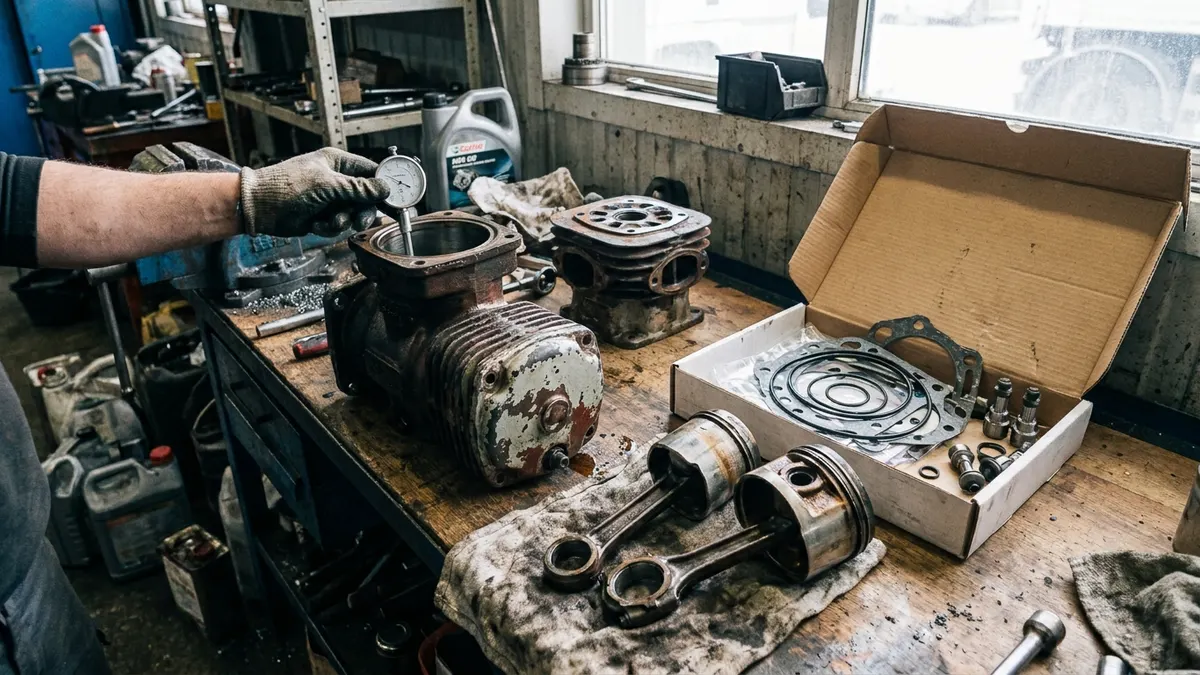
An air brake compressor repair kit is a bag of the soft parts and wear items that fail first inside a reciprocating compressor: gaskets and O-rings, the intake and discharge valve set, unloader pistons with their seals and springs, piston rings, and normally the crankshaft seal. The heavy pieces (block, head casting, crankshaft, connecting rods) are not in the kit, because you reuse yours. That makes a kit the right repair when the compressor is failing at sealing, valving or unloading, and the wrong repair when the bore is scored, the crank journals are worn, or a casting is cracked.
What is actually in the kit
Contents vary by compressor family and by supplier, but they fall into five recognisable groups. Most catalogues sell these separately so you buy only the wear area you need, and also bundled as a full overhaul kit.
| Kit type | Typical contents | Buy it when |
|---|---|---|
| Gasket and seal kit | Cylinder head gasket, base and cover gaskets, coolant port O-rings, crankshaft seal, sealing washers | External oil or coolant weeping, or any time the head comes off |
| Valve plate / valve kit | Intake and discharge valve discs or reeds, valve seats or inserts, valve springs, stop plates, head gasket | Slow air build, hot discharge line, air blowing back out of the intake |
| Unloader kit | Unloader pistons, bushings, O-rings, return springs, saddle or plunger assembly, cover gasket | Compressor never unloads, or unloads late and cycles constantly |
| Piston ring kit | Compression rings, oil control rings, sometimes wrist pin clips and rod bushings | Oil carryover into the tanks and air dryer, with the bore still in spec |
| Full overhaul kit | All of the above plus main and rod bearings, and in some kits complete pistons | High-hour unit being rebuilt on the bench rather than spot-repaired |
Read the parts list before you strip the compressor. Some valve kits include the head gasket and some do not, and a unit stripped on a Friday with no gasket in the box sits until Monday. Check too whether your kit supplies the valve seats or only the discs, because carbon-pitted seats will kill a new set of discs within weeks.
Which parts wear out first
Wear is not random. A compressor on a healthy system spends most of its life turning unloaded, and everything that moves during that cycle wears at a predictable order:
- Discharge valves and seats. They take the hottest, dirtiest duty in the unit. Oil vapour bakes onto the seat, the disc stops sealing, and hot air recirculates instead of leaving the head.
- Unloader pistons and seals. These stroke every time the governor swings between cut-in and cut-out. Hardened O-rings let the unloader leak, so the compressor pumps when it should be resting.
- Cylinder head gasket. Heat cycling plus a carboned-up discharge port raises head pressure and pushes the gasket, sometimes blowing between cylinders on a twin-cylinder unit.
- Piston rings. Slower to fail, but once they glaze or stick, oil goes downstream instead of back to the sump. See why an air compressor pumps oil before you assume rings are the whole story.
- Crank seal and bearings. Last to go. Bearing noise is your signal that a soft-parts kit is no longer the correct repair.
Will a repair kit fix your symptom?
Use this as a first sort before you order anything.
| Symptom | Usual cause | Kit fixes it? |
|---|---|---|
| Slow build, struggles to reach cut-out (120-135 psi) | Leaking discharge valves or head gasket | Yes, valve and gasket kit |
| Runs constantly, never unloads | Unloader seals, or a plugged governor signal line | Often, but test the governor first |
| Air puffing back out of the intake | Broken or unseated intake valve | Yes, valve kit |
| Oil in the tanks and dryer | Rings, coked discharge line, restricted oil return | Sometimes; measure the bore before you commit |
| Knocking or rumble under load | Rod or main bearing, wrist pin | No, rebuild or replace the unit |
| Coolant loss into the compressor | Head gasket or cracked head | Gasket kit only if the head passes a pressure check |
| Pressure bleeds off overnight, low-air warning (~60 psi) by morning | Leaks downstream in valves, chambers or lines | No, the compressor is not the fault |
What a repair kit does not include
- The discharge line, which almost always needs cleaning or replacing on an oil-passing repair
- The air dryer desiccant cartridge, which is contaminated by the same oil
- The governor, which is a separate device and a separate test
- Drive gear, pulley, coupling or mounting hardware
- Coolant and oil supply lines and their banjo washers on many kits
Matching the kit to your compressor
Do not order by truck model alone. One engine family may have run three compressor variants across its production life, and single- versus twin-cylinder units, water-cooled versus air-cooled heads, and air-actuated versus mechanical unloaders all take different internals. Work from the casting number and part number stamped on the compressor body, then confirm the head style by eye. OE-referenced ranges such as VADEN air brake compressor repair kits cross-reference to Bendix, Wabco/ZF, Knorr-Bremse and truck OEM numbers, which is the quickest way to confirm you are holding the right box. If you are still deciding, the case for a kit versus a replacement unit is set out in our guide to rebuilding versus replacing a compressor, and the sealing side is covered in the cylinder head gasket kit guide.
Making the repair last
- Scrape and solvent-clean the head and valve deck; carbon left on a seat ruins new discs.
- Check the head and deck for warp with a straightedge before reassembly.
- Fit the valve plate the right way up. Intake and discharge discs are not interchangeable.
- Torque the head in the manufacturer's sequence and to their current figures; over-torque distorts the deck.
- Prime the unit with clean engine oil, and replace or clean the discharge line and the dryer cartridge.
- Run the truck up and confirm the system cycles: cut-out in the 120-135 psi band, cut-in around 100-110 psi, and a fully charged system holding near 120 psi with no rapid bleed-down.
If the compressor still will not reach cut-out after a valve and gasket kit, stop replacing compressor parts. Check the governor, the unloader signal line, and system leakage before you tear the unit down a second time.
Need the part, not just the answer?
OE-grade air brake compressors and repair kits, manufactured and tested to commercial-vehicle standards.
Shop VADEN partsPublished by VADEN Original. Product links point to the manufacturer’s official catalogue. Specifications are general — always confirm figures against your vehicle’s service manual.