 airbrakecompressor
When an air compressor keeps failing after replacement, the new unit is seldom the real problem. It has most likely inherited whatever killed the first one: oil and carbon left in the discharge line and air dryer, a restricted oil drain or high engine crankcase pressure flooding it with oil, a saturated dryer letting moisture and sludge jam the governor and unloader, or a duty cycle pushed too high by leaks and accessory air. Fix that root cause first, or the next compressor will fail the same way.
If you have not yet confirmed that the compressor is the part failing, start with the symptoms of a failing air brake compressor.
Why a replacement fails the same way
An engine-driven air brake compressor is durable. It dies early when the system works against it: too much oil reaching the cylinder, too much heat, too many hours loaded, or dirty intake air. A new compressor replaces the damaged part but none of those conditions.
Watch for the false repeat failure too. Oil stored in uncleaned tanks and dryer desiccant keeps appearing at the drains, and a healthy new compressor gets condemned for oil it never pumped. Every compressor passes a trace of oil, so judge carryover with the manufacturer's measured test where one is published, not a wet drain valve the day after the repair.
Rule of thumb: when two compressors fail on the same truck with the same symptom, stop testing compressors and start measuring the system.
Read the failed unit before you scrap it
Before the old compressor goes back as a core, pull the head, inspect the valves, bores and bearings, and photograph the damage. A warranty claim on a failed replacement will be judged on the same evidence.
| What you find | What it points to | Where to look next |
|---|---|---|
| Hard carbon on the discharge valves and head | Sustained high discharge temperature | Duty cycle, discharge line restriction, coolant flow to the head |
| Wet oil through the head, little carbon | Oil flooding the crankcase or drawn past the rings | Oil return path, crankcase pressure, intake restriction |
| Scored bores and worn rings with grit | Unfiltered air entering the intake | Intake hoses, clamps, filter element and housing |
| Scored or spun bearings, seized crankshaft | Oil starvation or drive overload | Oil supply line, engine oil pressure, drive gear, coupling or belt |
| Cracked head or failed head gasket | Overheating, or a blocked discharge raising head pressure | Coolant lines, frozen or kinked discharge line |
| Sludge in a sticking unloader | Moisture and oil in the governor signal circuit | Air dryer condition, governor, signal line |
Root cause 1: contamination left in the system
A failing compressor pushes oil and carbon downstream, and it stays after the unit comes off: carbon in the discharge line, oil in the desiccant, emulsion in the reservoirs, sludge in the governor signal circuit. A carboned discharge line raises back pressure, so the new compressor runs hotter until its own valves carbon up. Sludge in the governor or unloader can hold the compressor loaded until it overheats and passes oil.
The cleanup is its own procedure: follow air system decontamination after a compressor failure before the new unit goes in, not after it fails.
Root cause 2: restricted oil drain and crankcase pressure
Most truck air compressors are lubricated by pressurized engine oil that drains back to the engine crankcase by gravity, through the mounting flange or an external return line. If oil cannot drain fast enough, it builds up in the compressor crankcase, overwhelms the piston rings and leaves with the discharge air. Check for:
- A kinked, crushed or uphill-routed return hose, or a drain passage choked with sludge.
- A mounting gasket or adapter that partly blocks the drain opening.
- High engine crankcase pressure from blow-by or a plugged crankcase breather or ventilation filter.
- Engine oil pressure outside the engine maker's range, checked with a test gauge.
- A restricted intake, which pulls oil past the rings from the other direction.
None of these lives inside the compressor, so a new unit inherits them all.
Root cause 3: a saturated or faulty air dryer
The dryer and compressor work as a pair. On most systems the dryer purges each time the governor cuts out, and the purge regenerates the desiccant. Desiccant soaked with oil from the first failure cannot regenerate, so moisture reaches the reservoirs, governor and unloader signal, and in cold weather freezes there, leaving the compressor stuck unloaded or unable to unload. A faulty dryer also adds load directly:
- A purge valve that leaks or sticks open bleeds supply air and keeps the compressor loaded longer.
- On dryers purged by a governor signal, a disconnected or blocked control line stops the purge and saturates a new cartridge quickly.
- A cartridge clogged with oil sludge restricts flow and raises back pressure at the compressor head.
Root cause 4: a duty cycle too high for the compressor
Duty cycle is the share of engine running time the compressor spends loaded, building air. A correctly sized compressor on a leak-free system typically runs loaded about 25 percent of the time or less. Push it well past that and discharge temperature climbs, oil carbonizes in the head and discharge line, and carryover rises. The drivers sit outside the compressor:
- Leaks. Every leak keeps the compressor loaded. Run released and applied leak-down tests with the system fully charged at around 120 psi.
- Accessory air and operation. Air suspension, air seats, bus doors and kneeling, tire inflation and body controls share the supply, and refuse trucks, city buses and yard tractors build much of their air at idle, where output is lowest.
- Governor and unloader. Cut-out typically falls within 120 to 135 psi and cut-in within 100 to 110 psi. A governor set high or a leaking unloader lengthens every loaded cycle.
- Undersized unit. A single-cylinder compressor where demand calls for a twin-cylinder or higher-output unit.
If demand stays high once the leaks are fixed, the answer is more capacity, not another like-for-like unit. Use the original OE part number to confirm fitment, then check whether a higher-output option exists for that engine; the VADEN Original air brake compressor range is cross-referenced to OE numbers for that purpose.
Other repeat-failure causes to rule out
- Intake leaks. A split hose or loose clamp after the filter admits dust that scores rings and bores.
- Cooling and routing. A kinked or air-locked coolant line overheats a water-cooled head, and a discharge line with a low spot can freeze and block the discharge.
- Drive faults. Worn gears or couplings, or belt tension and alignment errors, overload the crankshaft bearings.
- Wrong unit. A compressor can bolt on and still differ from the original in unloader arrangement, head cooling or output.
Fitment, priming and the first-start checks that catch these are covered in new air compressor break-in checks.
Root-cause checklist before fitting another compressor
- Classify the damage on the failed unit: carbon, wet oil, grit, bearing failure or cracking.
- Rule out a false failure caused by oil left over from the previous compressor.
- Confirm the oil return drains freely, and check crankcase pressure, the breather and intake restriction.
- Replace a carboned discharge line and correct low spots or sharp bends.
- Renew the dryer cartridge and confirm it purges cleanly at cut-out.
- Fix leaks, list accessory air users, and verify governor cut-out and cut-in.
- Match the replacement to the OE part number and to the vehicle's real air demand.
Record build-up time, governor readings and leak-down results when the new compressor goes in. If those numbers drift by the next service, the root cause is still on the truck.
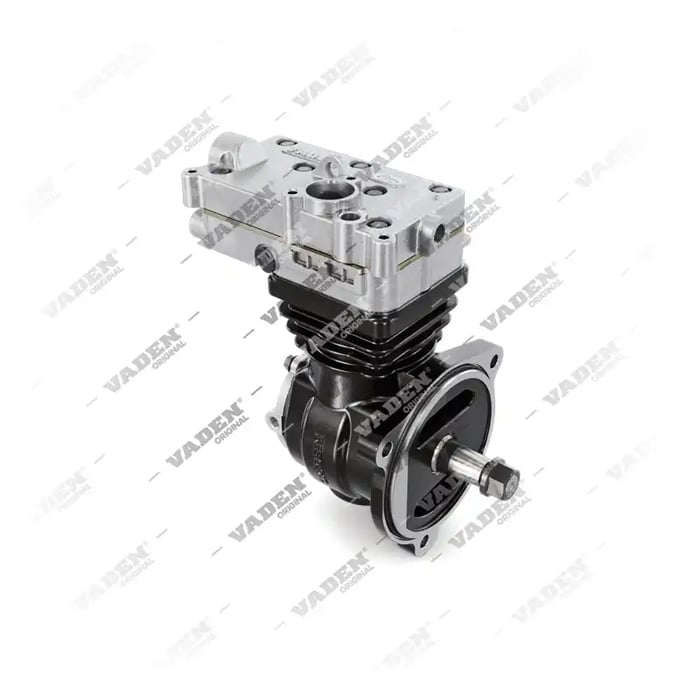
Need the part, not just the answer?
OE-grade air brake compressors and repair kits, manufactured and tested to commercial-vehicle standards.
Shop VADEN partsPublished by VADEN Original. Product links point to the manufacturer’s official catalogue. Specifications are general — always confirm figures against your vehicle’s service manual.