 airbrakecompressor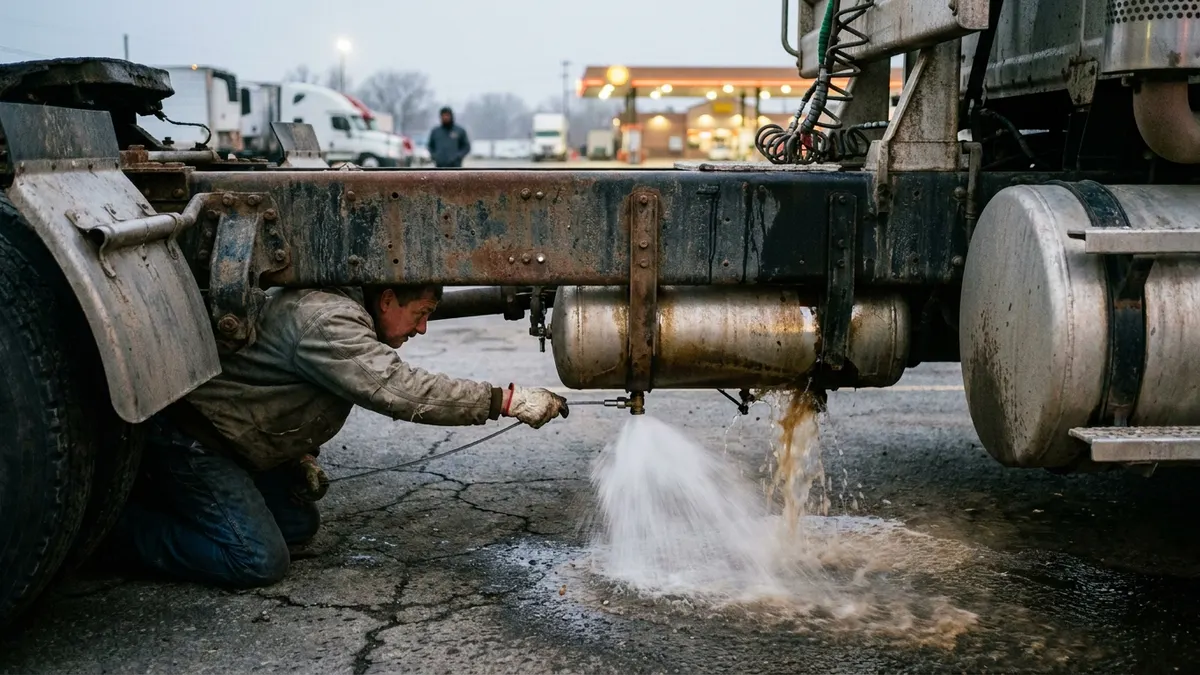
Drain the air brake tanks at the end of every working day, or before the truck moves in the morning, by opening the drain valve at the bottom of each reservoir and letting it bleed until nothing but dry air hisses out. Start with the wet tank (supply tank), then do the primary and secondary service tanks. With the system fully charged it takes about two minutes, and it is the cheapest air brake maintenance there is.
The reason is simple physics. The compressor draws in ambient air and squeezes it, and the moisture in that air condenses out as the compressed air cools in the tanks and lines. Add the fine mist of compressor oil that always sneaks past the rings, and the bottom of the wet tank becomes a pool of corrosive, valve-killing sludge. Every valve, chamber and dryer downstream is fed from those tanks.
Why draining matters more than it looks
Water in the system does four things, all of them bad. It rusts the tank from the inside out and eventually eats through the shell. It carries scale and rust flakes into relay valves, quick release valves and the foot valve, where the debris jams small ports and causes slow release or dragging brakes. It freezes in winter, plugging lines and drain valves and leaving you with brakes that will not release. And it emulsifies with compressor oil into a grey paste that coats air lines and chews up rubber seals.
Oil carryover is the other half of the problem. A healthy compressor passes only a trace. A worn one pumps enough oil to saturate the air dryer desiccant, after which the dryer stops removing moisture and the tanks fill with water fast. That is why oily drainage is a compressor diagnosis, not just housekeeping. See air brake compressor pumping oil for the full picture.
How to drain the tanks correctly
- Park on level ground, chock the wheels and set the parking brakes. Never work under a truck held only by service air.
- Let the system build to full pressure, normally around 120 psi, with governor cut-out typically in the 120 to 135 psi range. Pressure is what pushes the contaminants out.
- Open the wet tank drain first. It sits closest to the compressor and collects the most water and oil.
- Open the primary and secondary tank drains, plus any auxiliary or trailer reservoirs.
- Hold each valve open until the discharge runs clear and dry. A quick blip is not a drain.
- Close every valve, rebuild pressure, and confirm the governor cuts out normally and the low-air warning, which typically clears around 60 psi, is off before moving.
If a drain dribbles instead of blasting, the outlet is partly plugged with sludge or ice. Clear it. A valve that will not seal afterwards is a constant leak and needs replacing.
Manual versus automatic drain valves
| Feature | Manual drain (petcock / pull-cord) | Automatic drain valve |
|---|---|---|
| Operation | Driver opens it by hand or lanyard | Purges on pressure differential or governor cycle |
| Interval | Daily, driver-dependent | Continuous, unattended |
| Failure mode | Skipped, or the valve seizes or leaks | Fails silently: stops purging and nobody notices |
| Winter behavior | Can freeze shut; thaws with heat | Often heated, but the heater element can fail |
| Check required | The drain itself is the check | Pull the manual override weekly and watch for a purge |
An automatic drain is a convenience, not an excuse. A common shop finding on a truck with soaked tanks is an auto-drain that quit purging months earlier. Pull the ring, look for a solid blast of air and moisture, and if nothing comes out, drain the tank manually and rebuild or replace the valve.
Reading what comes out
The drainage is a free sample. Look at it before you kick it into the gravel.
| What comes out | What it usually means | Next step |
|---|---|---|
| Dry air, a few drops | Normal: dryer working, compressor healthy | Keep the routine |
| Clear water, steady amount | Humid climate or high duty cycle; dryer near capacity | Check the purge; review cartridge interval |
| Large volume of water every day | Dryer desiccant spent or purge valve stuck | Replace the cartridge, inspect the purge valve |
| Milky grey emulsion | Oil and water mixing: dryer passing both | New cartridge plus a compressor oil-carryover check |
| Heavy black oil or tar-like sludge | Excessive compressor oil carryover: rings, discharge line or unloader trouble | Inspect the compressor; expect downstream cleanup |
| Rust flakes and brown scale | The tank has been wet a long time; internal corrosion | Inspect tank condition and watch for contaminated valves |
Rule of thumb: if you can smear the drainage between two fingers and it feels slick, oil is getting past the compressor and the air dryer is fighting a losing battle.
Draining in winter
Cold weather turns a skipped drain into a no-go. Water that would have sat harmlessly in the tank freezes in the drain valve, in the dryer purge port and in the low points of the lines. The truck may build pressure and then lose it, or the spring brakes may refuse to release even with full system pressure, because spring brakes need delivered air pressure to compress the spring and a plugged or frozen line will not deliver it.
Drain warm, at the end of the shift, while the tanks are still above freezing and the moisture is liquid. If a valve is already frozen, thaw it with heat rather than forcing it, or you will crack the seat. Alcohol evaporators and tank heaters help, but a dryer that actually removes water is the real fix.
Where draining fits in the maintenance routine
Draining is the daily task; the dryer cartridge is the scheduled one. Cartridge replacement typically runs on an annual or mileage basis depending on duty cycle and the manufacturer's guidance, and it should be moved up if you are pulling a lot of water or oil at the drains. The compressor's own condition sets the ceiling on all of it: a compressor that pumps oil will ruin a fresh cartridge in short order.
Fold the drain into the walk-around. It pairs naturally with the leak-down and applied-pressure checks in the air brake pre-trip inspection, and it belongs on any written service schedule alongside the items covered in air brake compressor maintenance. Two minutes a day protects the pneumatic hardware and keeps a roadside inspection from turning into an out-of-service order.
If the drains keep giving you water, the drying side is no longer keeping up, and a cartridge or purge valve from the air dryer valves is the repair that drain pan is asking for.
Need the part, not just the answer?
OE-grade air brake compressors and repair kits, manufactured and tested to commercial-vehicle standards.
Shop VADEN partsPublished by VADEN Original. Product links point to the manufacturer’s official catalogue. Specifications are general — always confirm figures against your vehicle’s service manual.