 airbrakecompressor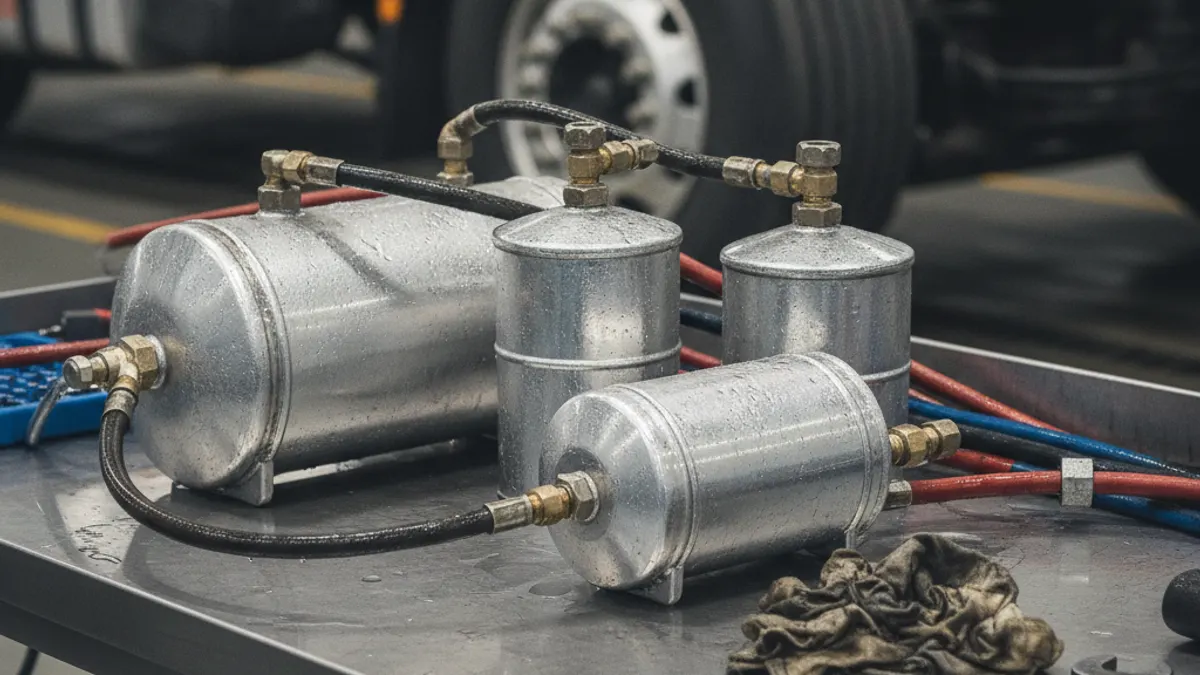
On a truck air brake system, the wet tank is the first reservoir the compressor discharges into. It is called wet because compressed air leaving the compressor is hot and saturated, and as it cools in that first tank the moisture condenses out along with any oil the compressor passed. The dry tanks — normally the primary and secondary reservoirs — sit downstream behind one-way check valves and feed the service brakes with air that has already given up most of its water and oil.
That is the whole idea: sacrifice one tank as a contamination trap so the tanks doing brake work stay clean. It only works if somebody drains the wet tank.
What the wet tank actually does
Air leaves a working compressor hot — hot enough that the discharge line is a burn hazard — carrying every bit of humidity that was in the intake air, now squeezed into a much smaller volume. In the supply tank the air slows, cools against the tank wall, and the water drops out as liquid. Oil that made it past the compressor rings collects there too, usually emulsified with the water into a grey or tan sludge.
The supply tank is also where system protection hardware normally lives:
- A safety valve (pop-off), commonly set around 150 psi, so a stuck governor or unloader cannot pressurize the system without limit.
- One-way check valves that isolate the primary and secondary circuits from the supply side.
- A drain at the lowest point of the tank — manual petcock or automatic drain valve.
- On many trucks, the governor signal line that tells the compressor when to unload.
The pressures the tanks work between
Settings vary by manufacturer and by how the vehicle is specified, so treat these as typical ranges and use the vehicle maker's current service data for exact figures:
- Governor cut-out: roughly 120–135 psi. The compressor unloads, and on a truck with an air dryer the dryer purges at the same moment.
- Governor cut-in: roughly 100–110 psi, where the compressor starts building again.
- Fully charged system: around 120 psi standing in the reservoirs.
- Low-air warning: light and buzzer at about 60 psi — a stop-now condition, not a caution.
A healthy wet tank does not change any of those numbers. A wet tank half full of water and sludge does, because it cuts usable reservoir volume — the symptom is a compressor cycling far more often than it should.
Wet tank versus primary and secondary tanks
| Reservoir | Position | Feeds | Contamination level |
|---|---|---|---|
| Wet / supply tank | First, directly off the compressor or the air dryer outlet | Primary and secondary tanks, accessories | Highest — water, oil, carbon |
| Primary tank | Downstream, behind a check valve | Usually rear service brakes and trailer supply | Low |
| Secondary tank | Downstream, behind a check valve | Usually steer axle service brakes | Low |
The check valves are the reason a dual system is safe. If the primary circuit springs a leak, the check valve holds pressure on the secondary side and you still have service braking on at least one axle group, with the spring brakes as the last resort once pressure falls far enough.
Reservoir sizing is regulated, not arbitrary: total reservoir capacity must be at least twelve times the combined volume of all service brake chambers, and every reservoir needs a means of draining condensate. That is why a tractor carries three or more tanks under the frame rails instead of one large one.
Where the air dryer changes things
On a truck fitted with an air dryer, the dryer sits between the compressor and the supply tank and does most of the moisture removal. The desiccant cartridge adsorbs water vapour, and the dryer purges the collected liquid to atmosphere each time the governor cuts out. That short blast of air every few minutes at idle is a healthy dryer purging.
A dryer does not retire the wet tank. Three things still put contamination in it:
- Saturated desiccant. A cartridge past its service life stops adsorbing and passes water straight through. Cartridges are generally an annual or per-service-interval item; heavy-duty and high-humidity operations replace them more often.
- Oil carryover. Desiccant does not remove oil, and oil poisons the desiccant over time. A compressor passing oil shows up as an oily film in the wet tank drainage long before it shows up anywhere else.
- Purge valve faults and cold-weather bypass. A frozen or leaking purge valve sends unprocessed air downstream.
Draining: order, frequency, and reading what comes out
Drain the wet tank first, then the primary and secondary. That order stops you pushing supply-tank sludge into a clean tank if a check valve is weak. On a truck without a dryer, daily draining is the norm; with a working dryer, weekly is a common shop standard — but the honest rule is to drain often enough to learn what your truck produces, then set the interval from that. The step-by-step draining procedure covers the safety notes.
| Drainage | Likely cause | Action |
|---|---|---|
| Dry air, light mist only | Dryer working, compressor healthy | Keep the current interval |
| Clear water, more than a few ounces | Dryer cartridge saturated or purge valve faulty | Service the dryer; drain more often meanwhile |
| Milky grey emulsion | Water mixed with compressor oil | Service the dryer, then monitor oil content |
| Dark oil, sludgy | Compressor passing oil, or a coked discharge line | Inspect the discharge line and compressor; consider replacement |
| Nothing at all, repeatedly | Drain valve plugged with sludge or ice | Remove and clear the drain valve — do not assume the tank is clean |
Never crack a drain valve with the system at full pressure and your face over it. Reduce pressure first, stand clear of the discharge path, and expect an oily spray on the first burst.
What a neglected wet tank costs you
Water that gets past the supply tank does not stay put. It travels to valve bodies, brake chambers and the trailer, where it corrodes bores, gums up valve pistons and freezes in winter. The failures it causes look like other problems: brakes that release slowly, a relay valve that will not seat, a governor that hunts, a trailer that will not charge. Water in the air tanks covers the downstream damage in detail.
Oil is worse in one respect — it swells rubber. Seals in relay valves, quick release valves and brake chambers soften and distort, and those parts fail early with no obvious cause until somebody drains a tank and finds it black.
Trailer reservoirs
A trailer normally has one reservoir fed from the tractor's supply line through the gladhands, so it gets whatever the tractor sends it. That makes trailer tanks the dirtiest reservoirs in most combinations — nobody drains them. Pull the trailer drain during your pre-trip and you will find out quickly how well the tractor's dryer and wet tank are doing their jobs.
Quick inspection points
- Drain valves present, reachable, and actually opening on every reservoir.
- Automatic drain valves cycling — a plugged auto drain gives no warning at all.
- Supply tank free of external corrosion at the lower seam, where standing water sits.
- Safety valve not weeping; a leaking pop-off often means a governor problem rather than a bad valve.
- Purge heard from the dryer at every governor cut-out.
Treat the wet tank as the system's filter rather than as one more tank of stored air, and most air quality problems on a truck end up where they belong — in a drain pan on the shop floor.
The wet tank only stays a filter while the dryer ahead of it purges properly; if you hear nothing at cut-out, the repair sits with the air dryer valves and their governor signal line, not with more frequent draining.
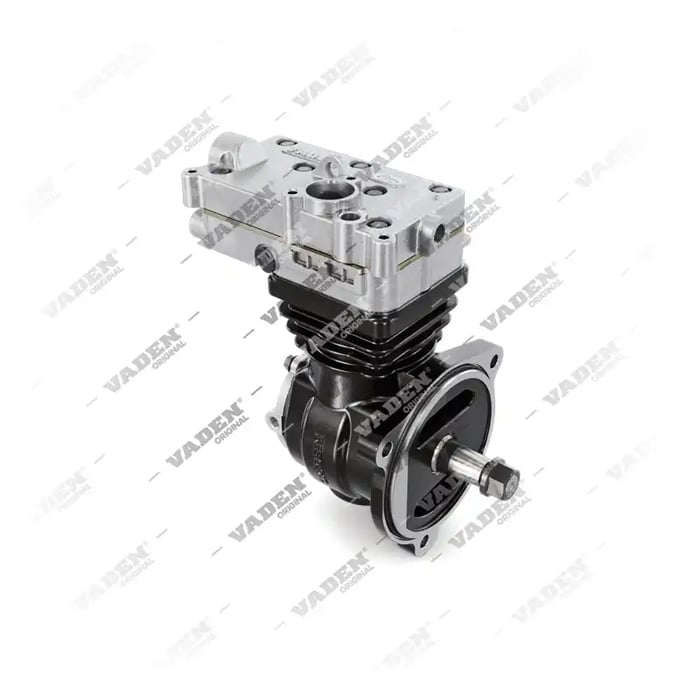
Need the part, not just the answer?
OE-grade air brake compressors and repair kits, manufactured and tested to commercial-vehicle standards.
Shop VADEN partsPublished by VADEN Original. Product links point to the manufacturer’s official catalogue. Specifications are general — always confirm figures against your vehicle’s service manual.