 airbrakecompressor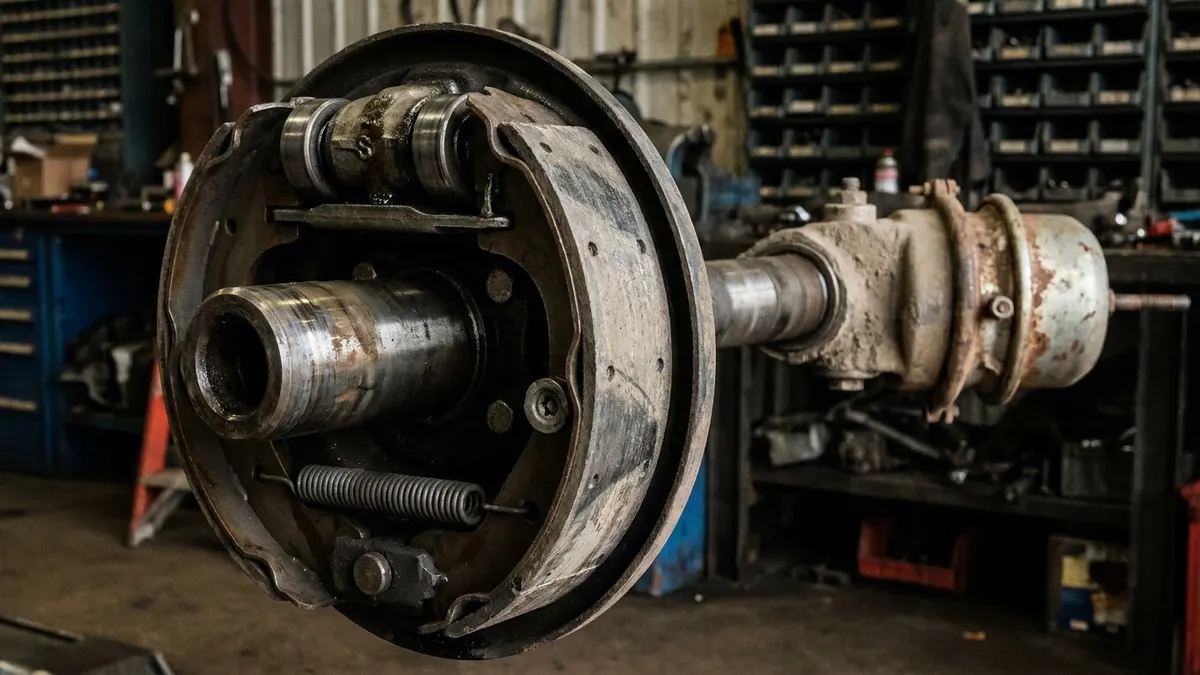
The brake spider — also called the anchor plate or torque plate — is the cast or forged steel plate at each wheel end that the whole drum brake is built on. It bolts (or on many trailer axles, is welded) to the axle housing flange and carries the two brake shoe anchor pins, the camshaft support bushing, the return spring anchors, and normally the dust shield and the ABS sensor block. It sees no air pressure whatsoever; its job is to react braking torque into the axle. When a spider cracks or its anchor bores wear out of round, the shoes stop sitting square in the drum and no amount of adjustment fixes it.
What the spider actually carries
Pull a drum off a standard heavy-truck wheel end and everything you are looking at hangs on the spider:
- Anchor pins. Two per wheel end, one for each shoe. The shoe web pivots on the pin (with a bushing on most designs), and the pin bore in the spider locates the shoe.
- Cam tube and camshaft bushing. The outboard end of the S-cam is supported by a bushing in the spider; the inboard end runs in a cam bracket on the axle housing.
- Return spring anchor. The pin or boss the shoe return spring pulls against.
- Dust shield mounting. The stamped shield that keeps road spray and debris off the linings.
- ABS sensor block. On most axles the sensor holder and spring clip mount to a boss on the spider, which is why a bent spider often shows up first as an ABS light.
Note that a truck brake spider is not the same thing as the stamped backing plate on a light-vehicle hydraulic drum brake. Those plates carry a wheel cylinder and are much lighter. This is a heavy casting sized to take the torque of a loaded commercial axle.
Where the spider sits in the air brake system
Air stops at the brake chamber. In a fully charged system running around 120 psi, with the governor cutting out somewhere in the 120–135 psi range and cutting back in around 100–110 psi, that stored air pushes the chamber diaphragm and drives the pushrod. From there it is all mechanical: pushrod to slack adjuster, slack to camshaft, camshaft to rollers, rollers to shoes, shoes to drum. The spider is the fixed point that all of that pushes against. The same is true when the spring brakes apply as pressure drops into the roughly 20–45 psi range — the mechanical path is identical, only the force source changes. That mechanical chain is covered in more depth on our page on S-cam foundation brakes.
Symptoms of a worn or cracked spider
Spider problems mimic other faults, which is why they get missed. Look for:
- Uneven lining wear at one wheel end — one shoe worn noticeably more than its partner, or a shoe tapered end to end, with no drum or cam fault to explain it. Compare against normal wear patterns on truck brake shoes and linings.
- Brake chatter or grab from a shoe shifting in an oval anchor bore under torque.
- A clunk on application or release from the same movement.
- Pushrod stroke that creeps back out shortly after adjustment, with the slack adjuster itself testing good.
- Excessive camshaft radial play at the outboard end, indicating a worn cam bushing or a worn bushing bore in the spider.
- Rust streaks or a witness line at the spider-to-flange joint, meaning the fasteners are loose or the joint has been working.
Inspection points
Inspect the spider any time the drum is off. It costs nothing extra and it is the one wheel-end part you cannot service in place.
| Area | What to look for | Action |
|---|---|---|
| Anchor pin bores | Elongation, ovality, pin movement in the bore, bright fretting marks | Replace the spider if the bore is out of round — do not build it up with weld |
| Anchor pins and bushings | Scoring, seizure, shoe binding at the anchor end | Replace pins and bushings, lubricate to the axle maker's spec |
| Casting body and webs | Cracks radiating from the pin bores, the cam tube or the mounting bolt holes | Replace — a cracked spider is not repairable |
| Mounting fasteners | Loose, missing or stretched bolts; rust weeping from under the heads | Replace fasteners and torque to the OE value in the correct pattern |
| Cam bushing bore | Bushing wear, seal damage, camshaft play beyond spec | Rebush; replace the spider if the bore itself is worn oversize |
| Flange face | Corrosion jacking, heat bluing, evidence of a past wheel-off or brake fire | Clean the joint; check the spider for warpage before reuse |
| Dust shield and ABS bracket | Bent shield contacting the drum, loose sensor holder | Straighten or replace, then reseat the sensor against the tone ring |
When it gets replaced — and when it does not
A spider is a long-life part. Most units go through several sets of shoes, drums and camshafts without being touched. It gets replaced for four reasons: a crack, anchor pin bores worn out of round, an oversize cam bushing bore, or physical damage from a wheel-off, a severe overheat, or a collision that bent the plate.
What does not justify replacement is surface rust, cosmetic scaling, or a worn anchor pin bushing — bushings and pins are serviceable items. Clean the casting, inspect it properly, and reuse it if the bores measure good.
One rule with no exceptions: do not weld a cracked spider. It is a torque-carrying structural member, welding changes the metallurgy around the repair, and a crack that reopens under load lets the shoe assembly move. Inspectors treat cracked brake components as defects, and a cracked structural member at a wheel end is the kind of finding that ends a trip at the scale house.
Replacement notes
Bolted spiders are a shop job but a straightforward one: chock and secure the vehicle, cage the spring brakes, pull the wheel, drum, hub and shoes, remove the chamber and slack, pull the camshaft, unbolt the spider from the flange, and reverse. Use new fasteners, torque to the axle manufacturer's specification, and confirm the spider seats flat on a clean flange — corrosion left under the plate will let the joint work loose later. Because the camshaft has to come out anyway, replace the cam bushings and seals at the same time; the procedure overlaps almost entirely with brake camshaft replacement.
Welded spiders — common on trailer axles — are a different matter. Cutting and rewelding a spider is a certified welding operation with alignment fixturing, and in practice many fleets replace the axle or send the assembly to an axle shop instead. Get the axle manufacturer's procedure before anyone strikes an arc.
When ordering, match by axle make, model and brake size (drum diameter and lining width), and confirm the hand — spiders are side-specific on most axles. After reassembly, adjust the brakes, verify pushrod stroke is within limits at both wheel ends, and check that the ABS sensor is seated and reading before the vehicle goes back into service.
Need the part, not just the answer?
OE-grade air brake compressors and repair kits, manufactured and tested to commercial-vehicle standards.
Shop VADEN partsPublished by VADEN Original. Product links point to the manufacturer’s official catalogue. Specifications are general — always confirm figures against your vehicle’s service manual.