 airbrakecompressor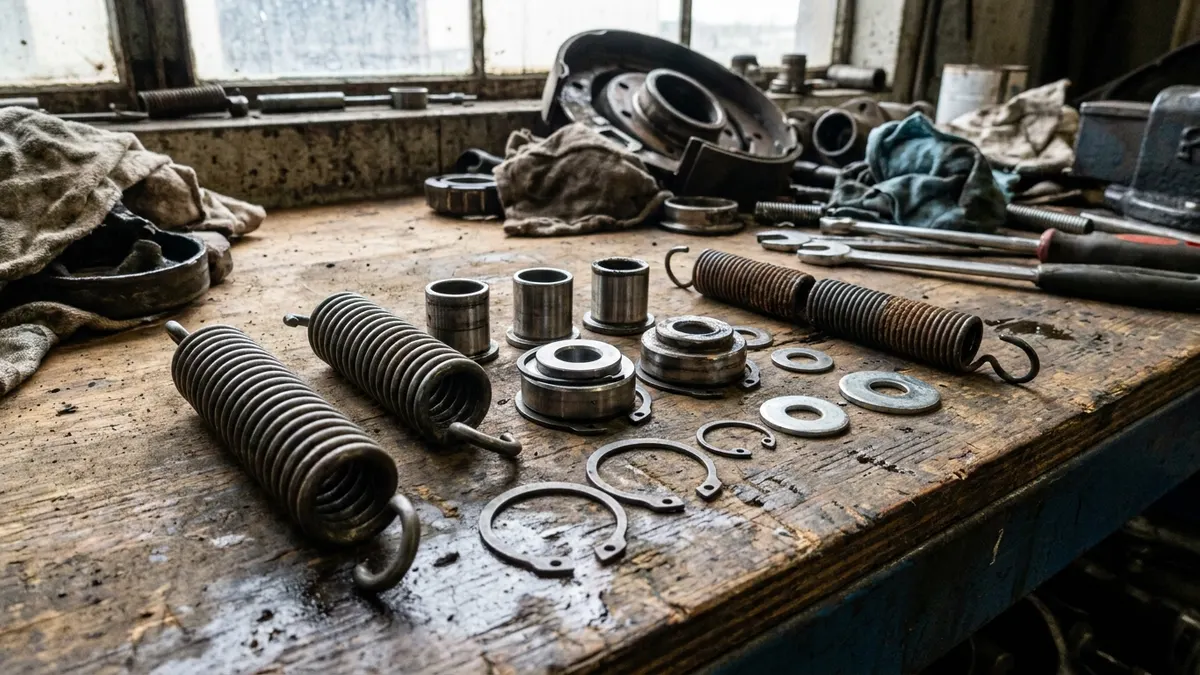
A brake shoe return spring kit is the set of springs and small retaining parts that pull the shoes back off the drum the instant air leaves the brake chamber: usually one heavy return spring per shoe pair, plus shoe retainer (hold-down) springs, roller retainer clips, anchor pin hardware and new cotter pins or retaining rings. On S-cam air brakes the release stroke is entirely mechanical — nothing hydraulic retracts the shoes — so a stretched, annealed or broken spring leaves the linings in light contact with a spinning drum. Fit new springs and hardware with every reline; they cost a fraction of a shoe set, and they are the parts most punished by the heat those old linings just made.
How the return spring fits into the release stroke
A brake application on a truck, bus or trailer is pneumatic, not hydraulic. Air enters the brake chamber, the pushrod extends, the slack adjuster rotates the S-camshaft, and the cam profile rolls the shoe rollers apart until the linings meet the drum. When the driver comes off the treadle, the relay or foot valve exhausts that air, the chamber's own diaphragm return spring retracts the pushrod, and the shoe return spring does the rest — it pulls the shoes inward, rolls the cam back to rest and restores running clearance.
Tank pressure has nothing to do with that part of the cycle. Whether the system is sitting fully charged at around 120 psi or the governor has just cut out somewhere in the 120-135 psi band, no air pushes the shoes away from the drum. Only the springs do. If you want the full mechanical path from chamber to lining, see how S-cam foundation brakes work.
Do not confuse these small springs with the power spring inside a spring brake chamber. That coil is the parking and emergency brake; it begins applying as pressure in the spring-brake circuit falls into roughly the 20-45 psi range, and it is a sealed, high-energy assembly that must never be cut open or disassembled. The return and hold-down springs inside the drum are ordinary service parts, meant to be replaced.
What a brake shoe return spring kit contains
Content varies by axle maker and foundation design, but a typical heavy-duty hardware kit covers one wheel end (two shoes) with the following:
| Part | What it does | Why it is in the kit |
|---|---|---|
| Shoe return spring | Pulls both shoes off the drum and rotates the S-cam back to rest | Loses tension through heat cycling; the single most common cause of slow release |
| Shoe retainer / hold-down springs and clips | Hold the shoe flat against the spider and anchor so it cannot cock or rattle | Fatigue and breakage let the shoe move, causing chatter and uneven contact |
| Roller retainer clips or springs | Keep the cam rollers captive on the shoe web | A missing clip lets a roller wander or fall out, wrecking the cam end |
| Cam rollers | Ride the S-cam profile and transfer cam lift into the shoe | Flat-spotted or brinelled rollers give harsh, uneven apply and stiff release |
| Anchor pins and bushings | Locate the pivot end of the shoe and let it swing freely | Dry or worn pins cause tapered lining wear and hold the shoe out |
| Cotter pins, washers, retaining rings, felt seals | Secure the assembly and keep grit out of the pivots | Single-use items — reusing a spread cotter pin is asking for it |
| S-cam bushings and seals (fuller kits) | Support the camshaft in the spider and bracket | Seized bushings imitate a weak spring exactly; check them at the same time |
Symptoms of weak or broken return springs
- Brakes slow to release, or the truck feels like it is towing an anchor for the first few seconds after a stop.
- One drum noticeably hotter than the others after a highway run — check by hand at a safe distance or with an infrared thermometer.
- Glazed, blue-tinged or tapered linings, and drums with heat checking or bluing.
- Hot brake odour on descents that other units on the same run do not produce.
- Automatic slack adjusters creeping tight because the shoes never fully return to their rest position.
- A rattle or knock from the wheel end at low speed, typically a broken hold-down or roller retainer spring.
- Uneven pull under moderate application when one side drags and the other releases cleanly.
Weak springs are only one item on the drag list. Seized S-cam bushings, dry anchor pins, a chamber that will not retract, a relay valve that exhausts lazily and simple over-adjustment all produce the same complaint, so work through the full dragging-brake diagnosis rather than throwing springs at it. If the camshaft will not spin freely by hand with the slack disconnected, the problem is in the cam bushings and rollers, not the spring.
Why springs fail, and how to judge a used one
Coil springs live on their heat treatment. Repeated heat cycling in a hot wheel end gradually anneals the wire, and a spring that has been through a genuine overheat event may never recover its rate even though it looks fine. Corrosion pitting starts fatigue cracks; over-stretching during a careless installation permanently sets the coil.
Bench check is simple: lay the old spring beside a new one. If free length is longer, if any coils have opened up or separated, if the hook eyes are worn thin or splayed, or if there is visible pitting, it is scrap.
Never reuse springs recovered from a wheel end that has been dragging or running hot. That is precisely the spring that has lost its rate, and refitting it guarantees a repeat visit.
Doing the job properly
- Chock the vehicle, cage the spring brakes and follow the drum removal procedure for that axle.
- Clean the spider, anchor pins and cam end. Check camshaft end play and radial play before you commit to parts.
- Fit new springs in the correct orientation, with hooks facing as the original — reversed hooks foul the web and chafe.
- Use a proper brake spring tool. Levering a return spring on with a pry bar over-stretches it before it ever sees service.
- Grease cam bushings and the slack adjuster to the maker's schedule and keep every trace of grease off linings and drum.
- Set the adjustment, then measure pushrod stroke at a full application and confirm both wheel ends release together.
- Road test and re-check drum temperatures at the first stop.
Choosing the right kit
Hardware kits are foundation-specific, not vehicle-generic. Spring free length, wire diameter, rate and hook style all vary between axle designs, and a spring with the wrong rate will either return the shoes lazily or drag the linings into the drum and give you long stroke. Cross-reference by axle and foundation brake part number, and buy springs and shoes as one job — renewing linings on tired hardware wastes the labour. On the friction side, specify the shoe set by the edge code the axle was certified with and keep it identical left to right; the springs should go in at the same time. For fleets, keeping a kit on the shelf per axle type turns a two-visit repair into one.
Need the part, not just the answer?
OE-grade air brake compressors and repair kits, manufactured and tested to commercial-vehicle standards.
Shop VADEN partsPublished by VADEN Original. Product links point to the manufacturer’s official catalogue. Specifications are general — always confirm figures against your vehicle’s service manual.