 airbrakecompressor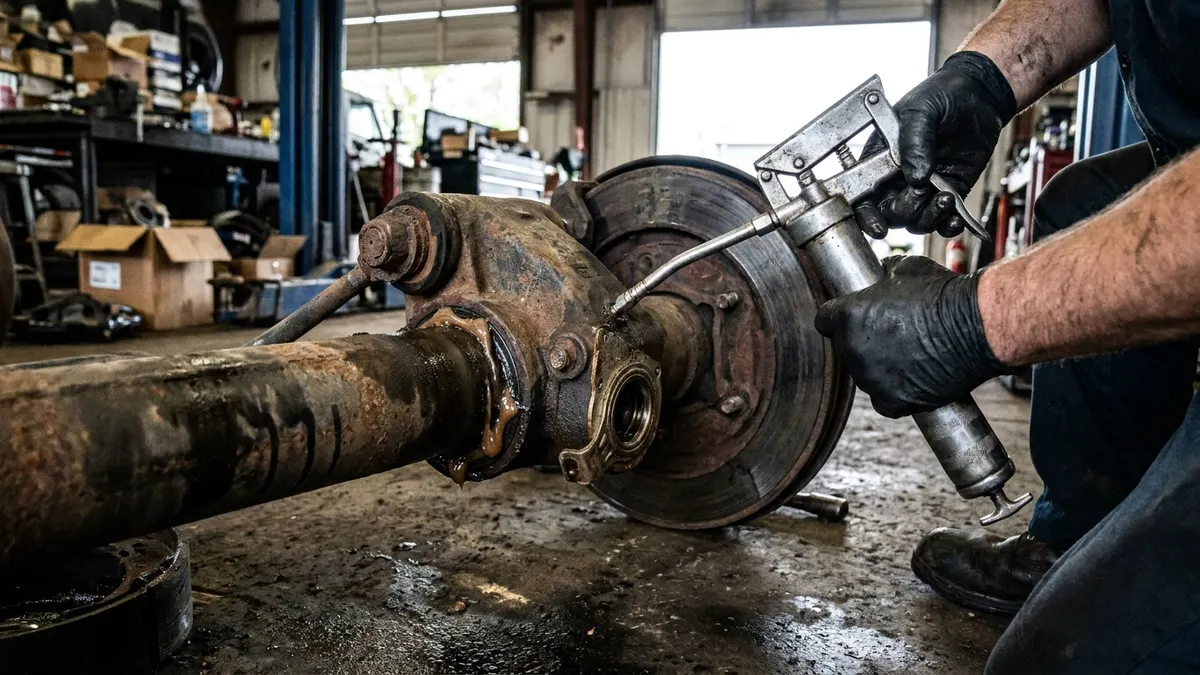
You replace a brake camshaft when its bearing journals, splines, or S-shaped head are worn far enough that the foundation brake can no longer hold adjustment, or when the shaft binds and the brake drags. On a truck or trailer S-cam brake, the camshaft is the mechanical link between the slack adjuster and the shoes, so once there is play in it, every bit of that lash shows up as extra pushrod stroke and lazy release. It is a wheel-end job: wheel off, drum off, shoes out, and the camshaft comes out through the spider and support bracket.
The camshaft itself never sees air pressure — it is pure mechanics — but the wheel end around it is pneumatic. Spring brakes begin applying as system pressure falls into the roughly 20-45 psi range, so the chambers must be caged before anything comes apart.
What the camshaft actually does
Air pressure in the service chamber pushes the pushrod out, the pushrod swings the slack adjuster, and the slack adjuster rotates the camshaft through a splined connection. The S-shaped head at the far end rolls against the shoe rollers and forces the linings out against the drum. Everything upstream of that is air; everything downstream is leverage. If you want the full chain of parts, see how S-cam foundation brakes work.
The shaft is supported in two places: a bushing in the brake spider at the head end, and a bushing in the camshaft support bracket at the slack adjuster end. Those two bushings, the seals that keep water out of them, and the journals they ride on are where nearly all camshaft trouble starts.
How S-cam camshafts wear out
Wear is rarely a single event. Grease gets pushed out or dries up, water and road salt get past the seals, the journals corrode and score, the bushings egg out, and the shaft starts to move sideways instead of only rotating. That radial play does two things: it eats stroke that should be applying the brake, and it lets the cam head sit off-center so one shoe gets loaded harder than the other.
The splines wear too, especially on units that are chronically over-stroked or that have had a slack adjuster hammered on. Rounded splines let the slack adjuster rotate a few degrees before the cam turns, which feels exactly like a brake that will not stay adjusted. The cam head can also develop flat spots or scoring where the rollers ride, and a shaft that has been overheated or bent in service should be scrapped, not reused.
Symptoms that point at the camshaft
| What you see | Usual cause | Action |
|---|---|---|
| Stroke creeps back out days after adjusting | Worn splines or worn cam bushings absorbing travel | Pull the drum and check cam play before blaming the slack adjuster |
| Cam head rocks or rattles in the spider bore | Bushings and journals worn together | Replace camshaft, both bushings, and seals as a set |
| One brake drags or releases slowly | Dry, corroded, or seized bushing; weak return spring | Free and lubricate; replace if journals are pitted |
| Clunk on light application or release | Spline lash or excessive end play | Check spline fit and the washer/snap ring stack |
| Uneven wear between the two shoes on one wheel | Cam head off-center, worn rollers, or a bent shaft | Replace the shaft and rollers, inspect the spider |
| Grease will not take at the cam fitting | Blocked passage or bushing packed with rust | Disassemble and inspect; do not force it |
Checking before you condemn the shaft
With the drum off and the brake released, grip the cam head and try to move it up and down and side to side. Some radial movement is normal; a noticeable rock, typically anything approaching about an eighth of an inch (roughly 3 mm) at the head, means the bushings and journals are done — but check the axle manufacturer's published limit, because it varies by spider and bushing design. Then check end play front to back at the snap ring, look for flat spots and step wear on the cam head, and test the splines by fitting the slack adjuster and feeling for rotational slop.
Do not diagnose lash from the pushrod alone. Set the brake properly first, using the correct slack adjuster procedure, then apply and measure stroke. If a freshly adjusted brake over-strokes with a healthy chamber and a good slack, the play is in the cam.
What the replacement job involves
- Park level, chock the wheels, and build the system to a normal fully charged pressure of around 120 psi so the spring brakes are fully released.
- Cage the spring brake chambers on the axle end you are working on, then release the parking brake control.
- Remove the wheel and drum, then the shoes, rollers, and return springs.
- Disconnect the slack adjuster: remove the snap ring, washers, and the slack itself, marking the installed position.
- Slide the camshaft out through the spider. If it is seized, use a proper puller or driver — never beat it through the bushing.
- Drive out both bushings and seals, clean the bores, and inspect the spider and support bracket for wear, cracks, or elongated bores.
- Install new bushings and seals, pre-grease the journals, and fit the new camshaft with the correct washer and snap ring stack to control end play.
- Reinstall the slack adjuster in the marked position, fit new rollers and hardware, refit shoes and drum.
- Grease the cam tube until fresh grease shows at the seal, following the intervals in the cam and slack lubrication guide.
- Set free stroke and adjustment, then apply and measure applied stroke on both wheel ends.
Ordering the right camshaft
S-cams are handed. A left-hand shaft in a right-hand position will rotate the cam head the wrong way and the brake will not apply correctly, so confirm the rotation direction before you order. Beyond handedness, match overall length, journal diameter, spline count and diameter, and the head style. Measure the old shaft rather than trusting a chassis lookup alone, because axles are frequently swapped over a truck's life. OE axle and brake suppliers such as Meritor, Bendix, Knorr-Bremse, Wabco/ZF, and Haldex all publish cross-reference data by axle series, and truck OEM part numbers usually map back to those.
Parts to replace at the same time
Treat the camshaft and its bushings as a matched pair — a new shaft in worn bushings will develop the same play within a season. While the wheel end is open, also plan on new seals, washers, snap rings, cam rollers, and shoe return springs. Details on bushing types and roller wear are covered in the guide to S-cam bushings and rollers.
Brake adjustment is consistently one of the most common out-of-service findings at roadside inspections. A camshaft that will not hold adjustment is a repeat offender, not a one-time write-up.
After the job
Re-check pushrod stroke on both sides of the axle after a short road test and a few firm applications, since new hardware settles. Compare the two wheel ends: a difference in stroke or in drum temperature after a run usually means one side is still dragging or one cam is not returning cleanly. If stroke has gone back out again within a few hundred miles, the fault is almost always something you did not replace — a worn spider bore, a tired slack adjuster, or a chamber with a failing return spring.
Need the part, not just the answer?
OE-grade air brake compressors and repair kits, manufactured and tested to commercial-vehicle standards.
Shop VADEN partsPublished by VADEN Original. Product links point to the manufacturer’s official catalogue. Specifications are general — always confirm figures against your vehicle’s service manual.