 airbrakecompressor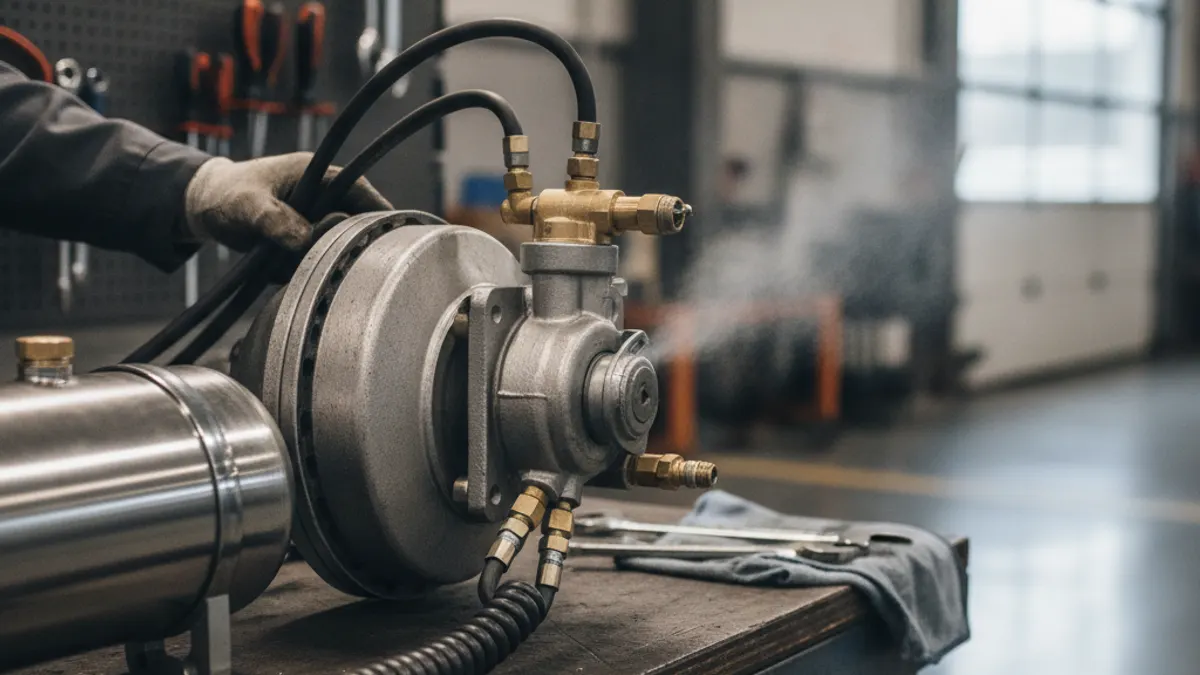
If your air brakes are slow to release, air is reaching the brake chambers normally but cannot escape fast enough when you lift off the pedal. The fault is almost always a failed quick-release valve or relay valve, a kinked or restricted air line, a blocked exhaust port, or mechanical drag — weak chamber return springs, seized S-cam bushings, or over-adjusted slack adjusters. Work out which axle hangs on, then trace back from that axle's chamber to the valve that should be dumping its air.
Do not live with it: partially applied brakes build heat continuously, glaze linings, cook drums, and turn into brake fade on the first long grade.
How a normal release works
An air brake system is pneumatic, not hydraulic, and that changes what release means. The pedal sends control air from the foot valve to the chambers; releasing is not simply shutting that supply off, because the air already in the chambers and lines has to be vented to atmosphere. That is the job of the release valves.
- Quick-release valve — usually on the front axle crossmember. When pedal pressure drops, its diaphragm shifts and dumps steer-axle chamber air straight out a local exhaust port instead of pushing it back through the foot valve.
- Relay valve — near the drive axles and again on the trailer. It treats the foot valve signal as a command only, feeding the chambers from the nearby reservoir and exhausting them through its own large exhaust port.
- Chamber return springs and slack adjusters — once the air is gone, the springs pull the pushrod back and the S-cam rotates off the shoes.
A healthy release is fast and audible: a sharp burst of air at the axle within a fraction of a second of lifting your foot. A drawn-out hiss, or silence, tells you where to look.
The common causes, ranked
| Cause | Typical symptom | Where to check |
|---|---|---|
| Failed quick-release valve | Steer axle drags; weak exhaust at the front | Front axle crossmember |
| Failed relay valve | Drive or trailer axle drags; delayed exhaust | Near drive axles or trailer center |
| Contaminated valve internals | Sticky, inconsistent release, worse when cold | Any valve; air dryer upstream |
| Blocked exhaust port or filter | Muffled exhaust; release slows gradually | Exhaust cover and rubber flapper |
| Kinked, crushed or wrong air line | One wheel end; often right after service work | Hose runs, clamps, frame rubs |
| Ice or water plug in the lines | Cold weather only; clears once warm | Line low points, tank drains |
| Weak or broken chamber return spring | Air exhausts but shoes stay on the drum | Service chamber, pushrod travel |
| Seized S-cam bushings or adjuster | Sluggish pushrod return; usually one wheel end | Camshaft, bushings, adjuster body |
| Over-adjusted brakes | Constant light drag, no release lag at the valve | Pushrod stroke measurement |
Valve contamination is a symptom, not the disease
When you pull a quick-release or relay valve and find oil sludge inside, the valve is the victim. Oil and moisture are travelling downstream because the air dryer is not doing its job: a saturated cartridge, a failed purge valve, or a compressor passing oil. Replacing the valve buys time; fixing the dryer and compressor fixes the cause.
Isolating the fault: a practical sequence
Work with the vehicle chocked, on level ground, at full system pressure, with a helper on the pedal.
- Confirm the symptom. Have the helper apply and release firmly while you stand at each axle. Listen for the exhaust burst and time it roughly: a delay you can count out loud is a delay.
- Find the hanging axle. After several applications, check drum and hub temperature with an infrared thermometer. A wheel end noticeably hotter than its mates on the same axle is dragging.
- Watch the pushrods. On release the chamber pushrod should snap back cleanly. A rod that creeps back or stops short points to the chamber, slack adjuster or cam, not the valve.
- Check the valve exhaust. Hold your hand near the quick-release or relay exhaust port during release. A strong, short blast is good; weak or absent flow means the valve or its exhaust path is restricted.
- Prove it by isolating. Crack the delivery line at the chamber during a release. If air dumps instantly there but was slow at the valve, the restriction is between the two. If the chamber holds air with the line open, the chamber is at fault.
- Measure pushrod stroke. Compare applied and released positions against the chamber's marked stroke limit. Over-stroke, or an adjuster that will not take up slack, makes this an adjustment problem rather than a valve problem; see how to adjust a slack adjuster.
- Test the whole system. Run a leak-down and build-up test; a truck that also loses pressure usually has more than one fault.
Never chase a slow-release complaint by backing off the slack adjusters to give the shoes clearance. That hides the fault and leaves you with long stroke and reduced braking — the exact condition that puts a truck out of service at a roadside inspection.
Reference pressures to sanity-check the system
Slow release is rarely a pressure problem, but a system outside its normal range confuses the diagnosis. Check these first.
| Parameter | Typical range | What it tells you |
|---|---|---|
| Governor cut-out | about 120–135 psi | Compressor stops loading; the unloader should vent |
| Governor cut-in | about 100–110 psi | Compressor resumes pumping |
| Fully charged system | around 120 psi | Baseline for every release-timing check |
| Low-air warning | about 60 psi | Lamp and buzzer must activate at or before this point |
| Spring brakes apply | roughly 20–45 psi | Parking brakes set automatically as pressure falls |
These are typical industry ranges, not a substitute for your chassis specification. Always confirm the exact pressures and stroke limits in the vehicle manufacturer's current service literature.
Repair notes that save a second visit
Replacing a quick-release or relay valve
These are inexpensive bolt-on parts, and replacement is the right call when the diaphragm has hardened, the seat is pitted, or the body is full of sludge. Match the valve by crack pressure and port configuration: relay valves come in different crack-pressure ratings, and the wrong one changes how quickly the rear brakes come on relative to the front. Source from an OE-grade line such as VADEN's quick-release valve range for commercial vehicles rather than the cheapest available casting.
On reassembly, use new O-rings, apply thread sealant only where specified, keep the exhaust port pointing downward, and make sure the exhaust flapper or filter is present and clean. A missing flapper lets road grit straight into the valve.
Chambers, cams and adjusters
If the pushrod is the slow part, replace the chamber rather than trying to salvage a weak return spring — the diaphragm is usually tired as well. Seized S-cam bushings need the cam pulled, cleaned and greased, or the bushings replaced. An automatic slack adjuster you have had to set by hand more than once has failed and should be replaced.
Cold weather cases
If the truck only hangs on below freezing and clears once warm, moisture in the lines is forming ice plugs. That is an air dryer and tank-draining problem, not a valve problem. Drain the tanks daily, replace the desiccant cartridge, and check that the dryer heater circuit works.
When to take it out of service
Stop and repair immediately if a wheel end is smoking or hot enough to smell, if the brakes stay applied after a full release, if pushrod stroke exceeds the marked limit on any chamber, or if the truck pulls hard to one side under braking. A hot drum has far less stopping capacity than a cool one, and dragging brakes on a loaded truck reach wheel-fire temperatures quickly.
The failure behind a slow release is local and audible. Listen first, feel for heat second, and only then start pulling parts.
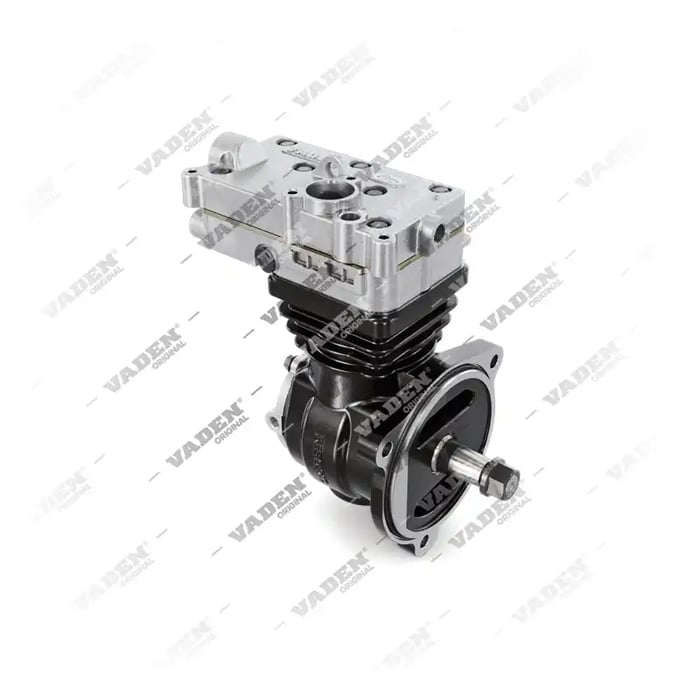
Need the part, not just the answer?
OE-grade air brake compressors and repair kits, manufactured and tested to commercial-vehicle standards.
Shop VADEN partsPublished by VADEN Original. Product links point to the manufacturer’s official catalogue. Specifications are general — always confirm figures against your vehicle’s service manual.