 airbrakecompressor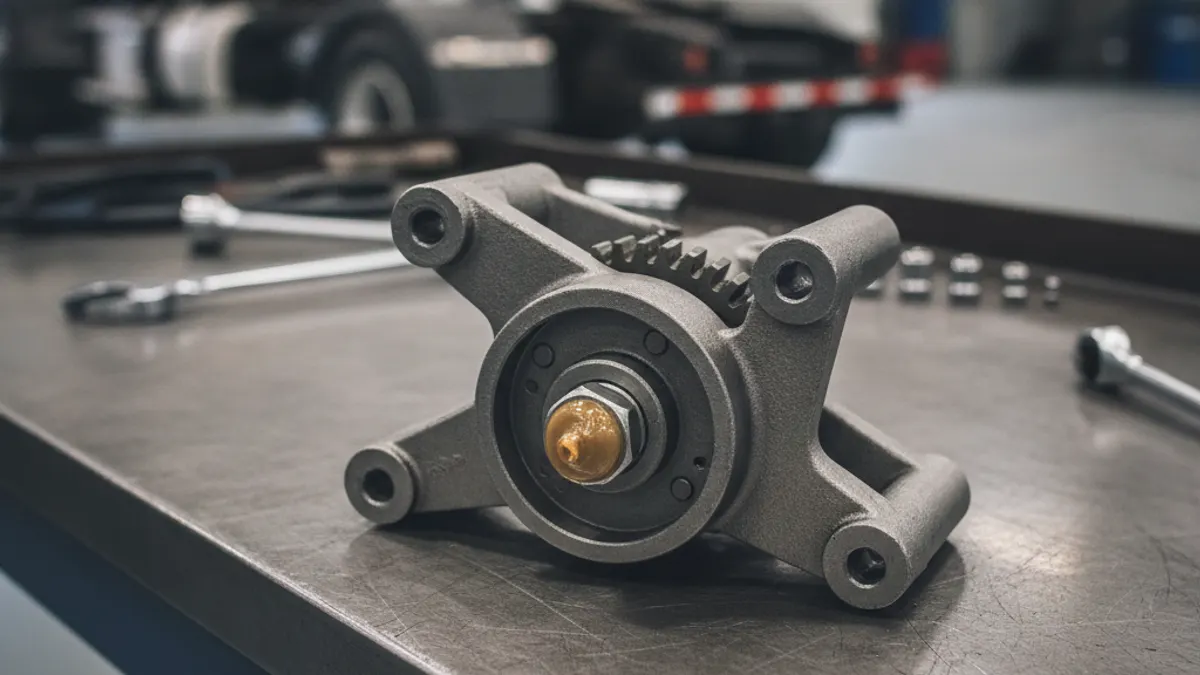
Grease the slack adjuster at its zerk fitting and the S-cam at its camshaft bushing fittings until fresh grease purges out at the seals — that purge is the whole point, because it flushes water and road grit out of the bushing rather than just topping it off. Most fleets do this at every A/B preventive maintenance service, roughly every 25,000 miles or quarterly in linehaul work and monthly or more in vocational and off-road duty. Use a hand grease gun and an NLGI No. 1 or No. 2 lithium-complex EP chassis grease unless the component manufacturer specifies otherwise.
What actually gets grease on a foundation brake
People say "grease the slacks" and stop there, but the slack adjuster is only one of the wear points that keeps an S-cam foundation brake moving freely. A dry camshaft bushing will hang a brake up long before a dry slack adjuster does.
| Point | What it is | Purge indicator | Typical interval |
|---|---|---|---|
| Automatic slack adjuster | Worm gear, worm shaft and internal clutch mechanism | Grease appears at the boot or seal around the adjusting hex | Every PM service (A/B) |
| Camshaft bushings (inner and outer) | Bushings supporting the S-cam tube in the spider and cam bracket | Grease appears at the cam head seal and bracket seal | Every PM service |
| Clevis and yoke pins | Push rod to slack adjuster connection | Usually no fitting — clean, inspect, light film only | Inspect every PM |
| Anchor pins and cam rollers | Shoe pivot and roller riding the cam profile | Only if a fitting is present; many are dry designs | At brake reline |
Some newer slack adjusters and cam bushings are sealed for life and have no zerk at all. If there is no fitting, do not drill one or force grease past a seal — check the part number and follow the manufacturer's service sheet.
Which grease to use
An NLGI No. 2 lithium-complex extreme-pressure chassis grease covers most applications. In sustained cold weather an NLGI No. 1 pumps better and reaches the far side of the bushing instead of sitting in the gallery. Synthetic and moly-fortified greases are specified by some brake manufacturers, particularly for high-heat vocational service.
Three rules matter more than the brand on the tube:
- Do not mix incompatible thickeners. Lithium and polyurea greases can separate into a soap-like mess that stops carrying load. Purge the old grease fully if you change types.
- Do not use a high-pressure air-powered gun on cam bushings. It will unseat the inner cam seal and push grease toward the linings. Hand gun, steady strokes.
- Keep grease off friction surfaces. Contaminated linings or a greasy drum cause grabbing and uneven braking, and an inspector who sees grease on a lining will write it up.
Greasing procedure
- Chock the wheels and secure the vehicle. Build the air system to its normal fully charged pressure — around 120 psi on most trucks, with the governor cutting out somewhere in the 120–135 psi range — so the brakes can be cycled.
- Release the parking brakes so the S-cam sits at rest and the bushings are not loaded. A cam held hard against its bushing will not accept grease evenly.
- Wipe every fitting clean before the coupler touches it. Pushing dirt into a bushing defeats the entire job.
- Grease the camshaft bushings first. Pump slowly until fresh grease shows at the cam head seal and at the bracket. Stop at first purge.
- Grease the slack adjuster until fresh grease shows at the seal. Water and rust slurry coming out first is normal on a neglected unit — keep going until it runs clean.
- Wipe off the purged grease. Left in place it collects abrasive road grit and becomes lapping compound.
- Apply and release the brakes several times, then check that each push rod returns fully and quickly. Sluggish return after fresh grease points to a bent rod, a weak return spring, or a seized cam, not a lubrication problem.
- Measure push rod stroke and compare it to the readjustment limit for that chamber type and size before you sign the PM off.
Why a dry cam causes drag and long stroke
The S-cam has to rotate freely in both directions. Applying the brake is easy — these are air brakes, and chamber air pressure is far stronger than any friction in the bushing. Releasing is the problem, because the only things pulling the cam back are the brake return springs and the chamber's internal spring. Those are weak by comparison.
When a bushing dries out and starts to rust, that return force is no longer enough. The cam relaxes slowly or hangs partway, the shoes stay in light contact with the drum, and you get a dragging brake — heat, glazed linings, a hot hub, and fuel burned for nothing. On the same axle, the free-moving side does more of the work, so the truck pulls under braking.
The stroke problem follows from the same friction. An automatic slack adjuster senses stroke and takes up clearance during application. A cam that binds or returns late changes the geometry the adjuster is reading, so it either under-adjusts and leaves you with long stroke, or over-adjusts and holds the shoes against the drum. Either way, the adjuster gets blamed for a bushing failure. If stroke keeps creeping out, verify cam rotation and bushing condition before condemning the slack adjuster.
Grease is not an adjustment. If an automatic slack adjuster has to be manually backed off to bring stroke into limits, something is wrong in the foundation brake — worn bushings, linings past spec, a failed adjuster, or a chamber problem. Manual adjustment of an automatic unit is a temporary measure to move the vehicle, not a repair.
How often, by duty cycle
Interval is driven by water and dirt exposure more than by mileage:
- Linehaul, dry climate: every PM service, roughly quarterly or every 25,000 miles.
- Regional and urban stop-and-go: every PM, with a stroke check between services because cycle count is high.
- Winter road-salt operation: shorten the interval; salt brine kills cam bushings faster than mileage does.
- Vocational, dump, mixer, logging, off-road: monthly or more, and after any deep water crossing or chassis pressure wash.
What to inspect while you have the gun in your hand
Greasing is the natural moment to catch problems early. Grab the S-cam head and check for radial play in the bushings — noticeable rock means bushings are due. Look at the cam head splines and the slack adjuster splines for wear. Check that the clevis pins are not egg-shaped and that the cotter pins or retainers are present. Confirm the adjuster's control arm anchor bracket is tight and not cracked, since a loose bracket makes an automatic adjuster stop adjusting entirely.
Finish by measuring stroke at every wheel end with a full application, and note anything close to its limit. If a wheel end is out, correct the underlying cause and follow the proper procedure in our guide to adjusting a slack adjuster rather than cranking the hex and moving on. Torque, stroke limits and lubricant grades vary by axle and brake maker, so the vehicle manufacturer's current service manual is always the governing reference.
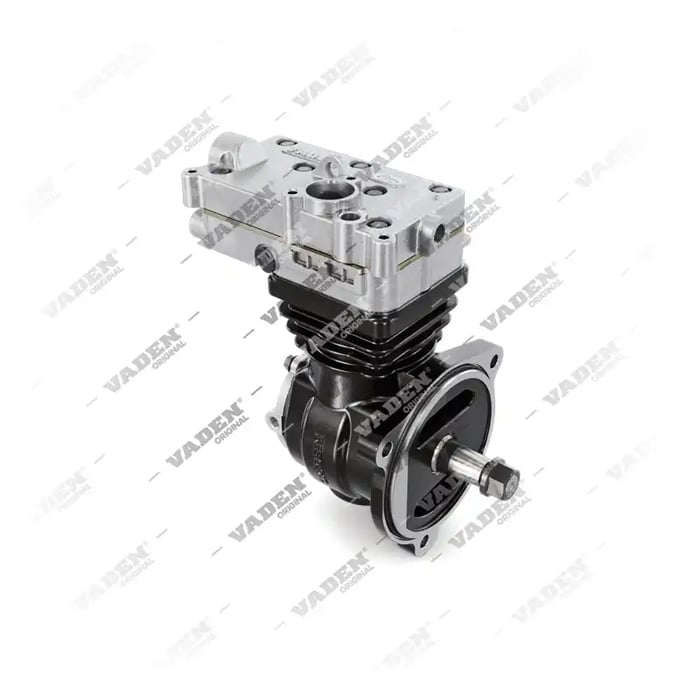
Need the part, not just the answer?
OE-grade air brake compressors and repair kits, manufactured and tested to commercial-vehicle standards.
Shop VADEN partsPublished by VADEN Original. Product links point to the manufacturer’s official catalogue. Specifications are general — always confirm figures against your vehicle’s service manual.