 airbrakecompressor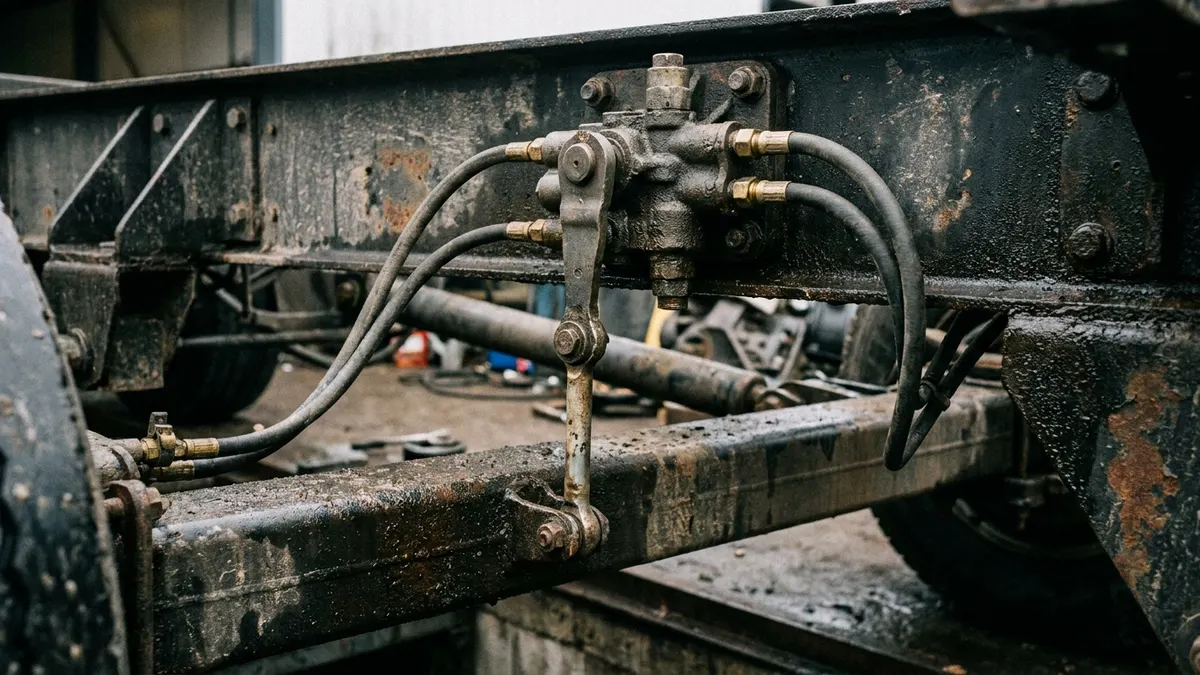
A bobtail proportioning valve reduces the air pressure delivered to a tractor's rear axle service brake chambers whenever the tractor is running without a trailer. Those rear brakes are sized to stop a loaded combination, so bobtail they are far more brake than the axle actually carries — and without proportioning, an ordinary pedal application can lock the drive wheels and make the truck feel violent and unstable. The valve watches trailer supply pressure: with the trailer supply line charged, proportioning is switched out and the rear axle receives full delivery again.
Where the valve sits and what it looks like
On most tractors the function is built into the rear axle relay valve, mounted on a frame rail or crossmember near the rear suspension. The Bendix BP-R1 bobtail proportioning relay valve is the pattern most technicians recognise; Wabco/ZF, Knorr-Bremse and Haldex build equivalent units, and some chassis use a separate proportioning valve plumbed ahead of a conventional relay valve.
The port layout is close to a standard relay valve, with one addition:
- Supply — large line from the rear service reservoir.
- Service (control) — signal line from the foot brake valve.
- Delivery — to the rear service brake chambers.
- Balance or trailer signal — a small line teed off the trailer supply (emergency) circuit downstream of the tractor protection valve. This is the port that tells the valve whether a trailer is coupled.
Why bobtail braking needs proportioning
Brake sizing on the drive axle assumes the tractor is pulling a loaded trailer, where a large share of the combination's weight sits over that axle. Drop the trailer and the same axle may carry only a fraction of that load, while the chambers, slack adjusters and drums stay exactly as big as they were. Apply the brakes at the same pedal effort and the rear tires reach their traction limit long before the front axle does.
The result is a tractor that stops abruptly, skips or hops the drive tires, flat-spots rubber and — on a wet or icy surface — can step the rear end out sideways. Federal braking standards require a tractor to meet stopping-distance limits both bobtail and coupled, and bobtail proportioning is the normal way manufacturers satisfy both cases with one set of foundation brakes.
How the valve decides
| Condition | Trailer supply line | Valve state | Rear axle delivery |
|---|---|---|---|
| Coupled to a trailer, supply knob pushed in | Charged to system pressure (fully charged is around 120 psi) | Proportioning switched out | Full delivery, essentially equal to control pressure |
| Bobtail, trailer supply knob pulled out | Exhausted to atmosphere | Proportioning active | Reduced — commonly near half of control pressure through the normal service range |
| Bobtail, hard or emergency application | Exhausted | Proportioning blends out at high control pressure | Rises back toward full delivery so stopping capability is retained |
Exact delivery values differ by valve and by chassis, so work from the valve manufacturer's service data rather than a remembered number. What matters diagnostically is the difference between the two states: charge the trailer supply and rear delivery should jump; exhaust it and rear delivery should drop noticeably at the same pedal effort.
Symptoms of a failed bobtail proportioning valve
| What the driver reports | Likely direction of the fault |
|---|---|
| Truck brakes harshly and grabs bobtail; drive tires chirp or lock on moderate applications; ABS activity with no trailer | Proportioning is not engaging — signal line pressurised, plugged balance port, or internal piston stuck in the coupled position |
| Rear tractor brakes feel dead with a trailer attached; trailer drums run hot while tractor drums stay cool; uneven lining wear front to rear | Proportioning stuck active — no trailer signal reaching the valve, kinked or broken signal line, leaking tractor protection circuit |
| Flat-spotted drive tires on an otherwise healthy truck | Repeated bobtail lockup; check the valve before condemning the tires or the foundation brakes |
| Audible leak at the valve body that changes with pedal position | Failed internal seal or exhaust diaphragm; the valve also behaves as a relay valve, so delivery timing suffers too |
Testing it on the truck
- Charge the system and let the governor reach cut-out (typically 120-135 psi), then confirm it cuts back in in the 100-110 psi band. A system that is not charging properly will confuse every pressure reading that follows.
- Chock the wheels and release the spring brakes. Remember that spring brakes begin applying mechanically as pressure falls into the 20-45 psi range, so keep reservoir pressure well above that during the test.
- Fit a calibrated test gauge at a rear service brake chamber or at the valve delivery port. Fit a second gauge at the control port if the chassis allows it.
- With the trailer supply exhausted (bobtail state), make a steady service application of roughly 40-60 psi control pressure and record delivery. It should be clearly lower than control.
- Charge the trailer supply line — coupled to a trailer, or with the supply circuit pressurised on a shop test rig — and repeat the same application. Delivery should now track control pressure closely.
- If delivery does not change between the two states, check the small signal line and its fittings first. A pinched, cracked or wrongly routed balance line is a far more common cause than an internal failure.
Follow the test with an applied and released leakage check on the rear circuit. A proportioning relay valve that leaks past its seals will also lengthen apply and release timing.
Repair or replace
These valves are not usually rebuilt in service. Seals harden, the bore scores, and the internal ratio piston is not a serviceable item on most designs, so the accepted repair is replacement with a unit of the same part number or a documented OE cross-reference. Fitment matters more than usual here: a plain relay valve will physically bolt into the same location and plumb up fine, but it removes the bobtail function entirely and leaves the truck over-braked on the drive axle. When sourcing a replacement, verify the part against the OE number and confirm the balance port is present — you can compare against OE-grade heavy-duty relay valves by reference number before ordering.
After fitting, purge the reservoirs, re-check crack pressure and timing, and repeat the bobtail-versus-coupled delivery comparison above so the new valve is proven, not assumed.
What it is not
Do not confuse bobtail proportioning with two neighbouring functions. An anti-compounding valve prevents mechanical spring force and service air pressure from adding together on the same brake, which is a chamber protection issue, not a load issue. A load-sensing or automatic load-proportioning valve varies delivery with suspension height or axle load on a continuous basis, mainly on trailers and European chassis. The bobtail valve is simpler: it makes one decision, trailer or no trailer, and applies a fixed reduction accordingly.
Need the part, not just the answer?
OE-grade air brake compressors and repair kits, manufactured and tested to commercial-vehicle standards.
Shop VADEN partsPublished by VADEN Original. Product links point to the manufacturer’s official catalogue. Specifications are general — always confirm figures against your vehicle’s service manual.