 airbrakecompressor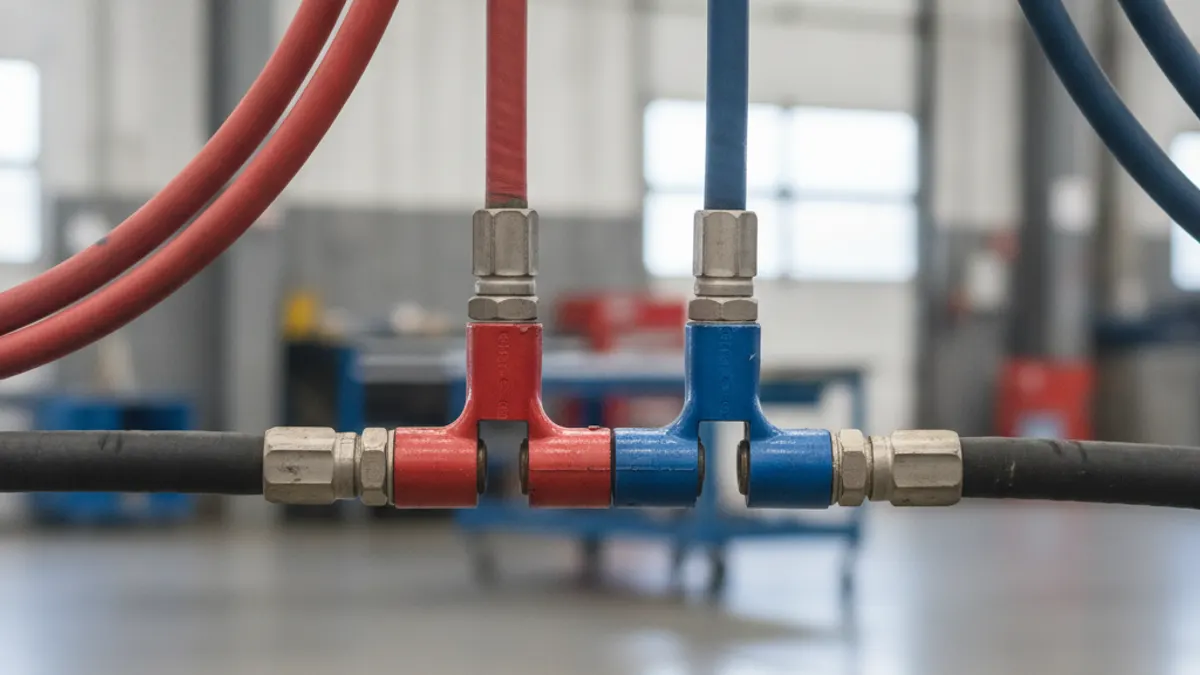
Gladhands — also written glad hands — are the palm-shaped coupling fittings that join the tractor's air lines to the trailer. A combination vehicle uses two lines: the service (control) line, which carries the driver's brake-application signal, and the emergency (supply) line, which feeds a steady supply of air to charge the trailer reservoir and release its spring brakes. Couple them wrong or run them with a bad seal, and you get a trailer that won't brake, spring brakes that drag, or a constant air leak the compressor can never keep up with.
The lines are colour coded so you can tell them apart at a glance: blue for service, red for emergency/supply. Getting this right is the whole game — the rest of this page covers the seals, the correct hook-up procedure, and how to run down a leak at the coupling.
Service line vs. emergency line: what each one does
The two lines do very different jobs, and understanding the split is the key to diagnosing trailer air problems.
| Line | Colour | Also called | Function |
|---|---|---|---|
| Service line | Blue | Control line, signal line | Carries the variable air signal from the foot valve (and trailer hand valve) to the trailer relay valve, telling the trailer brakes how hard to apply. |
| Emergency line | Red | Supply line | Delivers a constant supply of air to charge the trailer reservoir and hold the trailer's spring (parking) brakes released. |
The emergency line is the safety half of the system. As long as it is charged, the trailer's spring brakes stay released and the trailer reservoir stays full. If that line loses pressure — a broken hose, a pulled gladhand, a trailer breakaway — the tractor protection system vents it, the trailer's spring brakes slam on, and the trailer stops. That fail-safe behaviour is why it's called the emergency line, and it's why the tractor protection valve is wired into it.
The service line only carries air when you press the brake pedal or pull the trailer hand valve. That signal reaches the trailer's relay valve, which uses the trailer's own reservoir air to apply the brake chambers quickly, without the driver's signal having to travel the full length of the trailer.
The gladhand and its seal (glad hand seals)
A gladhand is a two-piece coupling: two identical palms lock together with a quarter-turn twist, and a rubber seal (polymer packing ring) seated in each palm presses face-to-face to make an airtight joint. Parts catalogues list these as glad hand seals, gladhand seals or packing rings interchangeably. That seal is the single most common failure point in the whole coupling. It's a wear item — rubber that gets crushed thousands of times, dragged through road grime, and baked by summer heat.
Symptoms of a bad gladhand seal:
- An audible hiss at the coupling that you can feel with a wet hand or hear when the system is fully charged.
- The air compressor cycling more often than normal because it's chasing a leak it can't fill.
- Slow trailer charge-up, or the trailer's spring brakes being reluctant to release.
- Water and dirt getting past the seal and into the lines, which loads up the air dryer and can foul downstream valves.
Seals are cheap and take seconds to swap. Pry the old ring out with a flat screwdriver, wipe the palm face clean, and press the new one in. Carry spares — a torn seal on a cold morning will otherwise strand a trailer that won't build air.
How to connect the air lines
Coupling is straightforward once the seals are good and you respect the colour coding. Work in a logical order and confirm the trailer charges before you move.
- Chock the trailer or confirm its spring brakes are set before you start.
- Inspect both gladhand seals on the tractor and the trailer. Replace any that are cracked, flattened, or missing.
- Connect blue to blue (service) and red to red (emergency). Line the palms up, press together, and twist to lock. You'll feel them seat.
- Push the trailer air-supply (red) knob in on the dash to charge the emergency line. The trailer reservoir fills and the trailer spring brakes release.
- Let the system come up to full pressure — a fully charged system runs around 120 psi — and listen for leaks at both couplings.
- Do a tug test and a brake-application check before you pull. Apply the trailer brakes with the hand valve and confirm they hold.
When you drop the trailer, reverse the logic: set the trailer spring brakes first by pulling the trailer air-supply (red) knob, which vents the emergency line and applies the trailer's parking brakes, then uncouple the gladhands. Never uncouple a charged trailer that isn't parked on its own spring brakes.
Crossed lines: the mistake that leaves you with no trailer brakes
Because the two gladhands are physically identical, it is possible to cross them — put service air into the emergency port and vice versa. On older or non-colour-keyed fittings this is a real hazard. A crossed connection can charge the trailer reservoir through the wrong path, release the spring brakes, and leave you with a trailer that has no service braking even though everything looks connected. Always match colour to colour, and if a trailer's gladhands aren't marked, trace the lines before you trust them.
Many fleets fit anti-crossover (polarized) gladhands — the service palm is offset or a different shape so it physically won't mate with the emergency palm. If you run mixed equipment, they're cheap insurance.
Hoses, dummy couplers, and hanger hardware
The air lines themselves are the coiled or straight hoses that run from the tractor's cab-mounted gladhands back to the trailer. Look for:
- Chafing and rub-through where the coils drag on the deck plate, the fifth wheel, or the frame. A worn spot becomes a blowout.
- Kinks and ice in cold weather. Water that got past the air dryer collects in low spots and freezes, choking the line.
- Dummy (dead-end) couplers on the tractor and trailer. Parking the gladhands on a dummy coupler keeps the seals clean and the lines free of road spray when the trailer is dropped.
Keep the hoses supported by their tender or hanger so they don't drag on the catwalk, and route them so a hard turn doesn't yank a gladhand loose. A gladhand that pops apart under way vents the emergency line and sets the trailer brakes — safe, but not something you want happening in traffic.
Finding a coupling leak
If the compressor is short-cycling or the system won't hold pressure overnight, the gladhands are an easy first suspect. Charge the system fully, shut the engine off, and brush soapy water on each coupling and along the hoses — bubbles show the leak. Check the seal faces first, then the hose crimps and the gladhand-to-hose fittings. A coupling leak is one branch of a broader problem; if you've ruled out the gladhands and the trailer is still bleeding down, work through why an air brake system loses pressure methodically rather than throwing parts at it.
Gladhands and their seals are the cheapest, most-ignored parts in the air system, yet a torn ring can idle a truck as surely as a failed compressor. Inspect them at every trailer swap, carry spare seals, and never assume blue-to-blue and red-to-red got connected right just because the palms locked.
Need the part, not just the answer?
OE-grade air brake compressors and repair kits, manufactured and tested to commercial-vehicle standards.
Shop VADEN partsPublished by VADEN Original. Product links point to the manufacturer’s official catalogue. Specifications are general — always confirm figures against your vehicle’s service manual.