 airbrakecompressor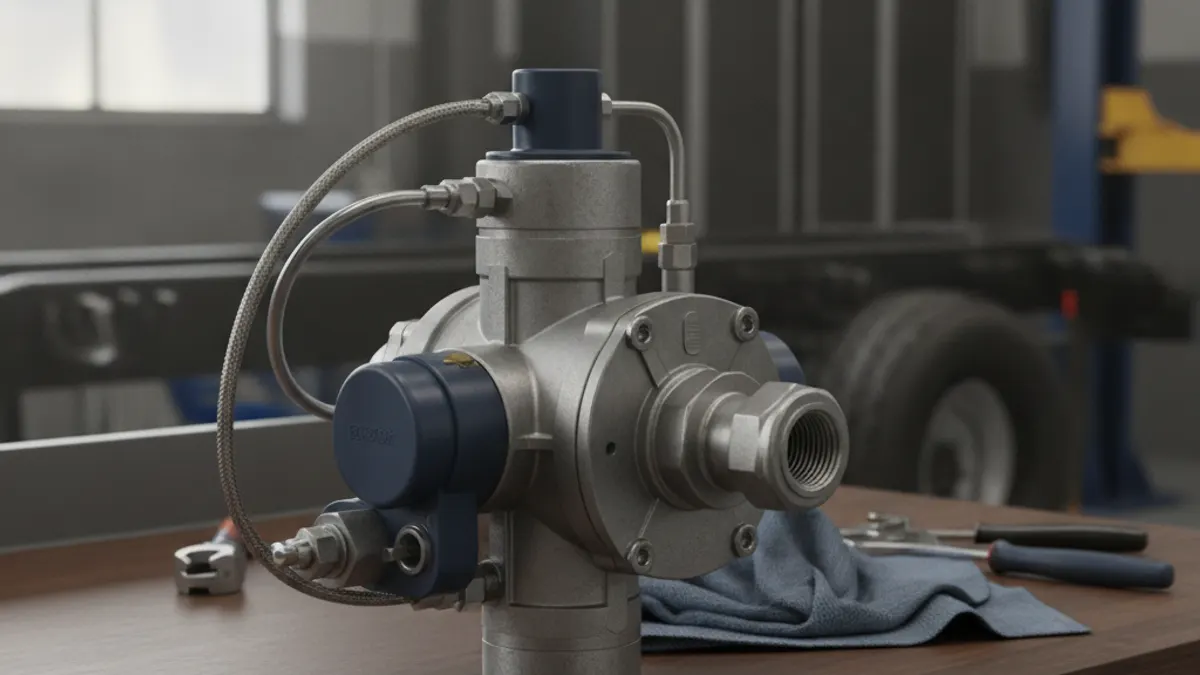
The trailer control hand valve (also called the trolley valve, Johnson bar, or trailer brake handle) is a hand-operated, modulating air valve on the dash or steering column that applies only the trailer service brakes, independently of the foot brake. Move the lever and it sends air pressure down the trailer service (control) line to the trailer's relay valve; move it back and the trailer brakes release. It is a testing and low-speed manoeuvring tool, not a way to slow a loaded combination, and it must never be used to hold a parked vehicle.
What the hand valve actually does
The hand valve is a graduated control valve, not an on/off switch. It is supplied with air from a tractor service reservoir, and its delivery port feeds the trailer service line through the tractor protection valve and out to the service gladhand, which is blue in North American practice and yellow on European couplings. Whatever pressure the lever commands, from a few psi at first movement up to roughly full reservoir pressure (about 120 psi on a fully charged system), is what the trailer relay valve reads as a control signal. The relay valve then delivers that pressure from the trailer's own reservoir to the trailer brake chambers.
Two things follow from that plumbing. First, the hand valve does nothing to the tractor's own brakes: you can hold the lever fully applied and the steer and drive axles remain free. Second, the hand valve and the foot brake valve both feed the same trailer control line through a double check valve, which passes whichever signal is higher. Applying both at once does not double trailer braking.
The lever is spring-returned and self-lapping: hold it partway and the valve balances delivery pressure against lever position and holds it there. Release it and the delivered air exhausts to atmosphere through the valve body, which is why a healthy hand valve gives one short, clean hiss on release and is silent in between.
Terminology: hand valve vs. "trailer control valve"
Shop language differs by region. In North America, "trailer control valve" usually means this hand valve. In European and export parts catalogues, a trailer control valve is normally the tractor-mounted relay valve that manages the trailer supply and service lines, and the dash lever, where fitted, is called the hand brake or trailer hand control. When ordering, quote the OE number and describe the port layout rather than relying on the name alone.
Correct and incorrect uses
| Situation | Hand valve? | Why |
|---|---|---|
| Trailer brake tug test during a pre-trip inspection | Yes | Applies the trailer brakes only, so you can pull gently against them and confirm they hold |
| Checking trailer service-line function and timing | Yes | Isolates the trailer circuit from the tractor brakes for diagnosis |
| Taking up slack while coupling on a slight grade | Briefly | Momentary, attended use only, with the driver in the seat |
| Slowing or controlling speed on a downgrade | No | Puts the whole retarding load on the trailer brakes; overheating and fade follow quickly |
| Routine stops in traffic | No | The foot valve balances tractor and trailer braking; the hand valve does not |
| Recovering a skid or trailer swing | No | Braked trailer wheels make the swing worse, not better |
| Parking, loading, or leaving the vehicle | Never | Air bleeds down over time and the service brakes release with nothing holding the rig |
Why you must never park with the hand valve
Service brakes hold only for as long as air pressure holds them. A hand-valve application is stored air acting on service diaphragms; any leak in the trailer control line, the relay valve, the chambers, or the hand valve's own exhaust port lets that pressure decay, and as it decays the brakes progressively release. A trailer that was "held" on a dock apron can be rolling an hour later.
Parking is the job of the spring parking brakes, which work the opposite way round: a heavy mechanical spring applies the brake and air pressure holds it off. The springs begin to apply and reach full mechanical application in roughly the 20-45 psi range, well below the low-air warning at about 60 psi, so a parked trailer that bleeds down ends up braked rather than free. Pull the trailer air supply (red) knob, chock the wheels as required, and leave the hand valve alone.
Using it in slippery conditions
Because the hand valve brakes the trailer only, locking trailer wheels on ice, gravel, or wet steel can start a trailer swing that the tractor cannot correct. If the trailer is already swinging, the correction is to release trailer braking so the wheels roll again and the trailer tracks. Treat the lever as a stationary test device and drive on the foot valve, using the engine brake or retarder for grade control.
Symptoms of a failing hand valve
- No trailer application. The lever moves, the trailer application gauge shows nothing and the tug test pulls through — a plugged delivery port, a failed internal piston, or a supply problem upstream.
- Trailer brakes drag after release. The valve is not exhausting, so residual control pressure stays in the line and the trailer arrives hot. Check the hand valve exhaust before condemning the relay valve.
- Continuous leak. An audible bleed at the valve in the released position, or a leak that appears only when applied, points to worn O-rings and seats. A constant leak also adds needless compressor duty cycle.
- Sticky or notchy lever. A dry pivot, contamination, or a weak return spring. A lever that does not spring back is a safety defect, because it can leave the trailer brakes partly applied.
- Slow trailer response. A long lag between lever movement and trailer application usually points to restricted or kinked lines, or a tired relay valve, rather than the hand valve itself.
How to test the hand valve
- Charge the system to governor cut-out (typically around 120-135 psi, with cut-in about 100-110 psi) and chock the wheels.
- Release the trailer spring brakes, then apply the hand valve fully and watch the trailer application gauge rise and hold.
- Hold the application for one minute with the engine off and check that the pressure is stable. Applied leakage beyond the usual limits, roughly 3 psi per minute for a single vehicle and 4 psi for a combination, means a leak in the applied circuit.
- Soap the hand valve body, the delivery fitting, and the exhaust port in both the applied and the released position.
- Release the lever and confirm that it snaps back and the trailer brakes release fully; walk the trailer and check for drag or heat at the drums.
- Finish with the standard seven-step air brake check, including the tug test, so the hand valve is verified as part of the whole system rather than in isolation.
Not every tractor has one
Many current tractors are built without a dash hand valve, and in several markets independent trailer-only braking from the cab is deliberately not provided. If your unit has no lever, the trailer service brakes are commanded by the foot valve and, on EBS-equipped combinations, by the trailer control module with a pneumatic back-up circuit. In that case the tug test is performed on the foot brake with the trailer spring brakes released, and the trailer brake circuit is diagnosed at the gladhands and the relay valve.
The hand valve is for testing and standing still. If the wheels are turning and you are reaching for the lever instead of the pedal, you are heating trailer brakes for no reason.
Air-line routing, fitting torques, and any valve-specific service limits should always be taken from the vehicle manufacturer's current service manual for your chassis and model year.
Need the part, not just the answer?
OE-grade air brake compressors and repair kits, manufactured and tested to commercial-vehicle standards.
Shop VADEN partsPublished by VADEN Original. Product links point to the manufacturer’s official catalogue. Specifications are general — always confirm figures against your vehicle’s service manual.