 airbrakecompressor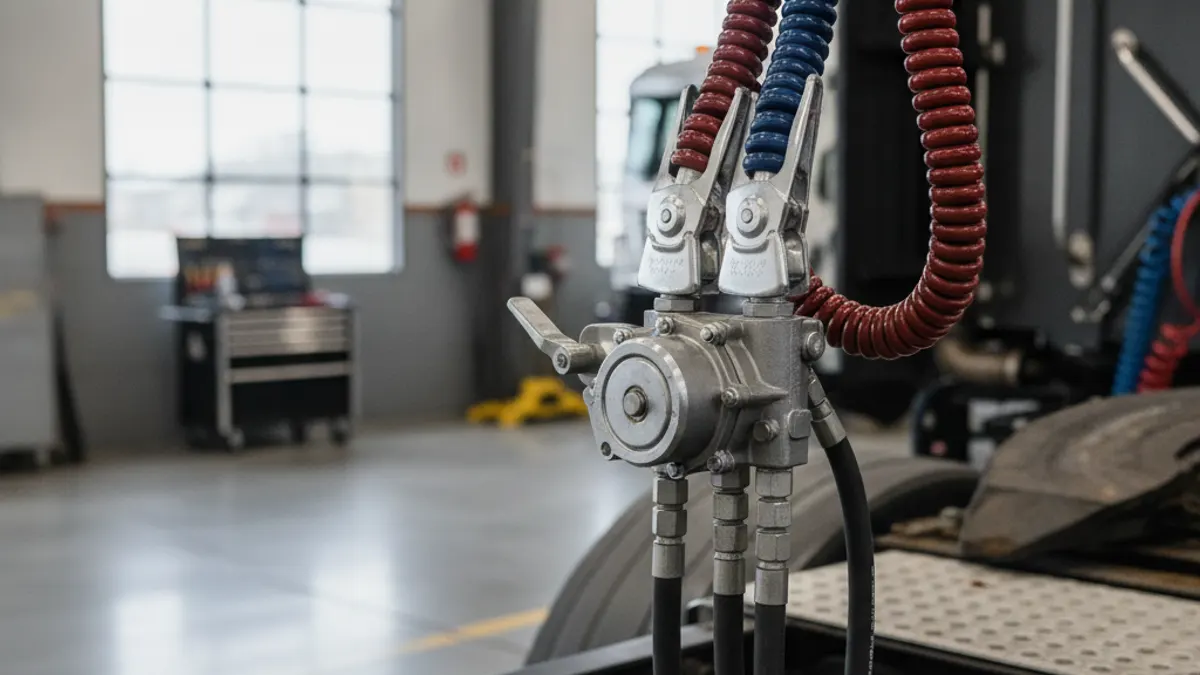
The tractor protection valve is a safety valve, mounted on the back of the tractor, that automatically shuts off the air supply between the tractor and the trailer when trailer-side pressure drops too far. Its whole job is to protect the tractor's braking air: if a trailer breaks away or a gladhand line ruptures, the valve seals the tractor's reservoirs so you keep enough air to bring the truck to a controlled stop. It works hand-in-hand with the red trailer supply valve on the dash, which the driver uses to charge or cut off the trailer.
Think of it as a firewall for your air system. Trailer air lines are the most exposed, abuse-prone part of the pneumatic circuit, and they're the first thing to fail in a jackknife, a hose blowout, or a trailer that separates from the fifth wheel. Without a tractor protection valve, that trailer failure would dump the tractor's air too, and you'd lose service braking on the whole rig.
Tractor protection valve vs. trailer supply valve
These two parts are often confused because they operate together, but they are different devices. Understanding the split makes diagnosing problems much easier.
| Component | Location | What it does | Driver control |
|---|---|---|---|
| Trailer supply valve | Dash (red, eight-sided knob) | Charges the trailer air supply line; opens/closes the feed to the trailer | Push in to supply air, pull out to cut it |
| Tractor protection valve | Rear of the tractor frame/cab | Automatically closes the tractor-to-trailer air path when pressure falls too low | Automatic (no direct control) |
The red, eight-sided knob is the trailer supply valve (sometimes called the trailer air supply). Pushing it in charges the trailer and opens the tractor protection valve; pulling it out, or having it pop out automatically, closes the protection valve and vents the trailer supply line. That vented supply line is what applies the trailer's spring brakes.
How it protects the tractor during a breakaway
On a normal combination vehicle, the tractor protection valve stays open once the system is charged and the red knob is pushed in. Air flows through it to charge the trailer reservoirs and to feed the trailer's service brakes when you apply the brake pedal. Everything is balanced and pressurized to the fully charged range, typically around 120 psi.
Now imagine the trailer breaks away and rips the gladhand hoses apart, or a supply line chafes through. Air rushes out the broken trailer line. As trailer-side pressure collapses and drags total system pressure down, the tractor protection valve closes automatically, usually somewhere in the 20 to 45 psi range, and the red trailer supply knob pops out. This does two critical things at once:
- Seals the tractor. The tractor's air reservoirs are isolated from the leaking trailer line, so the compressor can rebuild and hold pressure for the tractor's own brakes.
- Applies the trailer's spring brakes. Cutting and venting the trailer supply line removes the air holding the trailer's spring brake chambers off, so the parking springs slam the trailer brakes on and hold the runaway trailer.
That's the design intent of the whole safety layer: a trailer failure should never leave the tractor without brakes, and a runaway trailer should stop itself. If you want the bigger picture of how these circuits are laid out, see how the tractor and trailer sides are split in a dual air brake system.
Where it sits in the air system
Air is made by the compressor, regulated by the governor, dried, and stored in the reservoirs. From there the primary and secondary circuits feed the foot valve and the tractor's brake chambers. The trailer feed branches off through the tractor protection valve and the two gladhands: the supply (emergency) line and the service (control) line. The tractor protection valve controls the supply line; the service line only carries a brake-application signal when you press the pedal.
Because the tractor protection valve and the trailer supply/spring-brake logic live so close together, many trucks combine these functions into a multi-circuit or trailer control module. If a valve on a trailer breaks-away function or the multi-circuit protection assembly is worn, both charging and breakaway protection can misbehave. VADEN Original manufactures OE-grade multi-circuit protection valves for these applications, which keep each brake circuit isolated so a single leak can't drain the whole system.
Symptoms of a failing tractor protection valve
A bad tractor protection valve, or a worn trailer supply valve tied to it, shows up in a handful of recognizable ways. Because it's a safety device, don't run the truck with any of these unresolved.
| Symptom | Likely cause |
|---|---|
| Red trailer knob pops out on its own while driving | Low system pressure, a leak dropping trailer-side air, or a weak/sticking valve tripping early |
| Trailer won't charge (spring brakes won't release) | Protection valve stuck closed, plugged supply line, or a failed supply valve |
| Constant air leak at the rear of the cab or the valve body | Cracked valve, torn internal diaphragm, or failed seals |
| Knob won't stay in when pushed | Insufficient reservoir pressure, or the valve won't latch open due to internal wear |
| Trailer brakes drag or won't fully release | Protection valve not fully opening, restricting supply air to the trailer |
Note that some of these overlap with other faults. A truck that can't build air at all is more likely a compressor or governor issue than a protection valve, described in why an air brake compressor won't build pressure. The protection valve tends to be the culprit when the tractor holds air fine but the trailer won't charge, or when the knob won't stay in.
How to test the tractor protection valve
This is a standard part of the air brake pre-trip and a good periodic check. Do it on level ground, wheels chocked, with the trailer connected.
- Charge the system. Build air to the fully charged range (around 120 psi) with the engine running, then push the red trailer knob in so the trailer charges and its spring brakes release.
- Shut the engine off. Turn the key off but leave the ignition on so the gauges read.
- Fan down the pressure. With the brakes released, pump (fan) the foot brake repeatedly to bleed off air, watching the dash gauge.
- Confirm the knob pops. As pressure falls, the low-air warning should sound around 60 psi, and the trailer supply knob (and the tractor protection function) should pop out automatically in the 20 to 45 psi range. That confirms the protection valve trips before you'd lose the ability to hold the trailer.
You can also test the breakaway behavior directly: with the system charged and the trailer connected, pull the red knob out by hand. The trailer's spring brakes should apply immediately, and the tractor should hold its own pressure without bleeding down through the trailer line. If pulling the knob doesn't set the trailer brakes, or the tractor keeps losing air afterward, the valve isn't sealing.
Exact trip pressures vary by manufacturer and model. Always follow the vehicle maker's specifications; treat the 20-45 psi window as a general range, not a target number.
Repair or replace?
Tractor protection valves and multi-circuit protection valves are not parts to nurse along. Internal diaphragms and seals harden and crack with heat cycling and age, and a valve that trips erratically or leaks is a safety hazard on a combination vehicle. If testing shows it won't seal, won't latch, or leaks continuously, replace it with an OE-grade unit and re-test. When you do, it's worth checking the rest of the pneumatic supply chain at the same time, including the air dryer and lines, since contamination and moisture from a tired air dryer shorten valve life. Getting the protection layer right is what keeps a trailer failure from becoming a no-brakes emergency.
Source (VADEN Original): 4-Circuit Protection Valves
Need the part, not just the answer?
OE-grade air brake compressors and repair kits, manufactured and tested to commercial-vehicle standards.
Shop VADEN partsPublished by VADEN Original. Product links point to the manufacturer’s official catalogue. Specifications are general — always confirm figures against your vehicle’s service manual.