 airbrakecompressor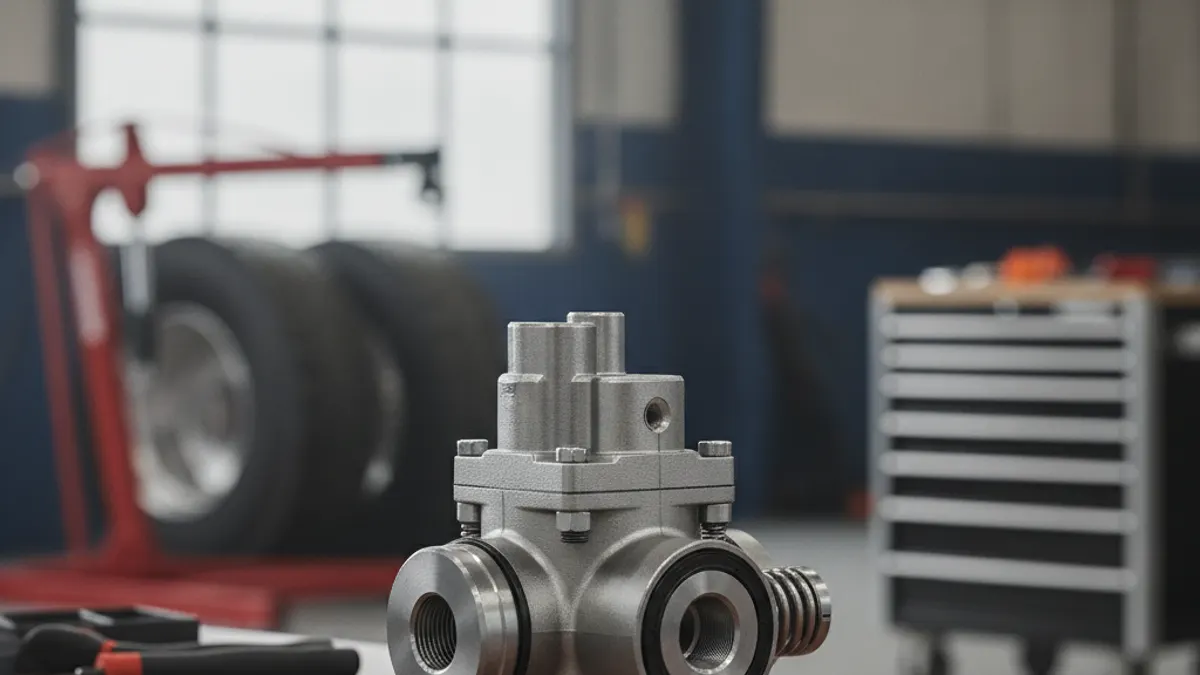
An anti-compounding valve is a double check valve that keeps service brake air pressure from stacking on top of spring brake force at the same brake chamber. When the parking brakes are set and the driver also presses the treadle, the valve routes that service air into the spring brake (hold-off) side of the chamber instead of letting it add to the pushrod load. The foundation brake then sees roughly the force of one application, not the sum of two.
On a tractor with spring parking brakes on the drive axles, the spring section and the service section act on the same pushrod, the same slack adjuster, and the same S-cam. Without an anti-compounding provision, a parked truck with the pedal floored can put close to double the designed force through that hardware. Technicians call that "compounding," and it is the reason the valve exists.
How brake force compounds
A spring brake chamber has two halves. The service half is pressurized by the foot valve during normal braking. The parking half contains a heavy coil spring that applies the brake mechanically whenever hold-off air falls into roughly the 20-45 psi band. Both halves push on the same output rod.
Set the parking brake and the spring pushes the rod out. Now press the pedal: service air pushes the same rod out again, in the same direction. The two forces add. A power spring is sized to deliver roughly the clamping force of a full service application, so a compounded application can approach double the intended load on the pushrod, slack adjuster, camshaft, and anchor pins.
The parts rarely fail on the spot. Compounding usually shows up as bent or twisted slack adjuster arms, cracked spiders or anchor brackets, bent pushrods, distorted chamber clamps, and cam bushings that wear out early on one axle only. A truck that always gets parked with the pedal held tends to eat drive-axle brake hardware.
How the anti-compounding valve prevents it
The valve is a shuttle with two inlets and one outlet. One inlet sees service delivery pressure from the foot valve or relay. The other sees hold-off pressure from the parking control circuit. The outlet feeds the spring brake hold-off port.
The shuttle seals off the lower-pressure inlet and passes the higher one. So when the dash control valve is pulled and hold-off air is exhausted, a service application travels through the double check valve into the hold-off side and compresses the power spring. As service pressure rises, spring force is backed off by a matching amount, and net force at the foundation stays in the normal range.
Release the pedal and that hold-off pressure bleeds back out through the exhaust, the spring reapplies, and the truck stays parked. This is a purely pneumatic, passive device: no electrical connection, no adjustment, nothing to calibrate.
What the valve changes, condition by condition
| Condition | Spring brake side | Service side | Force at foundation |
|---|---|---|---|
| Driving, brakes released | Held off by system air (roughly 120 psi when fully charged) | 0 psi | None |
| Driving, normal stop | Held off | Treadle pressure | Service only |
| Parked, pedal not applied | Spring applied, hold-off exhausted | 0 psi | Spring only |
| Parked, pedal applied, valve working | Partly released by service air through the double check | Treadle pressure | Roughly one application |
| Parked, pedal applied, no anti-compounding | Spring fully applied | Treadle pressure | Both forces added, hardware damage risk |
Where you will find it
Placement varies by builder. It may be a standalone brass or composite double check valve on the frame rail near the spring brake chambers, an internal passage inside the dash park control valve, or a function built into a spring brake control valve or relay assembly. Some later chamber designs handle it internally. On trailers the same logic normally sits inside the spring brake control valve on the trailer air kit.
If you cannot find a discrete valve, do not assume the system lacks the function. Check the vehicle's air system schematic before you start adding plumbing; an anti-compound line where the manufacturer did not design one can defeat the park function.
Symptoms of a failed anti-compounding valve
Parking brake will not hold with the pedal pressed
If the shuttle sticks toward the service inlet or a seat leaks, service air can stay trapped in the hold-off side after the pedal is released, holding the spring off. The truck rolls with the yellow knob out. That is an out-of-service condition.
Spring brakes drag or release slowly
A sticking shuttle or a restricted exhaust path makes hold-off air bleed out slowly, so the spring brakes drag after release and the drums run hot on one axle.
Repeated foundation hardware damage
Bent slacks, bent pushrods, or broken anchor hardware on the spring brake axles with no impact history usually points back to compounding, either a failed valve or a plumbing error after a repair.
Air leak at the valve body
An audible leak with the park brake applied and the pedal down often means a leaking internal seat.
Checking and replacing it
- Chock the wheels. Do not rely on any brake you are about to disturb.
- Charge the system until the governor cuts out, normally somewhere around 120-135 psi, then shut the engine off. Fan the pressure down and confirm the low-air warning comes on near 60 psi, and that the governor cuts back in around 100-110 psi when you restart and build again.
- Recharge, apply the parking brake, and watch the spring brake pushrods. They should extend.
- With the parking brake still applied, have a helper hold a full treadle application while you watch the pushrods. With a working anti-compounding function, rod travel should not increase noticeably beyond the spring-applied position.
- Release the pedal. Hold-off air must exhaust and the spring brakes must stay firmly applied. Any delay or partial release means the valve or its exhaust is restricted.
- Soap the valve body and both inlets with the park brake applied and the pedal held. No bubbles.
- To replace: drain the affected reservoir, tag both inlet lines before removal because reversing them defeats the valve, fit new fittings with sealant rated for air brake use, torque to the manufacturer's figure, recharge, then repeat the checks above.
Never drive a unit whose parking brake releases when the service brakes are applied. It will not hold on a grade, and it can move while a technician is under it.
Habits that reduce compounding
Even with a healthy valve, park with the knob only, not knob plus pedal, and never knob plus a wedged pedal. Do not use the parking brake as a service brake at speed. When caging a chamber for service, cage it fully and back the slack off rather than fighting the spring with air. After any work on a brake chamber, re-check pushrod stroke on both sides of the axle; uneven stroke is often the first sign that a slack was tweaked by a compounded application.
The valve is cheap, passive, and easy to overlook, and it protects the most expensive parts of the foundation brake. Put it on the annual air system inspection instead of waiting for a bent slack adjuster to report the failure for you.
If the annual check condemns yours, the double check body belongs to the same park-and-emergency circuit family as the rest of the emergency valves, so change it while the lines are already open.
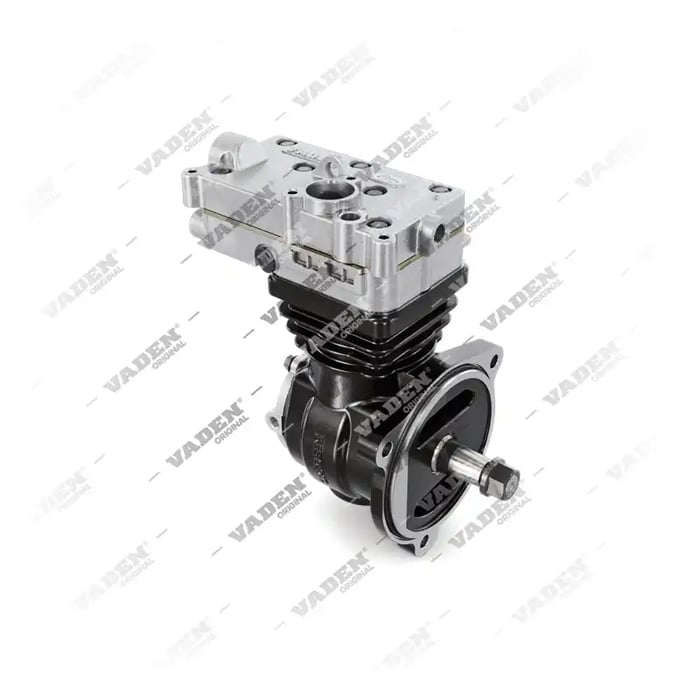
Need the part, not just the answer?
OE-grade air brake compressors and repair kits, manufactured and tested to commercial-vehicle standards.
Shop VADEN partsPublished by VADEN Original. Product links point to the manufacturer’s official catalogue. Specifications are general — always confirm figures against your vehicle’s service manual.