 airbrakecompressor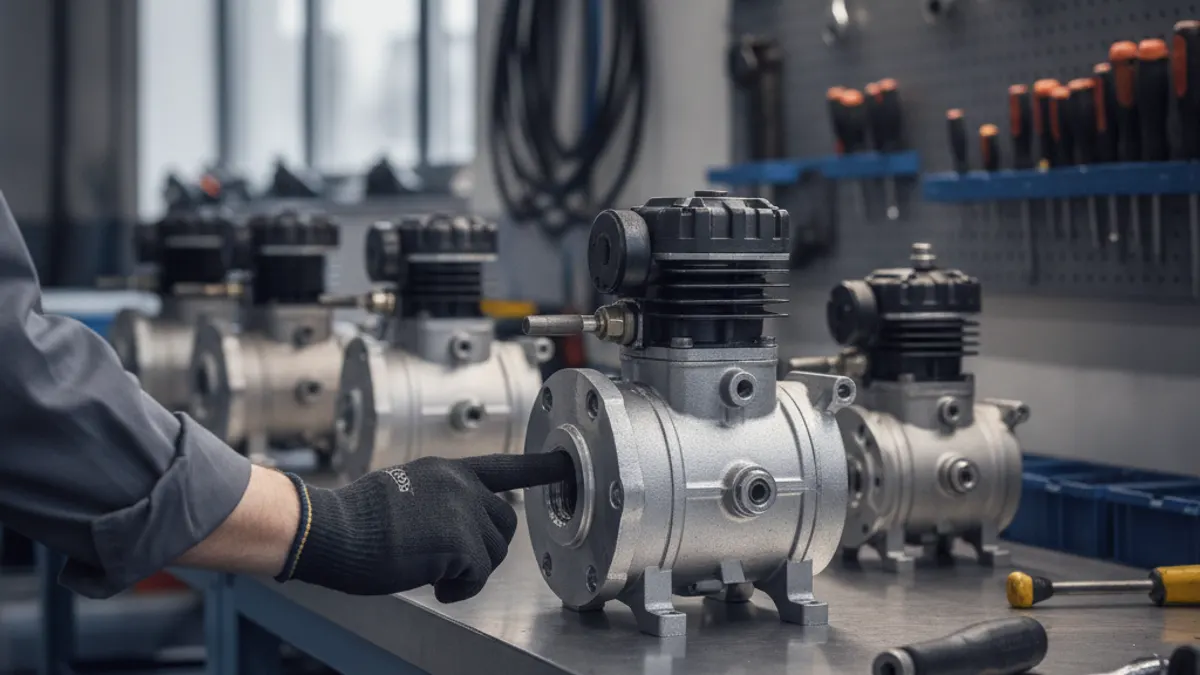
To choose the right air brake compressor, start with the OE part number stamped on the old unit and your engine serial number, then verify five things before you buy: displacement and rated air delivery, single versus twin cylinder, the mounting flange and bolt pattern, the drive method (gear, belt or splined coupling), and the cooling type (air-cooled or liquid-cooled). A compressor that matches all five will bolt on, charge the pneumatic system to a normal governor cut-out of roughly 120–135 psi, and keep up with your duty cycle. Get any one of them wrong and you are either back under the truck within the week or slowly cooking a new unit.
Step 1: Identify what you actually have
Chassis year and model are not enough. Two identical-looking tractors off the same lot can carry different compressors because of different engines, different accessory drives, or a mid-year supplier change. Pull the information from the part itself:
- Compressor casting or tag number — usually stamped on the crankcase or a data plate near the head.
- Engine make, model and serial number — the compressor is an engine accessory, so this is the controlling reference.
- Photo of the mounting face and drive end — flange shape, bolt count and gear or pulley type settle most fitment questions instantly.
- Port positions — inlet, discharge, coolant and governor/unloader ports must suit your existing plumbing.
With those four details a supplier can cross-reference the correct replacement without guesswork. Working from a catalogue of air brake compressors listed by engine and OE reference beats eyeballing a match from a photo.
Step 2: Match displacement and air output to demand
Capacity is quoted two ways. Displacement (cc per revolution, or cubic inches) is the fixed swept volume — the comparable number. Air delivery (CFM or litres per minute) is displacement multiplied by speed and volumetric efficiency, so it is always quoted at a specific rpm. A CFM figure taken at 2,000 rpm tells you nothing about one taken at 1,200 rpm.
The practical rule: the compressor should refill the reservoirs from the low-air warning point (around 60 psi) back up to cut-out within the gaps between brake applications, without spending an excessive share of running time loaded. A unit that pumps constantly pushes heat and oil vapour downstream into the dryer and valves.
| Application | Air demand profile | Typical choice |
|---|---|---|
| Line-haul tractor, single trailer, steel suspension | Low to moderate — mostly service brakes | Single cylinder, standard displacement |
| Tractor with air suspension, air seats, air-operated fifth wheel | Moderate — many small constant consumers | Larger single, or small twin |
| Vocational: tipper, mixer, refuse, crane | High — PTO, air shift, frequent stops | Twin cylinder, high displacement |
| Multi-trailer combinations | High — large total reservoir volume to fill | Twin cylinder, high displacement |
| City bus: kneeling suspension, air doors | Very high — near-continuous cycling | Twin cylinder, liquid-cooled |
If the old compressor was struggling before it failed — long build times, governor rarely reaching cut-out, low-air buzzer during a busy shift — do not fit the same size and expect a different outcome. First rule out leaks and a restricted air dryer, then consider stepping up if the truck genuinely gained air consumers since it was built.
Step 3: Single or twin cylinder
A single-cylinder unit is lighter, cheaper, has fewer wear parts and is entirely adequate for most over-the-road tractors. A twin moves substantially more air per revolution at the same drive speed, which matters when the vehicle spends its life filling large reservoir banks or feeding air-hungry bodywork.
Do not up-size on instinct. A twin draws more drive torque, weighs more and generates more heat; if the accessory drive and cooling circuit were specified for a single, fitting a twin creates new problems. Up-size only where the vehicle manufacturer offered that option for your engine. Our comparison of single versus twin-cylinder air compressors covers the trade-offs.
Step 4: Mounting, drive and rotation
Most mail-order mistakes happen here. Check each point against the old unit before ordering:
- Flange pattern — bolt count, hole spacing and pilot diameter. Several sizes are in common use and they do not swap between one another.
- Drive type — gear off the timing case, belt from a pulley, or splined coupling. Gear-driven units often need the original gear transferred.
- Rotation direction — clockwise or counter-clockwise viewed from the drive end. The wrong rotation will not build pressure correctly and can damage the unit.
- Drive gear condition — where a gear is reused, inspect for chipped or worn teeth. A new compressor behind a worn gear is wasted money.
- Discharge port orientation — the line to the dryer needs a downward or level run, with no low spots where condensate can collect and freeze.
Step 5: Cooling and lubrication
Air-cooled compressors shed heat through finned castings and ambient airflow. Liquid-cooled units are plumbed into the engine coolant circuit and stay far cooler under sustained load, which is why high-duty-cycle vehicles get them from the factory. Never substitute one for the other. An air-cooled unit fitted where a liquid-cooled one belongs runs hot, carbonises oil in the discharge port, and starts passing oil downstream within months.
Lubrication is almost always pressure-fed from the engine oil gallery. Confirm the replacement uses the same feed and return arrangement, and that the supply line is clear before first start-up — oil starvation destroys a fresh compressor in minutes.
Discharge line temperature is the best single predictor of compressor life. A correctly sized, correctly cooled unit with a clean, properly routed discharge line stops the dryer being swamped with hot, oily air.
Step 6: Quality tier and what is in the box
Compressors sell as genuine OE, OE-grade aftermarket, economy aftermarket and remanufactured units. The differences that matter are casting quality, valve plate and reed materials, ring and bearing specification, and whether the finished unit is flow-tested before it ships.
| Check before buying | Why it matters |
|---|---|
| Warranty length and terms | A short or heavily conditional warranty signals low confidence in the build |
| Tested and certified output | Confirms real delivery, not a catalogue figure copied from the OE spec |
| Gasket and fitting kit included | A missing gasket costs a second trip and another day of downtime |
| Unloader and governor porting supplied | Some units ship without the unloader assembly — know what has to transfer over |
| Core return required | Affects the true cost, especially on remanufactured units |
For the full breakdown, see our comparison of OE versus aftermarket truck air compressors.
What to replace at the same time
A compressor rarely fails without leaving contamination behind. When you fit the new unit:
- Replace the air dryer cartridge — the old one is saturated with oil carried over from the failure.
- Inspect the discharge line; replace it if it is oil-fouled, heat-damaged or carboned up, and blow it through at minimum.
- Check governor operation — cut-out around 120–135 psi, cut-in around 100–110 psi on most systems — and replace it if erratic or sticking.
- Drain every reservoir fully and note how much oil and water comes out.
- Inspect the unloader assembly if it transfers to the new compressor.
Skipping the dryer cartridge is the most common false economy here: contamination from the old failure goes straight back through the system you have just cleaned up.
Quick decision summary
- Same truck, same duty, no air complaints? Fit the direct OE equivalent, like for like.
- Compressor never kept up? Prove there are no leaks first, then consider the higher-displacement option your engine supports.
- High duty cycle, hot climate or repeat failures? Check whether a liquid-cooled variant was factory-offered and fix the discharge line routing.
- Budget-driven? On a gear-driven compressor buried behind the timing case, the labour of a second replacement dwarfs the price gap.
Get the identification right and the rest is straightforward. Torque figures, timing marks, exact governor settings and coolant capacities are vehicle-specific, so work to the manufacturer's current service manual for those values rather than a generic specification.
Source (VADEN Original): Air Brake Compressor Duty Cycle & Efficiency Guide
Need the part, not just the answer?
OE-grade air brake compressors and repair kits, manufactured and tested to commercial-vehicle standards.
Shop VADEN partsPublished by VADEN Original. Product links point to the manufacturer’s official catalogue. Specifications are general — always confirm figures against your vehicle’s service manual.