 airbrakecompressor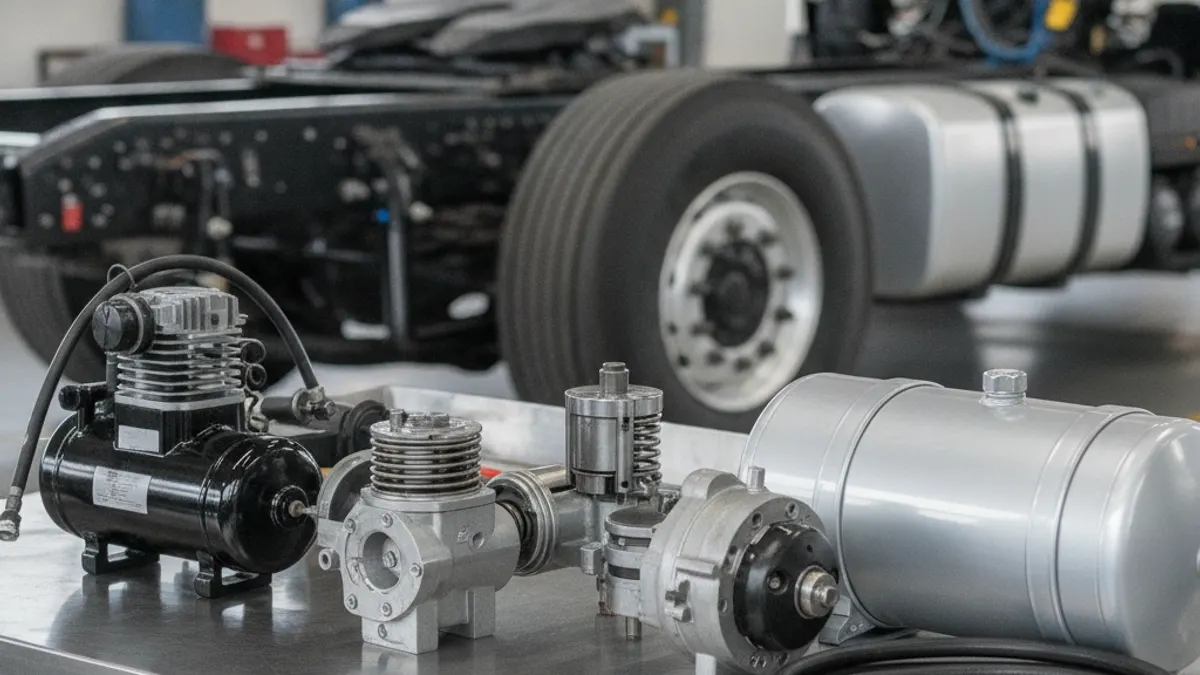
Air brake terminology falls into four groups: making air, storing and drying it, controlling it with valves, and turning it into mechanical clamping force at the wheel. Air brakes are pneumatic, so compressed air does the job hydraulic fluid does on a car, and every term below belongs to one of those four stages. Learn them in those groups and service manuals, inspection reports, and shop conversations become readable. What follows are the terms a truck, bus, and trailer technician uses day to day, with typical pressure ranges where they matter.
For how the parts work together rather than isolated definitions, start with how air brake systems work, then come back here for individual words.
Air supply and charging terms
| Term | What it means |
|---|---|
| Air compressor | Engine-driven pump (gear, belt, or direct drive) that supplies compressed air to the whole system. It turns constantly with the engine but only pumps into the tanks when the governor tells it to. |
| Governor | Pressure-sensing valve that switches the compressor between loaded (pumping) and unloaded (idling). See the air brake governor page for adjustment and failure symptoms. |
| Cut-out pressure | The upper setting, commonly about 120-135 psi, at which the governor stops the compressor building further. |
| Cut-in pressure | The lower setting, commonly about 100-110 psi, at which the governor puts the compressor back to work. The gap between cut-in and cut-out is usually around 20-25 psi. |
| Unloader | The mechanism (plungers in the compressor head, or a separate unloader valve) that holds the intake open so the compressor spins without pumping air. |
| Build-up time | How long the system takes to raise pressure across a defined band. A common yardstick is roughly 85 to 100 psi in about 45 seconds at governed rpm. |
| Fully charged | A system sitting at normal operating pressure, around 120 psi on most highway vehicles, with the governor cut out. |
| Safety valve (pop-off) | Spring-loaded relief valve in the supply reservoir, typically set near 150 psi, that vents if pressure climbs far above normal and protects tanks and lines. |
Air treatment and storage terms
| Term | What it means |
|---|---|
| Air dryer | Canister between compressor and tanks that removes moisture and oil aerosol before air reaches the reservoirs. |
| Desiccant cartridge | Replaceable element inside the dryer holding beads that adsorb water vapor. A service item, not a lifetime part. |
| Purge | The dryer's exhaust event: the sharp hiss shortly after the governor cuts out, blowing collected water and oil out of the dryer sump. |
| Wet tank (supply reservoir) | First tank downstream of the compressor and dryer, and the designed collection point for whatever moisture and oil get past the dryer. More on wet tank vs dry tank. |
| Primary and secondary reservoirs | The dry tanks feeding the two independent brake circuits, typically one serving the drive axles and one serving the steer axle and trailer. |
| Check valve | One-way valve that lets air into a reservoir but stops it draining back if upstream pressure is lost. |
| Drain valve | Manual petcock or automatic valve at the bottom of a tank for expelling condensate. Regular draining is basic preventive maintenance. |
| Carryover | Oil and water that reach the tanks and downstream valves past the dryer, usually pointing to a worn compressor or saturated desiccant. |
Control valve terms
| Term | What it means |
|---|---|
| Foot brake valve (treadle valve) | Driver-operated dual-circuit valve that meters air to the service brakes in proportion to pedal effort. |
| Relay valve | Valve mounted near the axle that uses a small pilot signal from the treadle valve to deliver a large volume of air locally, cutting apply and release time. |
| Quick release valve | Valve that dumps chamber air to atmosphere close to the chamber instead of routing it all the way back to the pedal. |
| Tractor protection valve | Isolates the tractor's air supply and closes the trailer lines if the trailer breaks away or supply pressure falls dangerously low. |
| Trailer supply valve | The red octagonal dash knob that charges the trailer emergency line and releases the trailer spring brakes. |
| Parking control valve | The yellow diamond dash knob that applies and releases the tractor spring brakes. |
| Pressure protection valve | Valve that cuts off auxiliary air users (suspension, seats, PTO) below a set pressure so the brakes always get air first. |
| Anti-compounding valve | Stops service application and spring brake force adding together on the same foundation brake, which would overload the pushrod and cam. |
| Load sensing valve (LSV, also ALB) | Mechanical or electronic valve that reduces delivered pressure when the axle is lightly loaded, limiting wheel lock on an empty vehicle. |
Foundation brake terms
| Term | What it means |
|---|---|
| Brake chamber | Diaphragm actuator converting air pressure into pushrod force. Sized by effective area, such as type 24 or type 30. |
| Spring brake (piggyback) | Second chamber section holding a heavy coil spring that applies the brake mechanically. Air holds it off, so losing air lets it apply. It starts dragging on as pressure falls into roughly the 20-45 psi band. |
| Caging bolt | Threaded tool that mechanically compresses the power spring so a spring brake can be released without air, for towing or chamber replacement. |
| Pushrod stroke | How far the pushrod travels on an application. Excess stroke is the most common out-of-adjustment write-up at inspection. |
| Slack adjuster | Lever arm converting pushrod movement into camshaft rotation, and setting lining-to-drum clearance. Almost all current units are automatic. |
| S-cam | S-shaped cam at the end of the camshaft that spreads the brake shoes against the drum as the slack adjuster rotates it. |
| Brake shoe and lining | Curved shoe carrying the friction lining that presses against the drum. |
| Air disc brake | Alternative foundation design using a caliper and rotor instead of cam, shoes, and drum. |
Trailer, warning, and inspection terms
| Term | What it means |
|---|---|
| Gladhand | Coupler joining tractor and trailer air lines. The emergency (supply) line is red, the service line is blue. |
| Emergency (supply) line | Line that charges the trailer reservoirs and holds the trailer spring brakes released. |
| Service line (control line) | Line carrying the driver's brake application signal to the trailer relay valve. |
| Low-air warning | Buzzer and lamp that must activate before pressure falls below about 60 psi in either circuit. |
| Dual air brake system | Two independent service circuits fed by separate reservoirs, so a failure in one still leaves usable braking. |
| Leakage rate | Pressure drop per minute with the engine off, brakes applied or released, measured at inspection against a set limit that is tighter for single vehicles than for combinations. |
| Brake lag | Delay between pedal movement and full application at the wheel: a normal trait of pneumatic systems, made worse by undersized or missing relay valves. |
| Out of service (OOS) | Condition severe enough that an inspector prohibits the vehicle from moving until repaired, such as brakes beyond the adjustment limit. |
Pressure figures worth memorizing
These numbers anchor most diagnostic conversations. Treat them as typical ranges: the vehicle manufacturer's current service data governs the specific unit in front of you.
| Event | Typical range (psi) | Approximate bar |
|---|---|---|
| Governor cut-out | about 120-135 | 8.3-9.3 |
| Governor cut-in | about 100-110 | 6.9-7.6 |
| Normal fully charged system | around 120 | around 8.3 |
| Low-air warning activates | before pressure drops below about 60 | about 4.1 |
| Spring brakes begin to apply | roughly 20-45 | 1.4-3.1 |
Using the vocabulary to diagnose
Fault descriptions point at components once you know the words. Slow build points at the compressor, dryer, and leaks. Will not release points at the spring brakes, relay valve, and control valves. Grabby or uneven braking points at foundation brake adjustment and oil-contaminated linings. Check the gauge before condemning a part: a governor set low and a leaking system produce similar complaints.
Pressure readings only mean something against the manufacturer's specification for that vehicle. Use the ranges above to judge whether a reading is plausible, then check the service data before adjusting or replacing anything.
Naming the part correctly is also how you order it: relay valve, quick-release valve and spring brake chamber are three separate line items in any listing of air brake replacement parts.
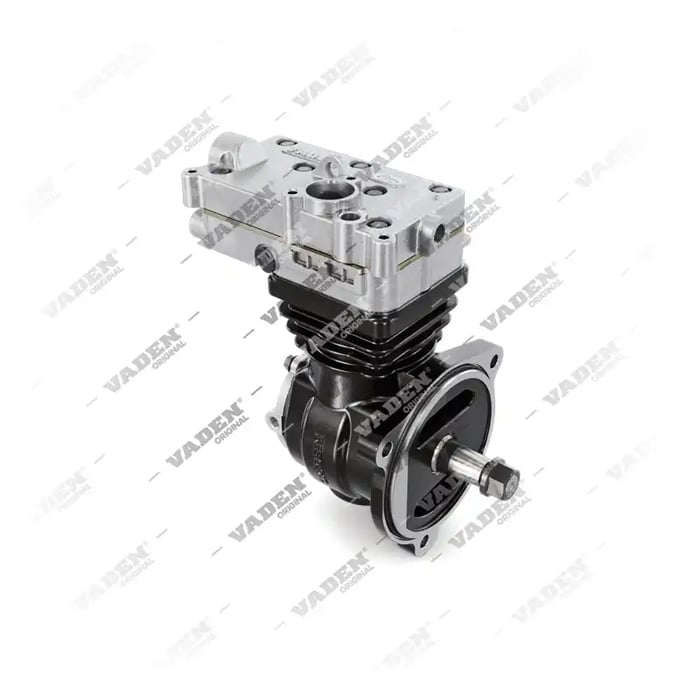
Need the part, not just the answer?
OE-grade air brake compressors and repair kits, manufactured and tested to commercial-vehicle standards.
Shop VADEN partsPublished by VADEN Original. Product links point to the manufacturer’s official catalogue. Specifications are general — always confirm figures against your vehicle’s service manual.