 airbrakecompressor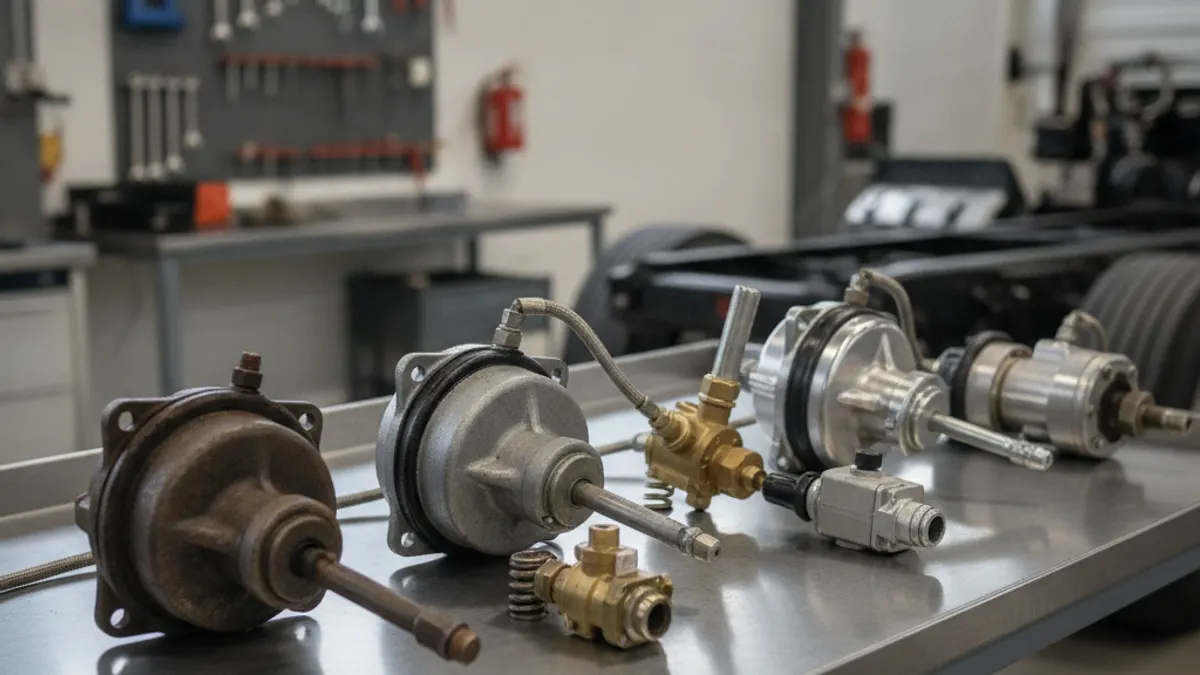
The air brake was invented by George Westinghouse, who patented a compressed-air railway brake in 1869 and founded the Westinghouse Air Brake Company that same year. That first design used air pressure to apply the brakes, which failed dangerously when a train broke apart. In 1872 he patented the automatic air brake: every car carried its own reservoir and a triple valve, so any loss of line pressure applied the brakes instead of releasing them. That inversion is why compressed air, rather than hydraulics or cables, became the standard on heavy vehicles and still is today.
The problem before air brakes
Nineteenth-century trains stopped with brakemen. The engineer whistled, and men walked the roofs of moving cars turning handwheels one by one. Stopping distance depended on how fast those men could move. Collisions were routine, and brakemen were killed doing it.
Steam brakes and vacuum brakes were both tried. Steam condensed and froze before it reached the rear of a long train. Vacuum systems worked, and stayed in use in Britain and elsewhere for decades, but a vacuum can only ever give about one atmosphere of differential, roughly 14.7 psi. Compressed air has no such ceiling: a small tank can hold around 120 psi and apply large clamping force through a modest chamber. That energy density is the practical reason air won.
Straight air versus automatic air
Westinghouse's 1869 patent is called the straight air brake. A steam-driven pump on the locomotive charged a reservoir, and the engineer's valve sent air down a train line to the brake cylinders on each car. Push air in, brakes apply. Vent the line, brakes release.
The flaw is obvious once you say it out loud: a burst hose, a parted coupling or a train breaking in two dumps the line, and every brake on the train releases at the worst possible moment.
The 1872 automatic brake reversed the logic. Air from the locomotive charges an auxiliary reservoir on each car through the train line. A triple valve on each car watches line pressure and does three things: charge the reservoir, apply the brake, or release it. When line pressure drops, whether the engineer commanded it or a hose let go, the triple valve connects that car's own stored air to its own brake cylinder. The train stops itself. Westinghouse later added the quick-action triple valve so the application propagated rapidly down a long train instead of crawling car to car.
Every air-braked truck and trailer built since runs on this principle. Lose supply pressure and the spring brakes apply. The system is designed to fail toward stopped.
Timeline: air brake milestones
| Period | Development | Why it mattered |
|---|---|---|
| 1869 | Westinghouse straight air brake patent; Westinghouse Air Brake Company founded | One person could brake a whole train from the cab |
| 1872 | Automatic air brake with triple valve and car reservoirs | Pressure loss now applies the brakes: the fail-safe principle |
| 1887 | Burlington, Iowa brake trials | Quick-action automatic braking proven on long trains |
| 1893 | U.S. Railroad Safety Appliance Act | Power brakes made a legal requirement, not an option |
| 1920s-1930s | Air brakes adopted on trucks and buses; Bendix and Westinghouse partner on automotive hardware | Railway logic scaled down to highway vehicles |
| Mid-20th century | Spring brake chambers for parking and emergency | A mechanical spring holds the vehicle with zero air |
| 1975 | U.S. FMVSS 121 takes effect for air-braked vehicles | Dual-circuit service braking and performance standards mandated |
| 1970s-1980s | Desiccant air dryers replace alcohol evaporators | Moisture removed at source rather than treated downstream |
| Late 1990s | ABS required on new U.S. air-braked tractors and trailers | Wheel-lock control on heavy combinations |
| 2000s onward | EBS and air disc brakes spread, especially in Europe under ECE R13 | Electronic control layered over pneumatic actuation |
From rail to road
Trucks got heavy faster than their brakes did. Early heavy trucks used mechanical linkage and later hydraulics, both workable on a rigid two-axle vehicle and both poor once you start adding trailers. A hydraulic circuit has to be sealed, filled and bled; you cannot casually connect and disconnect one in a muddy yard several times a day. Air can be. Two gladhands, a shove, done, and a leak vents harmlessly to atmosphere instead of losing fluid and pedal.
By the late 1920s and into the 1930s, air brakes were standard equipment on buses and larger trucks in the U.S. Bendix and Westinghouse joined forces around 1930 to build automotive air brake components, and those names, along with Wabco and later Knorr-Bremse in Europe, still appear on the compressors, governors and valves under a modern truck.
The road version reorganised the railway layout without changing its philosophy. An engine-driven air compressor replaced the steam pump. A governor cycled that compressor between loaded and unloaded states instead of letting it run flat out. The triple valve's job was split across relay valves, quick release valves and, on the trailer, an emergency relay that applies the trailer brakes if the supply line is lost, which is exactly the 1872 idea in a different casting.
What the modern system inherited
A truck built today is Westinghouse's architecture with a century of refinements bolted on:
- Fail-safe actuation. Spring brakes begin to drag as air bleeds off and are fully applied by roughly 20-45 psi, depending on the chamber.
- Stored energy at each point of use. Reservoirs on the tractor and on the trailer, just like the reservoirs on each rail car.
- Working pressure around 120 psi. Governors typically cut out somewhere in the 120-135 psi band and cut back in around 100-110 psi, so a fully charged system sits near 120 psi. A dash warning light and buzzer come on when pressure falls to roughly 60 psi.
- Redundancy. Service braking is split into two independent circuits so one failure does not take everything, the road equivalent of not trusting a single line.
- Air quality management. Compressors pass hot, wet, slightly oily air. Dryers and purge cycles exist because moisture and oil were destroying valves long before anyone wrote a standard about it.
What has genuinely changed is control, not actuation. ABS, EBS, stability control and automatic emergency braking all sit on top of the pneumatic layer, modulating pressure faster and more precisely than a foot ever could. The air still does the work. For the mechanical walkthrough of how those pieces fit together on a current vehicle, start with how air brake systems work, and compare the two philosophies side by side in air versus hydraulic brakes.
Why it never got replaced
Alternatives have been proposed throughout the 150 years since. None beat the combination air offers: a free and unlimited working fluid; leaks that vent to atmosphere instead of dropping the pedal; couplings a driver can connect in seconds in any weather; energy that can be stored in a steel tank; and a failure mode that stops the vehicle rather than freeing it.
Electromechanical braking may eventually change that on some heavy vehicles, and electronic control already dominates the decision-making. But the actuator at the wheel end is still a diaphragm pushed by compressed air and held in reserve by a spring, an idea patented in 1872 that nobody has needed to replace.
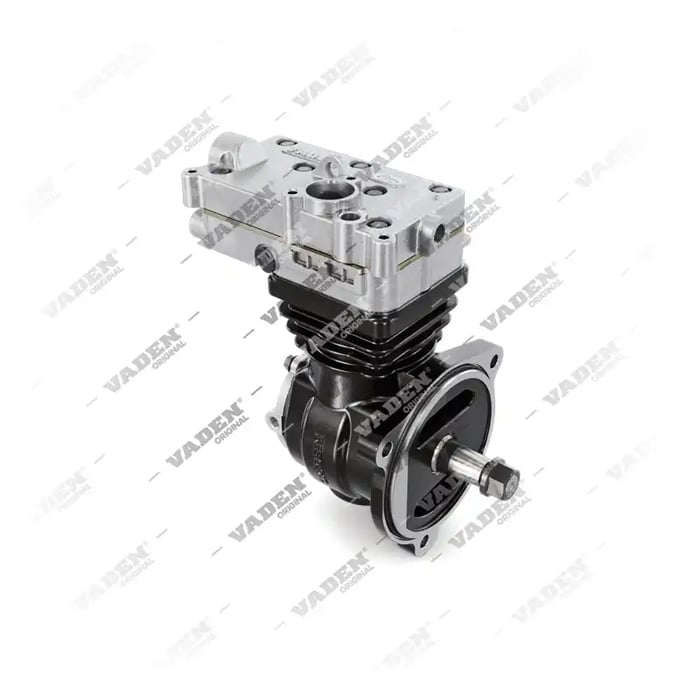
Need the part, not just the answer?
OE-grade air brake compressors and repair kits, manufactured and tested to commercial-vehicle standards.
Shop VADEN partsPublished by VADEN Original. Product links point to the manufacturer’s official catalogue. Specifications are general — always confirm figures against your vehicle’s service manual.