 airbrakecompressor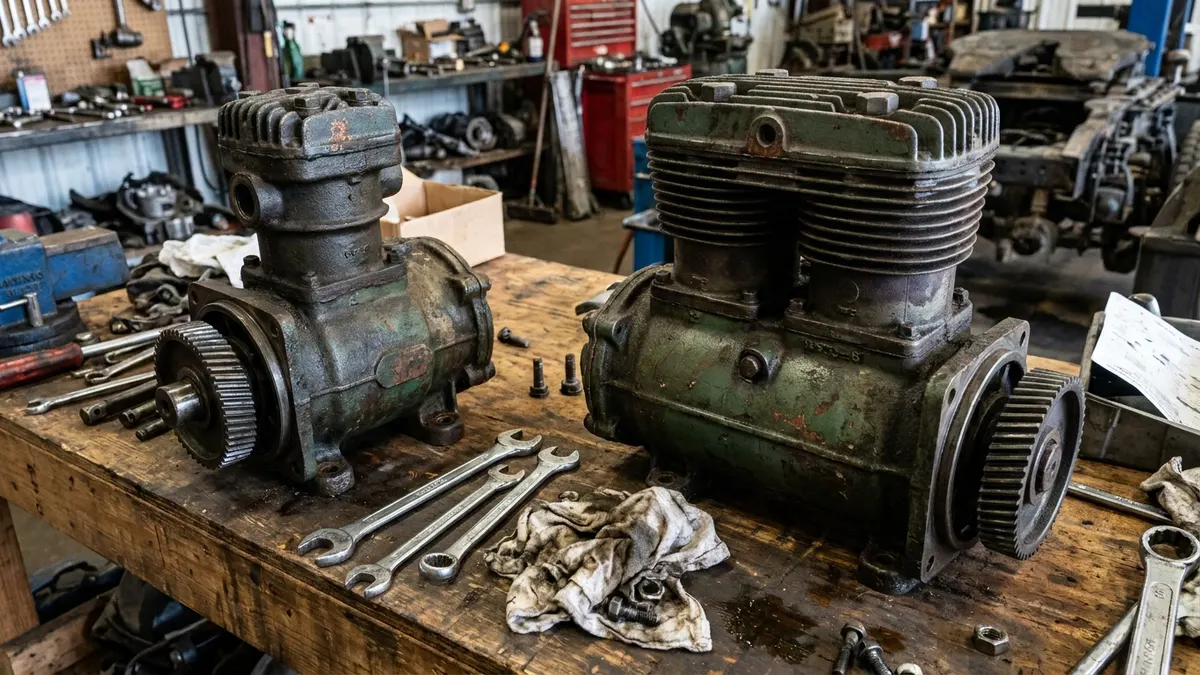
Almost every modern heavy truck uses a gear-driven air brake compressor: it bolts to a machined drive pad on the engine and is turned directly by the timing gear train. Belt-driven compressors are the minority, showing up on buses, medium-duty chassis, older equipment and vocational builds where the engine has no compressor drive pad or where extra compressor speed at idle is wanted. The pumping end works the same either way — a reciprocating piston compressor charging the wet tank until the governor cuts out, typically between 120 and 135 psi — but mounting, lubrication, service and failure behaviour differ enough that the two are never interchangeable on the same engine.
How each drive is put together
Gear-driven compressors
A gear-driven unit mounts to a flange or pad on the front gear housing, flywheel housing or accessory pad, and its drive gear meshes with the cam gear, crank gear or an idler in the timing train. The drive is positive — no slip, no tension to set — so the compressor turns at a fixed ratio to engine speed for the life of the install. In most designs, engine oil is fed through a gallery in the mounting pad or an external supply line, and drains back through the pad, so the compressor shares the engine's oil supply, filtration and pressure. Cylinder heads on larger gear-driven units are usually coolant-cooled through hoses tied into the engine's cooling circuit, which is what lets them run continuously at high duty cycles without cooking the discharge valves.
Belt-driven compressors
A belt-driven unit sits on a bracket and is turned by a V-belt or poly-V belt from the crankshaft pulley, exactly like an alternator or an air conditioning compressor. Because you choose the pulley ratio, a belt drive can overdrive the compressor — useful on a transit bus that spends its day at idle running doors, kneeling and suspension while still needing to recover air. Lubrication varies: some belt-driven compressors are self-lubricated with their own sealed sump and a dipstick or fill plug that must be checked on a schedule, while others still take engine oil through external supply and return lines. Heads may be air-cooled or coolant-cooled depending on the model.
Gear vs belt at a glance
| Trait | Gear-driven | Belt-driven |
|---|---|---|
| Mounting | Machined drive pad, gear meshed to timing train | Bracket and pulley off the crankshaft belt |
| Drive speed | Fixed ratio to engine, no slip | Set by pulley ratio; can be overdriven, can slip |
| Lubrication | Nearly always engine oil through the pad or a line | Self-lubricated sump or external engine-oil lines |
| Cooling | Commonly coolant-cooled head | Air-cooled or coolant-cooled, model dependent |
| Typical duty | Line-haul, heavy vocational, high displacement | Bus, medium-duty, retrofit, lower displacement |
| If the compressor seizes | Load goes straight into the gear train | Belt squeals, glazes or breaks first |
| Routine attention | None beyond oil, air filter and discharge line | Belt condition, tension and alignment |
| Replacement labour | Higher — pad access, gear, gaskets, oil feed | Lower — bracket, pulley, belt |
Reliability and how each one fails
Gear-driven compressors fail from the inside out. Worn rings, a cracked head, a leaking head gasket or a tired unloader show up as oil in the air dryer, slow build-up or a knocking noise under load — not as a drive problem. The drive itself rarely gives trouble, but when the compressor does seize, the timing gear train absorbs the shock, and that turns a parts job into an engine job. Torsional vibration from the crankshaft also passes straight into the drive gear, which is why loose or worn drive gear hardware deserves a look any time the unit is off.
Belt-driven compressors add a second, easier failure path. A glazed, oily or loose belt slips under load, so the compressor spins slower than the engine thinks it does and recovery time stretches out — a classic reason a truck seems fine at cruise but sags in stop-and-go work. Overtightening is just as damaging: excess side load wears the front bearing and shaft seal, and a leaking shaft seal on an engine-oil-fed unit will drip. The belt does act as a mechanical fuse, but on a single serpentine layout a thrown belt also takes the water pump and alternator with it, so treat it as a roadside failure, not a convenience.
What changes when you service them
On a belt-driven unit, checking the drive is part of every PM: belt condition, tensioner travel, pulley alignment and, on self-lubricated compressors, the oil level. If the truck is slow to build pressure, the belt is the first thing to rule out — long before you condemn the compressor, governor or unloader. On a gear-driven unit there is nothing to inspect on the drive; you watch oil carryover, discharge line temperature and carbon build-up, and cut-out and cut-in behaviour instead, expecting cut-out around 120-135 psi and cut-in around 100-110 psi with the low-air warning clearing well above its roughly 60 psi trigger.
Removal is where the gap widens. A belt-driven compressor comes off with the belt, bracket bolts and a couple of air and oil connections. A gear-driven unit means clearing access to the pad, unmeshing or pulling the drive gear, dealing with the pad gasket or O-ring and the oil feed, and in some engines respecting gear timing marks. Plan the extra hours; the step-by-step sequence is covered in our air brake compressor replacement guide.
Matching a replacement
Never try to convert one drive type to the other. Order against the OE number stamped on the unit and confirm every one of these:
- Drive type and interface — gear pad versus pulley shaft, plus flange bolt pattern and pilot diameter.
- Rotation direction — many compressors are handed; the wrong rotation will not lubricate or unload correctly.
- Lubrication method — engine-fed versus self-lubricated; a self-lubricated unit plumbed to an oil gallery will flood.
- Cooling — air-cooled versus coolant-cooled head, and the port sizes to match your hoses.
- Displacement and duty — sized to the air demand; see single versus twin-cylinder units.
- Port configuration — inlet source (air cleaner or boosted intake), discharge thread and unloader/governor signal ports.
Cross-reference catalogues of OE-grade air brake compressors list these attributes against Bendix, Wabco/ZF, Knorr-Bremse and truck OEM numbers, which is the fastest way to confirm you are looking at the same drive configuration and not just the same displacement.
If you are unsure which you have, look at the back of the compressor, not the front. A machined flange sitting flush against the engine with no belt in sight is gear-driven; a bracket, pulley and belt is belt-driven.
So which is better?
For heavy, high-duty service, gear drive wins: no slip, no belt maintenance, consistent output and the ability to carry larger displacement units. Belt drive earns its place where the engine offers no drive pad, where the compressor must be overdriven at idle, or where quick, low-cost replacement matters more than absolute duty cycle. Neither drive changes what the air system expects downstream — a fully charged system near 120 psi, spring brakes applying somewhere in the 20-45 psi range as pressure falls — so the right answer is simply the one your engine was built for, sized correctly and installed clean.
Source (VADEN Original): Air Brake Compressor Duty Cycle & Efficiency Guide
Need the part, not just the answer?
OE-grade air brake compressors and repair kits, manufactured and tested to commercial-vehicle standards.
Shop VADEN partsPublished by VADEN Original. Product links point to the manufacturer’s official catalogue. Specifications are general — always confirm figures against your vehicle’s service manual.