 airbrakecompressor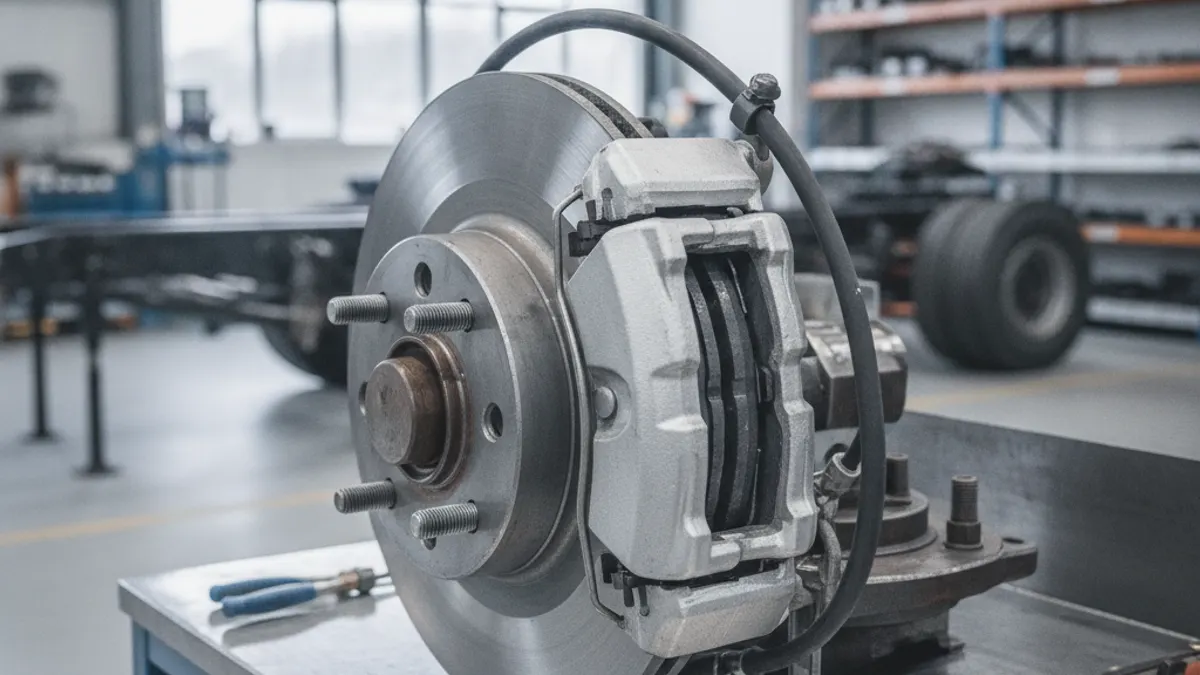
UN ECE Regulation No. 13 is the European (and wider UNECE) type-approval standard that defines how brakes on trucks, buses and trailers must be built and how well they must perform. In practical terms it requires every heavy vehicle to have three independent braking functions — service, secondary and parking — each meeting a minimum deceleration or holding performance, backed by a dual-circuit compressed-air supply, a driver warning device, anti-lock braking and, on heavy buses and coaches, an endurance brake. No European type approval is granted, and no trailer is plated, without demonstrating compliance.
R13 is not a maintenance manual and it is not something a technician tests at the roadside. It is the specification the vehicle was certified against, which is exactly why it is worth understanding: almost every design feature in a European air brake system — dual circuits, two-line trailer coupling, mechanical spring-brake release, load sensing — exists because R13 demands it.
Which vehicles ECE R13 covers
Scope is set by vehicle category, not by a weight class in the American sense. Passenger cars and light vans are handled separately by Regulation 13H; R13 itself is the heavy-vehicle document.
| Category | Vehicle type | Air brake relevance |
|---|---|---|
| M2 / M3 | Buses up to 5 t (M2) and buses and coaches above 5 t (M3) | Full air or air-over-hydraulic; endurance brake required on heavy coaches |
| N2 / N3 | Goods vehicles from 3.5 to 12 t (N2) and above 12 t (N3) | Dual-circuit full air braking, ABS, load sensing |
| O3 / O4 | Trailers and semi-trailers above 3.5 t | Two-line air braking, spring parking brakes, trailer ABS/EBS |
| M1 / N1 | Cars and light vans | Normally hydraulic; usually approved to R13H instead |
The braking functions R13 mandates
The regulation is built around functions, not components. A single valve or chamber may serve more than one function, provided failure of one does not defeat the others.
| Function | What it must do | Indicative requirement |
|---|---|---|
| Service braking | Graduated control from the driver's seat, acting on all wheels, split into at least two independent circuits | Around 5 m/s² deceleration in the prescribed cold-brake test |
| Secondary (emergency) braking | Stop the vehicle after a single failure in the service system, still under graduated control | Roughly half the service figure — in the region of 2.2 to 2.5 m/s² |
| Parking braking | Hold the vehicle stationary with the driver absent, by purely mechanical means | Laden vehicle on about an 18% gradient; laden combination on about 12% |
| Endurance braking | Sustained speed control on long descents without using the service brakes | Required on heavy coaches; retarder, exhaust or engine brake |
The parking-brake rule is why European trucks use spring brakes, and why R13 also insists on a means of mechanically releasing them when the air system is dead — the cage bolt in every spring brake chamber is a regulatory requirement, not a convenience. See spring brakes and parking brakes for how that hardware works.
How performance is proven: Type-0, Type-I and Type-II tests
R13 verifies braking with a defined test sequence rather than a single stopping-distance figure:
- Type-0 — cold-brake performance, engine connected and disconnected, from a prescribed speed. This is the baseline stop.
- Type-I — fade and recovery. Repeated or continuous braking heats the foundation brakes, then the Type-0 stop is repeated hot; the vehicle must retain a defined proportion of its cold performance.
- Type-II — the mountain descent test. The vehicle descends a long gradient at a fixed speed on the endurance brake alone, then must still stop. Coaches face the tougher Type-IIA variant.
Because fade is explicitly tested, the regulation forces adequate foundation brake sizing and, on coaches, a genuinely effective retarder. It also explains why in-service brake performance in most national inspection regimes is checked on a roller brake tester rather than by a road stop.
Air supply rules — the part that sizes your compressor
Annex 7 governs the energy supply, and it is the section most relevant to anyone specifying or replacing a compressor. Three requirements matter most:
- Charging time. From empty, the reservoirs must reach a defined working level within a few minutes at a specified engine speed — with a longer allowance when a trailer is coupled, because the trailer reservoirs have to fill as well.
- Reservoir capacity. After eight full-stroke applications of the service brake with no replenishment, the remaining pressure must still deliver full secondary braking performance.
- Low-pressure warning. A visual, and normally audible, warning must alert the driver well before secondary performance is compromised.
European systems typically run a governor cut-out around 8.1 to 8.5 bar (about 118 to 123 psi) and cut-in around 7.2 to 7.6 bar (about 105 to 110 psi), with a safety valve set above cut-out. A fully charged system therefore sits close to 8 bar, roughly 120 psi, and the low-pressure warning generally operates around 5 bar — comparable in intent to the 60 psi warning threshold used in North America. These are indicative ranges only: settings vary by manufacturer, so work from the vehicle plate and the current service manual. When a truck fails the charging-time check, the usual suspects are a worn compressor, a leaking discharge line, a stuck unloader or a saturated air dryer — the same diagnostic path described under the air brake governor.
Two-line trailer braking and compatibility
R13 requires a two-line air connection to trailers: a supply (red) line that charges the trailer and a control (yellow) line that signals demand. Break or disconnect the supply line and the trailer must brake automatically — the fail-safe behaviour single-line systems could not guarantee, which is why single-line braking is no longer acceptable for new approvals in the EU.
The regulation also defines braking compatibility: the relationship between control-line pressure and braking rate must fall within prescribed bands, so that a tractor from one manufacturer and a trailer from another share the work sensibly. When a combination runs with the trailer doing far too much or too little of the braking, that is usually a compatibility or calibration issue rather than a worn-lining issue.
ABS, EBS and stability control
Anti-lock braking to the R13 category 1 specification has been mandatory on heavy goods vehicles, buses and their trailers in Europe for decades, with electronic braking systems (EBS) and electronic stability control added through later amendments and EU general safety legislation. The workshop consequences are practical: warning lamp behaviour is prescribed, the trailer ABS lamp must be visible to the driver, and defeating or bypassing an ABS fault is a type-approval breach as well as a roadworthiness one.
R13 versus US FMVSS 121
| Aspect | ECE R13 (Europe/UNECE) | FMVSS 121 (United States) |
|---|---|---|
| Legal mechanism | Type approval before sale | Manufacturer self-certification |
| Core metric | Deceleration and gradient holding, plus fade and descent tests | Stopping distance from a set speed, plus system timing |
| Parking brake | Defined gradient, mechanical hold | Defined grade holding, spring brake based |
| In-service policing | National periodic technical inspection and roadside checks | Roadside inspection and out-of-service criteria |
The two rulebooks reach similar safety outcomes by different routes, which matters whenever a vehicle or a component crosses between markets. For the North American side, see FMCSA air brake regulations.
What R13 means in the workshop
You will never quote annex numbers to a customer, but three habits follow directly from the regulation. Treat the two service circuits as genuinely independent — cross-connecting them during a repair destroys the secondary braking case. Never delete or bypass load sensing or ABS; adhesion utilisation is an approval condition, not an option. And when you replace air supply components, fit parts that restore the original charging and sealing performance, because the reservoir charging time and the eight-application reserve were calculated around the output of the compressor the vehicle was approved with.
UN R13 is amended regularly through successive series of amendments and supplements. For any compliance decision, work from the current consolidated text published by UNECE and from the vehicle manufacturer's approval documentation.
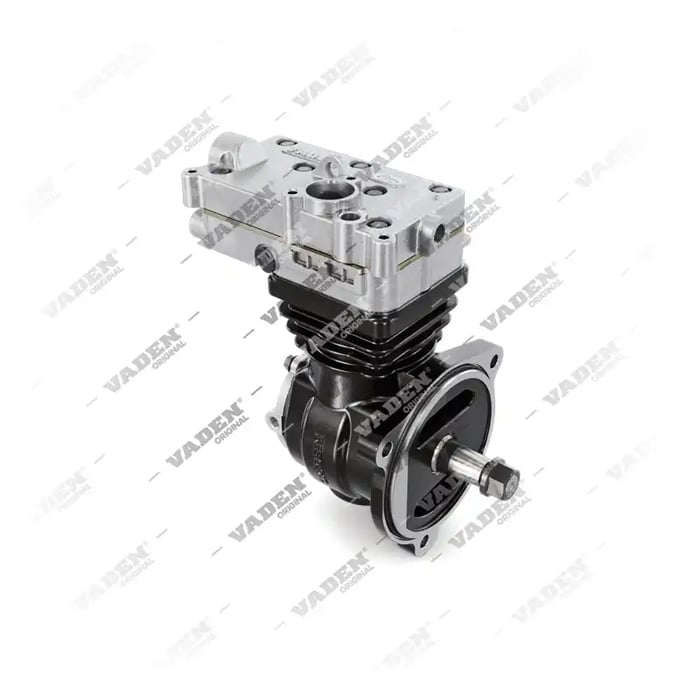
Need the part, not just the answer?
OE-grade air brake compressors and repair kits, manufactured and tested to commercial-vehicle standards.
Shop VADEN partsPublished by VADEN Original. Product links point to the manufacturer’s official catalogue. Specifications are general — always confirm figures against your vehicle’s service manual.