 airbrakecompressor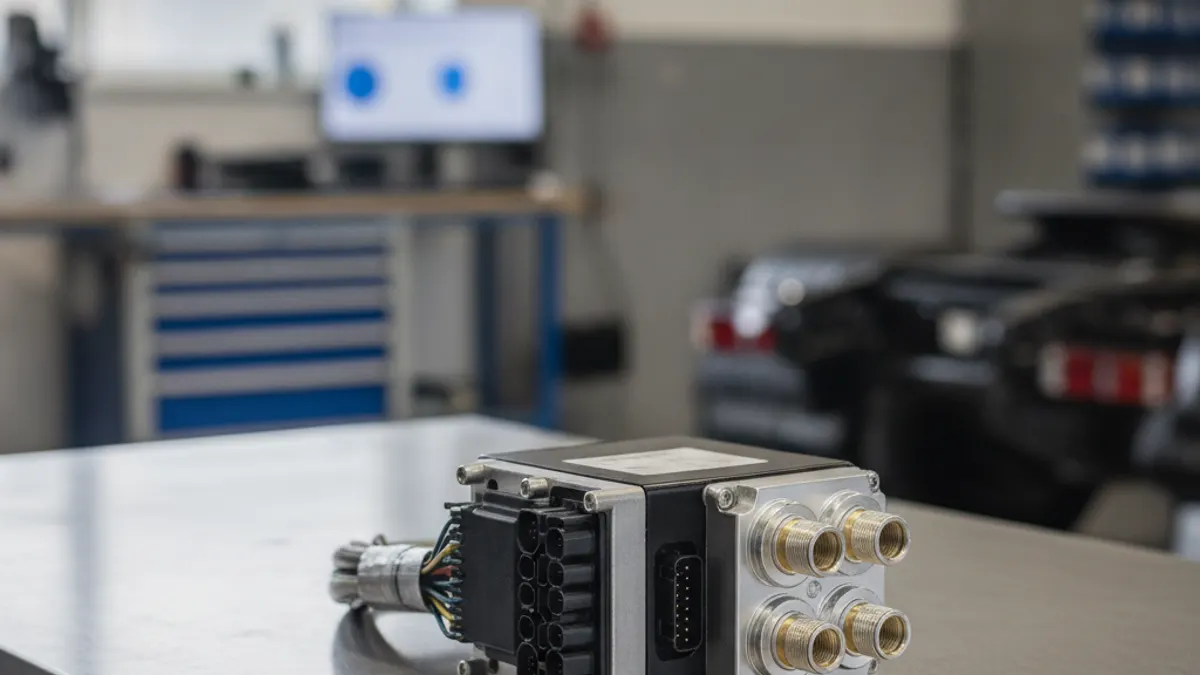
An EBS (electronic braking system) is an air brake system that is commanded electrically instead of purely pneumatically. When you press the pedal, a sensor reads how hard and how fast you pushed and sends that as an electrical signal to control modules at each axle, which then meter out compressed air to the brake chambers. The air still does the muscle work at the wheels — EBS replaces the slow-traveling air signal with a near-instant electrical one, and layers ABS, traction control, and diagnostics on top.
In practice that means the rear brakes on a tractor-trailer begin applying almost as quickly as the front, instead of waiting for an air pressure wave to travel the length of the vehicle. The result is a shorter, straighter, more balanced stop. If you want the fundamentals of the pneumatic side first, see how air brake systems work.
EBS vs conventional air brakes
A conventional air brake system is fully pneumatic: the foot brake valve sends an air pressure signal down the lines, and the relay valves and brake chambers respond to that pressure. It works, but air is slow to travel, so the rear of a long combination lags the front.
EBS keeps the full air system as a backup but adds an electrical control layer that reacts far faster and can adjust each axle independently.
| Feature | Conventional air brakes | EBS |
|---|---|---|
| Primary signal | Air pressure through the lines | Electrical signal to axle modules |
| Response time | Slower — air must travel the vehicle | Faster — signal is near-instant |
| Brake balance | Fixed by valve sizing and plumbing | Adjusted electronically, axle by axle |
| ABS / traction control | Add-on module | Integrated into the system |
| Backup if electronics fail | N/A | Pneumatic circuit still stops the truck |
| Diagnostics | Manual — gauges and leak checks | Stored fault codes via scan tool |
| Brake wear | Checked manually | Monitored and evened out automatically |
How EBS actually works
The pedal in an EBS truck houses an electronic sensor (often called a brake signal transmitter) alongside a conventional pneumatic valve. Press the pedal and the sensor reports demand to a central EBS control unit. That unit talks to pressure control modules mounted near each axle, and those modules release the right amount of air from the reservoirs into the brake chambers.
Because each axle has its own control module and its own wheel speed sensors, the system can do things a pure air system cannot:
- Brake balancing — it distributes braking force so no single axle or the trailer does more than its share, which evens out lining and drum wear.
- Load-sensing — it factors in how heavily the vehicle is loaded and adjusts pressure so an empty trailer does not lock up.
- Integrated ABS — anti-lock control is built in rather than bolted on, sharing the same wheel speed sensors. See ABS on air brakes for how that layer behaves.
- Coupling force control — on a tractor-trailer it manages how much the trailer brakes relative to the tractor, reducing "pushing" and jackknife risk.
The compressed air supply behind all this is unchanged. The air compressor still charges the reservoirs, the governor still cycles cut-out around 120–135 psi and cut-in around 100–110 psi, and the low-air warning still trips near 60 psi. EBS decides how the stored air is used; it does not make its own air.
Faster response and shorter stops
The biggest safety gain from EBS is reaction time. In a conventional system the signal to apply the brakes is a pressure change that physically has to travel from the pedal valve to the farthest chamber. On a long combination that delay is real, and it means the front brakes bite before the rear and trailer catch up — an unbalanced, longer stop.
EBS sends the electrical command to every axle module at effectively the same instant, then air is metered locally at each axle. The brakes come on together, more evenly, and the whole vehicle settles faster. Combined with continuous balancing, that shortens stopping distance and keeps the rig tracking straight instead of trying to pivot.
Built-in diagnostics
An EBS control unit monitors its own sensors and valves constantly. If a wheel speed sensor drops out, a module stops responding, or pressures fall outside expected ranges, the system logs a fault code and lights the dash warning. A technician reads those codes with a scan tool and goes straight to the affected component instead of chasing symptoms.
That is a shift from conventional troubleshooting, where a slow leak or a lazy valve is found by ear, soap spray, and gauge readings. For the classic pneumatic hunt, compare air brake system losing pressure — the mechanical failure modes are the same, but EBS often points you at them before they strand the truck.
What still fails on an EBS truck
EBS does not eliminate the wearing parts. You still have brake chambers, slack adjusters, S-cams, shoes, and drums doing the physical stopping, and they wear and need service on the same schedule. The compressor, air dryer, and reservoirs still supply the air. What EBS changes is how the brakes are commanded and monitored, not the foundation brake hardware.
The pneumatic backup
A fair question: what happens if the electronics quit? EBS is designed as a fail-safe system with a conventional pneumatic circuit underneath. If the electrical control is lost, the pedal's pneumatic valve still sends an air signal through the lines and the truck still stops — you lose the electronic refinements (balancing, integrated ABS behavior, faster response), but you do not lose braking. This redundancy is a legal and design requirement, not an optional extra.
Rule of thumb: EBS makes a good air brake system faster, smarter, and self-diagnosing — but the air, the compressor, and the foundation brakes are still doing the actual work, so maintain them exactly as you would on any air-braked truck.
Is EBS the same as EBS on trailers?
Trailer EBS is the trailer-side half of the same idea: an electronic control module on the trailer that meters air to the trailer's brakes and talks to the tractor over the electrical connection. It brings the same benefits — faster, balanced trailer braking, integrated ABS, and stored fault codes — to the unit behind the kingpin. On a matched tractor-and-trailer EBS setup, coupling force control keeps the two halves braking in proportion so the trailer neither drags nor shoves.
Whether the truck runs EBS or conventional air, the supply side sets the ceiling on everything else. A tired compressor or a saturated air dryer will undercut even the smartest EBS, so keep the charging system in good order.
When a stored code points at hardware rather than wiring, it is usually the unit metering the air that has failed, and that repair starts with the axle and trailer EBS modulators.
Source (VADEN Original): EBS Brake Modules
Need the part, not just the answer?
OE-grade air brake compressors and repair kits, manufactured and tested to commercial-vehicle standards.
Shop VADEN partsPublished by VADEN Original. Product links point to the manufacturer’s official catalogue. Specifications are general — always confirm figures against your vehicle’s service manual.