 airbrakecompressor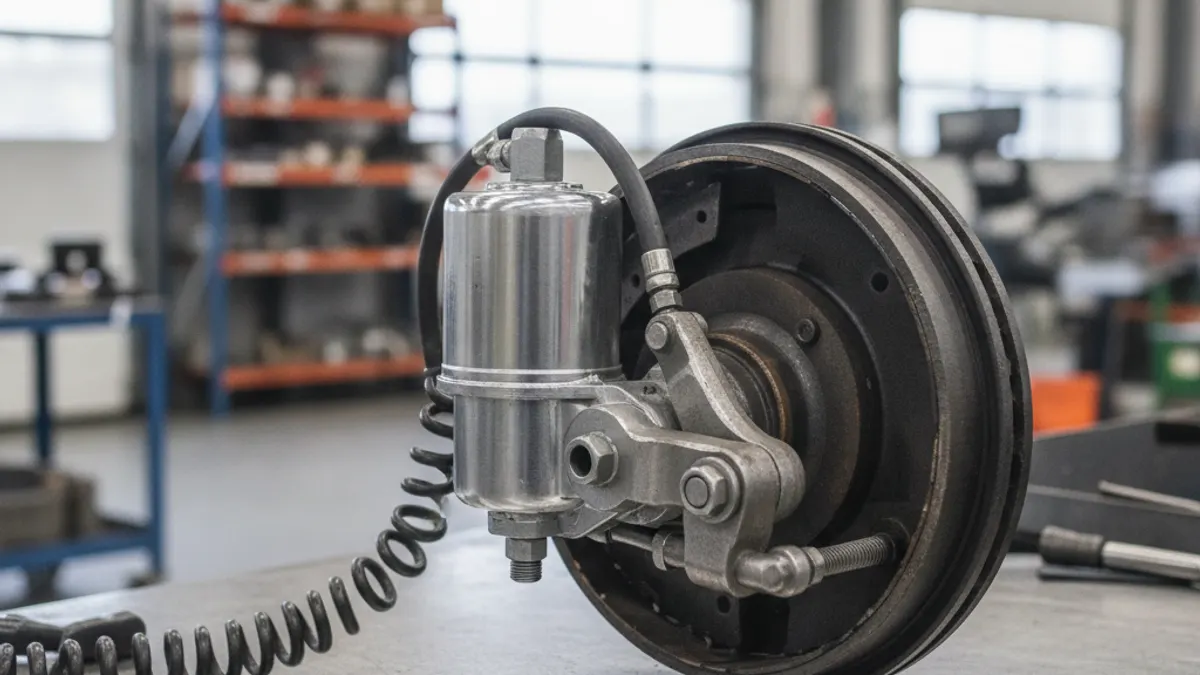
Bus and coach air brakes work on the same principle as truck air brakes: an engine-driven compressor charges the reservoirs, a governor controls when it loads and unloads, and driver-applied air pressure pushes brake chamber pushrods to apply the foundation brakes. It is a fully pneumatic system, not hydraulic. What changes on a bus is the architecture around that core. There is no trailer to charge or protect, air disc brakes are far more common than S-cam drums, a retarder does most of the slowing, and a set of interlocks ties the brakes to the passenger doors, the kneeling function and the wheelchair ramp.
If you already service tractors, the components will be familiar. The duty cycle is what catches people out: a city bus cycles its doors and air suspension hundreds of times per shift, and every cycle is air the compressor has to make.
What buses share with trucks
The charging side is essentially identical. A piston compressor mounted to the engine feeds a wet tank, an air dryer strips moisture and oil aerosol, and the dry tanks feed the service circuits. Pressures follow the same familiar targets.
| Function | Typical range | Notes |
|---|---|---|
| Governor cut-out | ~120-135 psi (~8.3-9.3 bar) | Compressor unloads; system at working pressure |
| Governor cut-in | ~100-110 psi (~6.9-7.6 bar) | Check the differential, not just the peak |
| Fully charged system | ~120 psi (~8.3 bar) | Baseline for leak-down and applied-leakage tests |
| Low-air warning | ~60 psi (~4.1 bar) | Buzzer and dash lamp, often with a cabin tone on coaches |
| Spring brake application | ~20-45 psi (~1.4-3.1 bar) | Parking and emergency brakes drag on as pressure falls |
These are diagnostic ranges, not a substitute for the spec sheet. Coach builders and transit specifications vary, so confirm exact figures against the manufacturer's current service literature.
The dual-circuit split is also shared. Every modern bus runs at least two independent service circuits, so a failure in one axle group leaves the other working, the same principle described in dual air brake systems. A multi-circuit protection valve at the wet tank isolates each circuit, and on buses it also protects the auxiliary circuits feeding suspension, doors and kneeling, so an air bag leak cannot drain the brake reservoirs.
Where bus and coach systems diverge
No trailer, but far more auxiliary air
A bus has no tractor protection valve, no gladhands and no trailer supply line. What it does have is a heavy auxiliary air load: leveling valves on every axle, kneeling valves that dump the curbside bags, door cylinders, often an air-operated ramp, and on articulated buses a second body's suspension. Hourly air consumption can exceed that of a loaded tractor-trailer.
Air disc brakes are the norm
Most modern coaches and a growing share of transit buses run air disc brakes rather than S-cam drums. That replaces slack adjusters and cam tubes on the maintenance list with caliper guide pins, pad wear sensors and rotor thickness checks. Fade resistance also matters more, since coaches descend long grades fully loaded. The trade-offs are covered under air disc vs drum brakes.
Retarders do most of the work
Coaches almost universally carry a retarder, either a hydrodynamic or electromagnetic driveline unit or an engine brake. On mountain routes the retarder is the primary speed control and the service brakes are held in reserve, which is why a coach can finish a long descent with cool foundation brakes. Blending is often automatic: the first pedal travel commands retarder torque before air reaches the chambers.
Interlocks tied to the doors
Transit buses use a brake-and-accelerator interlock, the feature technicians new to buses trip over. When the passenger door opens past a set threshold, a solenoid valve applies the rear service brakes and cuts throttle authority so the bus cannot move while passengers board. Close the door and it releases. If a bus will not release its brakes at a stop, check the door interlock and its switch before condemning a relay valve or chasing a stuck spring brake.
Chamber sizing and layout
Buses generally carry spring brakes on the drive axle only, sometimes on the tag axle as well, with service-only chambers on the steer axle. Chamber sizes often differ from heavy-truck equivalents because axle loads are lower and disc actuators use a high-ratio internal lever, so never substitute a chamber by eye; match type and stroke to the build sheet.
Duty cycle and service intervals
How hard the compressor works is the single biggest reliability factor on a bus air system. A highway coach at steady cruise runs a modest duty cycle. A city bus stopping every couple of blocks, kneeling and cycling doors keeps the compressor loaded much of the time, raising discharge temperature, carbonizing oil in the discharge line and pushing moisture past the dryer.
| Item | City transit | Highway coach |
|---|---|---|
| Air dryer cartridge | Shorten interval; high moisture and oil carryover | Standard interval usually adequate |
| Compressor inspection | Check discharge line for carbon at every major service | Monitor for oil passing at longer intervals |
| Tank draining | Critical if the dryer is marginal; check the wet tank weekly | Check at scheduled service |
| Foundation brakes | High cycle count, moderate energy per stop | Lower cycle count, high energy on grades |
| Retarder | Often fitted, moderate use | Heavy use; check fluid or coil condition |
An overworked charging system shows the same symptoms as on a truck: slow build times, water and oil at the tank drains, and eventually a compressor that will not hold pressure under load, so the guidance on a compressor not building pressure applies directly. On a bus, add one step first: isolate the auxiliary circuits, because a leaking kneeling valve or door cylinder masquerades as a weak compressor.
Inspection and passenger-safety considerations
Buses are inspected more aggressively than freight vehicles: a brake defect on a coach carrying fifty passengers carries a different consequence than the same defect on a box trailer. Practical implications for the shop:
- Pre-trip discipline. Applied-leakage, low-air-warning and spring-brake-application checks before every service run. On disc-braked buses, add a visual pad thickness check through the caliper window.
- Out-of-service criteria apply per axle. Defective brakes counted against the vehicle total sideline a bus quickly, and the steer axle gets the least tolerance.
- Interlock function is a safety item. A door interlock that fails to apply the brakes lets a bus creep while passengers board. Test it, do not assume it.
- Spring brake release procedure. Crews should know where the caging tools live and how to use them; a coach stranded on a live roadway is its own hazard.
- Cabin noise as a diagnostic. Passengers hear leaks a driver never would, so chase a hiss reported from a wheel arch.
Rule of thumb: verify the interlocks and auxiliary circuits before condemning a brake component. More transit brake faults are door switches, kneeling valves and suspension leaks than foundation brake failures.
Common bus-specific faults
- Slow air build in city service. Usually a saturated air dryer plus an auxiliary leak rather than a failed compressor. Measure build time with the auxiliaries isolated.
- Bus applies its own brakes at a stop. Door interlock engaged, or a sticking door switch. Confirm the door is fully closed and the switch is making.
- Kneeling slow or one-sided. Leveling or kneeling valve, or a collapsed air bag. This drags system pressure down and can trip the low-air warning at stops.
- Retarder not engaging. Dumps all deceleration onto the service brakes, producing rapid pad wear and fade complaints on descents.
- Oil at the tank drains. Compressor passing oil, aggravated by high duty cycle. Confirm the discharge line is clear before fitting a new compressor, or it suffers the same fate.
If you understand how a truck system charges, splits into circuits and applies pressure to the chambers, you can work on a bus. Learn the interlocks, respect the duty cycle, and treat the auxiliary air circuits as a first-line suspect.
Because doors, kneeling and suspension air all draw on the same supply, a coach compressor works far harder than a tractor's — specify on duty cycle, not weight, when you look at heavy-duty air compressors.
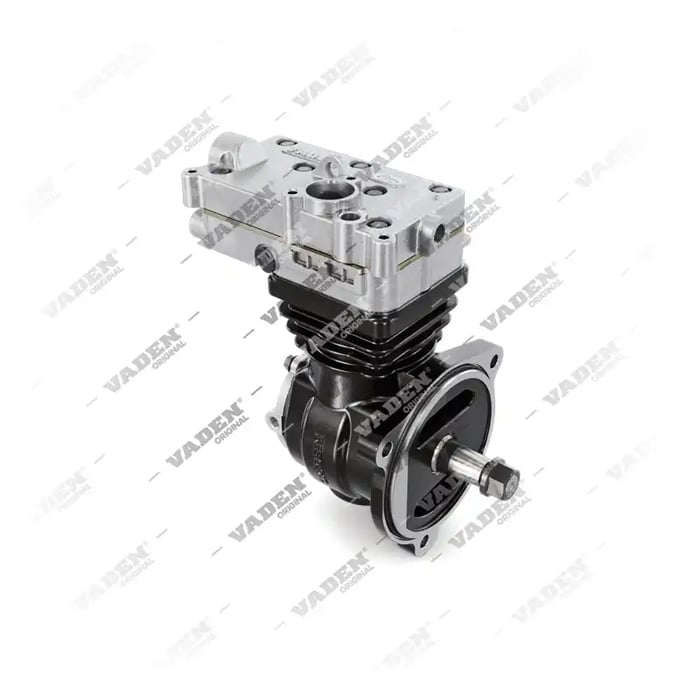
Need the part, not just the answer?
OE-grade air brake compressors and repair kits, manufactured and tested to commercial-vehicle standards.
Shop VADEN partsPublished by VADEN Original. Product links point to the manufacturer’s official catalogue. Specifications are general — always confirm figures against your vehicle’s service manual.