 airbrakecompressor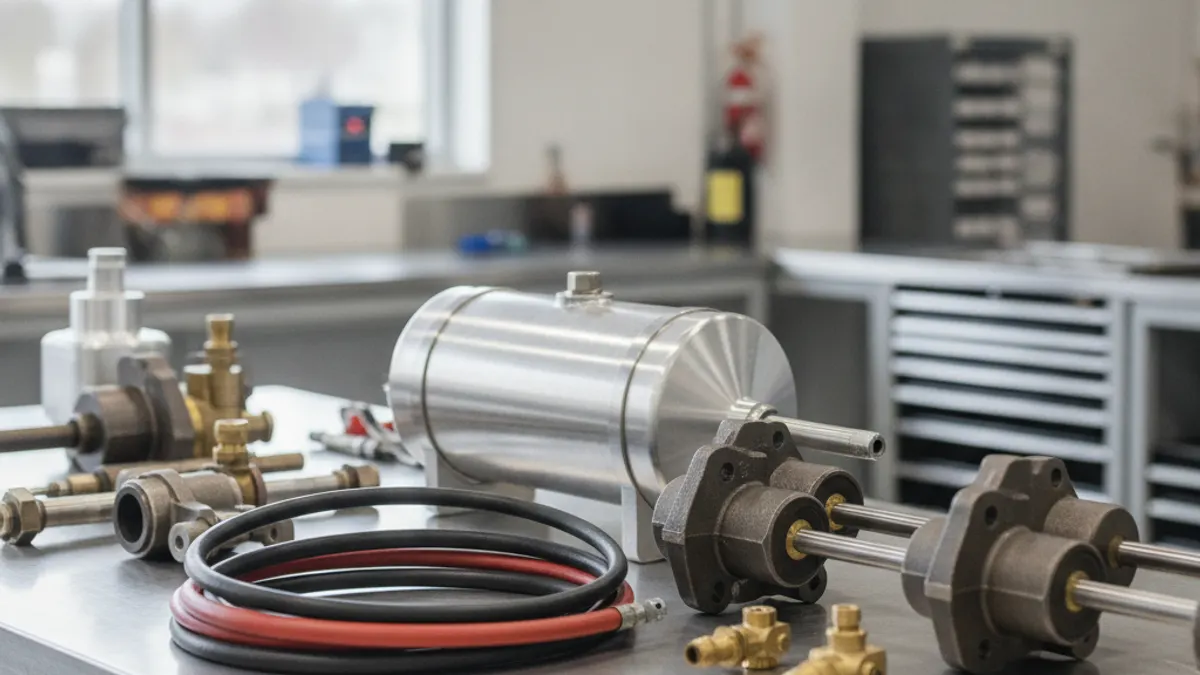
FMCSA air brake regulations live mainly in the Federal Motor Carrier Safety Regulations (FMCSRs), Parts 393 (equipment) and 396 (inspection and maintenance), and they set the minimum standards a commercial vehicle's pneumatic air brake system must meet. In short: the truck needs a low-air warning that trips at or before 60 psi, air-loss rates must stay under tight limits, every brake must be within its adjustment (pushrod stroke) limit, and the system must be periodically inspected by a qualified person. Enforcement at roadside follows the Commercial Vehicle Safety Alliance (CVSA) out-of-service criteria.
These rules apply to trucks, truck-tractors, buses, and trailers operated in interstate commerce. Below is a technician's breakdown of the provisions that actually get checked — and the numbers you need to pass.
Required Warning Devices and Gauges
Under 49 CFR 393.51, any vehicle with air brakes must have a signal — visible or audible — that warns the driver when system pressure drops to a dangerous level. The threshold is set no lower than one-half of the compressor governor cut-out, and in practice the warning must activate at or above 60 psi. On a typical system with governor cut-out around 120-135 psi and cut-in near 100-110 psi, a low-air buzzer and dash light coming on around 60 psi is what you want to see.
The vehicle also needs a pressure gauge readable from the driver's seat showing reservoir pressure. During a seven-step air brake check, verifying the low-air warning and gauge operation is a required step — a dead warning device is an automatic failure and an out-of-service condition.
Air-Loss (Leakage) Limits
FMCSA and CVSA set maximum permissible air-loss rates for a static leak test — engine off, system fully charged near 120 psi, brakes released, then brakes applied. If a vehicle bleeds down faster than these limits, it fails.
| Condition | Single vehicle (truck/bus) | Combination (tractor-trailer) |
|---|---|---|
| Brakes released, engine off | 2 psi in 1 minute | 3 psi in 1 minute |
| Brakes fully applied, engine off | 3 psi in 1 minute | 4 psi in 1 minute |
Excess leakage points to a failing fitting, a leaking chamber diaphragm, a bad valve, or a tired governor and unloader. Work through the source of the leak before condemning the compressor, and understand how air brake systems work so you know where pressure should hold and where it commonly escapes.
Brake Adjustment and Pushrod Stroke
Out-of-adjustment brakes are the single most common air-brake violation at roadside. FMCSA requires that brakes be maintained so the pushrod stroke — the distance the chamber rod travels when brakes are applied — stays within the manufacturer's and CVSA limits for that chamber type and size. Beyond the limit, the foundation brake loses mechanical advantage and braking force drops off fast.
Adjustment depends on chamber type and size. Common examples of maximum applied stroke:
| Chamber type / size | Approx. maximum stroke |
|---|---|
| Standard clamp type 30 | 2.0 in |
| Standard clamp type 24 | 1.75 in |
| Standard clamp type 20 / 16 | 1.75 in |
| Long-stroke type 30 | 2.5 in |
| Long-stroke type 24 | 2.0 in |
Always confirm the marking on the chamber — long-stroke and standard chambers look similar but have different limits, and mixing them up will get a truck placed out of service. Manual slack adjusters must be checked and reset by hand; automatic slack adjusters should never be manually adjusted to mask a fault. If a brake is out of stroke, the fix is the slack adjuster or the brake chamber, not a band-aid.
Inspection, Repair, and Qualified Personnel
Part 396 governs inspection and maintenance. Every commercial vehicle must pass a periodic (annual) inspection covering the brake system, and the carrier must keep the required records. Under 49 CFR 396.25, anyone who inspects, repairs, or performs maintenance on the brakes must be a qualified brake inspector — meaning they have the training or experience and the tools to do the work correctly. Drivers are also required to perform a pre-trip and post-trip review of brake condition and note defects on the Driver Vehicle Inspection Report (DVIR).
A practical air brake pre-trip inspection covers governor cut-in and cut-out, low-air warning, static leak-down, brake adjustment, and mechanical condition of chambers, hoses, and slack adjusters. Catching a defect in the yard is far cheaper than catching it at a scale.
Roadside Enforcement and Out-of-Service Criteria
DOT and state officers use CVSA out-of-service criteria during roadside and DOT inspections. Key triggers that place a vehicle out of service include:
- 20% rule: if 20% or more of the vehicle's brakes are defective (out of adjustment, missing, broken, or non-functioning), the unit is out of service.
- Any brake out of stroke beyond the adjustment limit counts as a defective brake toward that 20%.
- Inoperative low-air warning device.
- Air loss exceeding the permissible leakage rate.
- Mismatched, cracked, or leaking chambers, or a non-functioning tractor protection system.
The theme running through every one of these rules is the same: the system has to build, hold, and apply pressure predictably, and every foundation brake has to do its share of the work.
Regulations set the floor, not the goal. A system that just barely passes a leak-down test is a system that's already telling you a fitting, valve, or diaphragm is on its way out.
Related Standards Worth Knowing
Beyond Parts 393 and 396, drivers must hold the proper CDL air brake endorsement to operate air-braked vehicles. And because moisture is a system killer, keeping a working air dryer and draining the tanks routinely supports every leakage and warning-device requirement above. Meeting FMCSA standards is not a once-a-year event; it is the running condition of a properly maintained system.
Need the part, not just the answer?
OE-grade air brake compressors and repair kits, manufactured and tested to commercial-vehicle standards.
Shop VADEN partsPublished by VADEN Original. Product links point to the manufacturer’s official catalogue. Specifications are general — always confirm figures against your vehicle’s service manual.