 airbrakecompressor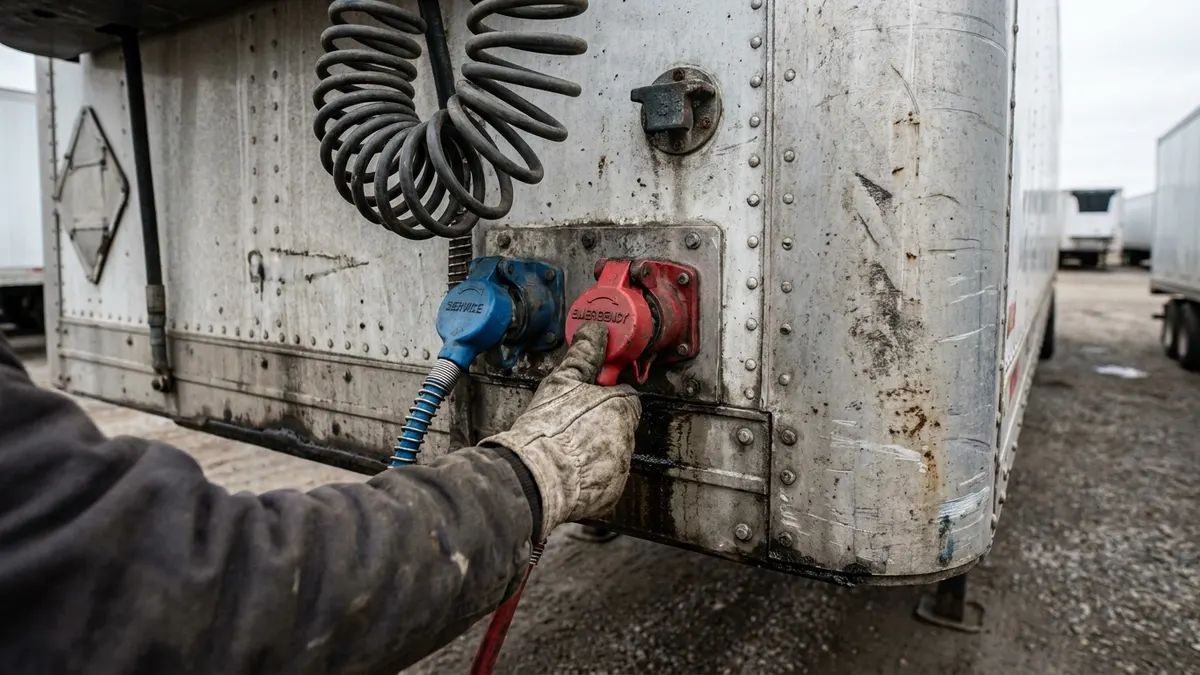
A Duomatic coupling head is the self-sealing connector that joins the compressed-air brake circuits between a towing vehicle and its trailer or drawbar trailer in European practice. In its strict sense the name describes a combined coupling that carries both the supply and the control circuit inside one keyed housing and connects them in a single movement; in everyday parts-counter use across Europe the same word is applied to the red and yellow palm-style coupling heads sold in pairs. Either way the function is identical: a leak-tight, quick-release, colour-coded pneumatic joint that seals itself the instant it is parted, so the towing vehicle does not dump its reservoirs when a trailer is dropped.
These are compressed-air connections working at system pressure, not hydraulic fittings. On a healthy vehicle the governor cuts out somewhere in the 120-135 psi band and cuts back in around 100-110 psi, with the system sitting near 120 psi fully charged. Everything downstream of the coupling head — trailer reservoirs, relay valve, spring brake chambers — depends on that supply arriving without restriction.
Duomatic, palm coupling or gladhand?
The three terms describe the same point in the system solved three different ways. North American practice uses two separate gladhands with a flat face, a rubber seal and a quarter-turn mating action, and the heads themselves are open — the shut-off is done upstream at the tractor protection valve. European coupling heads normally carry an internal spring-loaded check valve in the head itself, so an uncoupled head does not vent. The true Duomatic combined coupling goes one step further and merges both circuits into a single body.
| Type | Circuits per connector | Self-sealing head | Typical region |
|---|---|---|---|
| Gladhand | One | No — sealed at the coupling face only | North America |
| Palm coupling head | One | Usually, via an internal check valve | Europe, Middle East, much of Asia |
| Duomatic combined coupling | Two in one body | Yes, both circuits | Europe, common on drawbar trailers |
If you work on North American equipment, the flat-face palm connector and its seal are covered separately under gladhands and air lines; the failure modes overlap, but the parts do not interchange.
Red supply, yellow service
European colour coding differs from the North American convention, and mixing the two up is the fastest way to create a dangerous coupling error. Red is the supply, yellow is the control.
| Line | Colour | What it does | What happens if it fails |
|---|---|---|---|
| Supply (emergency) | Red | Charges the trailer reservoirs and holds the spring brakes released | Trailer brakes apply automatically as pressure falls; spring brakes take hold roughly between 20 and 45 psi |
| Service (control) | Yellow | Carries the driver's brake demand signal to the trailer relay valve | Little or no trailer braking on demand; the tractor does all the work |
The dash low-air warning device should be sounding well before the spring brakes intervene, typically around 60 psi. A supply-line leak at a coupling head is therefore not a slow nuisance — it is a fault that will eventually park the combination on the road.
Sizes, threads and identification
Coupling head geometry and interchangeability between towing vehicle and trailer are set by the international and DIN standards behind European air brake connections, and the braking behaviour itself by UNECE R13. What you actually order, though, comes down to three things: connection thread, tube size and the orientation of the head on the mounting bracket.
| Detail | Common values | Notes |
|---|---|---|
| Connection thread | M16x1.5, M22x1.5 | Measure the male thread on the head, not the hose end |
| Tube / hose size | Commonly 12 mm and 16 mm outside diameter | Larger bore is normally reserved for the supply circuit |
| Body colour | Red supply, yellow service | Colour is a warning aid, not a substitute for checking the marking |
| Valve arrangement | With or without integral check valve | A non-valved head fitted to a valved position will vent the circuit when uncoupled |
Do not confuse the coupling head thread with the M16x1.5 test connector used for gauge work on the same circuits; they look similar and are not interchangeable in function. Thread, seat form and sealing method for the rigid pipework are covered under air brake hoses and fittings.
What actually wears out
Two parts do the work and two parts fail. The face seal — a moulded rubber ring in the mating surface — hardens, takes a set and eventually splits, giving the classic steady hiss when the units are coupled and a compressor that cycles more often than it should. The internal check valve and its spring collect moisture, oil carry-over and grit; when the plunger sticks the trailer is slow to charge, slow to release, or drags on one axle group.
Contamination is the root cause behind most of it. An uncoupled head left hanging on the hose collects road spray and grit within a single wet shift, and that debris is delivered straight into the trailer valves at the next hook-up. Dummy couplings on the headboard are not decoration. Keeping the air dryer and its cartridge in good order matters just as much, because a wet system attacks the seal material from the inside.
Preventing cross-connection
Cross-connecting supply and service leaves the trailer without a charging circuit while the control circuit sits at line pressure — depending on the valve arrangement, that means an immobilised combination with the spring brakes still applied, or a trailer that will not brake when the pedal is pressed. A combined Duomatic body removes the risk entirely because the keyed housing only mates one way. With separate heads, the barriers are weaker: colour, the marking cast into the body, and hose lengths routed so the wrong head cannot physically reach. Some head designs are profiled so a supply unit will not latch to a service unit, but many are not, so treat colour discipline as a hard rule rather than a preference. The circuit logic behind all of this is set out under semi-trailer air brake systems.
Inspection, leak checking and replacement
With the combination coupled and charged, listen at each head with the system at rest, then again with the service brake applied and held. Soapy water on the mating faces and on the union behind the head will find what your ear misses. Run the applied and released leakage test to the limit specified for the vehicle and country of operation, and treat a coupling head as the first suspect when the released reading is poor but the chambers are dry.
To replace a head, drain the reservoirs and confirm the circuit is at zero before unscrewing anything. Fit new sealing rings on both units rather than one, avoid PTFE tape that can shred and migrate into the check valve, and use only the sealant the manufacturer specifies on the thread. Do not over-torque an alloy body onto a steel bracket. Replacement heads, dummy couplings, sealing rings and the associated unions are catalogued together under VADEN Original's connection components and coupling range, which is the practical way to match thread and valve type before you commit. Recharge, repeat the leak test, then confirm trailer response and release on a low-speed check before the vehicle goes back into service.
Need the part, not just the answer?
OE-grade air brake compressors and repair kits, manufactured and tested to commercial-vehicle standards.
Shop VADEN partsPublished by VADEN Original. Product links point to the manufacturer’s official catalogue. Specifications are general — always confirm figures against your vehicle’s service manual.