 airbrakecompressor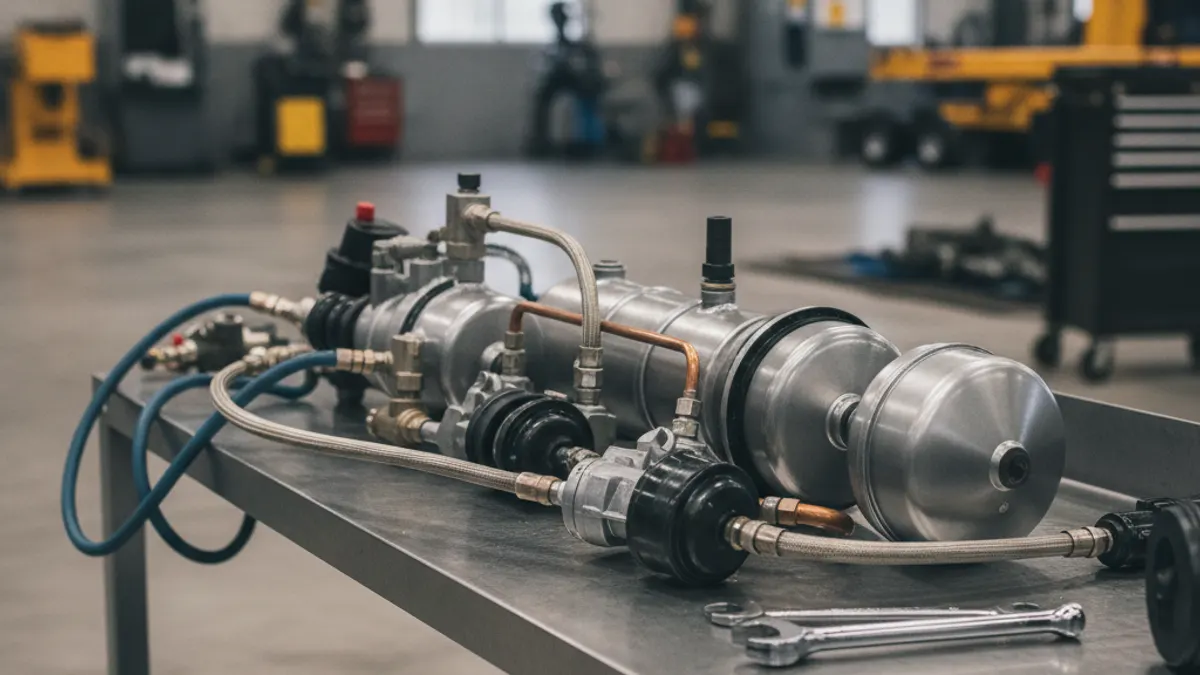
A semi-trailer air brake system is a pneumatic system fed from the tractor through two hoses: a supply line (also called the emergency line, red gladhand) and a service line (control line, blue gladhand). The supply line charges one or more reservoirs on the trailer so the trailer carries its own air. The service line carries no working air at rest and acts purely as a signal, telling valves on the trailer how hard to apply. If the supply line loses pressure, whether from a burst hose, a dropped trailer or a breakaway, the trailer applies its brakes automatically.
That split is the most important idea in trailer braking. The tractor does not push air 53 feet down the trailer every time you touch the pedal. It sends a pressure signal, and stored air already sitting a few feet from the wheel ends does the work.
The two air lines
Supply line (emergency line, red)
The red gladhand feeds trailer supply air. When the driver pushes in the red octagonal trailer air supply knob on the dash, the tractor protection valve opens and system air flows back to fill the trailer reservoir. This line stays pressurized the whole time you are driving, normally at full system pressure in the neighborhood of 120 psi once the governor cuts out. Its second job is to act as a dead-man circuit: pressure in this line is what holds the trailer's spring brakes released.
Service line (control line, blue)
The blue gladhand carries only what the foot valve or the trailer hand valve commands. Press the pedal halfway and the service line sees a partial pressure; press it hard and it sees close to reservoir pressure. That signal reaches the trailer relay valve, which opens a large local port and feeds the brake chambers from the trailer tank. When you release, the relay valve exhausts chamber air to atmosphere right there on the trailer instead of back up the line.
Component by component
| Component | Function | Notes for the tech |
|---|---|---|
| Gladhands and hoses | Couple tractor supply and service air to the trailer | Red = supply, blue = service; seals and filter screens are common leak sources |
| Tractor protection valve | Seals off tractor air if the trailer line fails | Closes automatically as supply pressure falls, roughly in the 20 to 45 psi band |
| Trailer reservoir(s) | Store air locally for the trailer service and spring brakes | Drain valve at the low point; drain regularly, especially in cold weather |
| Spring brake control valve (relay-emergency valve on older units) | Charges the tank, releases spring brakes, triggers emergency application | Older trailers use a combined relay-emergency valve; modern ones use a dedicated spring brake valve plus a service relay valve |
| Relay valve | Speeds application by feeding the chambers from the trailer tank | Sticking or sluggish relays are a top cause of slow trailer response and brake drag |
| Service brake chambers | Convert air pressure into pushrod force | Sized by type number; stroke must stay inside the adjustment limit |
| Spring brake (piggyback) chambers | Park and emergency braking by mechanical spring force | Air holds the spring compressed; air loss applies the brake |
| Foundation brake: S-cam drum or air disc | Turns pushrod force into friction at the wheel | S-cam trailers use slack adjusters that still need greasing and stroke checks; air disc axles use a caliper with internal adjustment |
| ABS modulator valves and ECU | Cycle chamber pressure to prevent wheel lockup | Powered through the blue auxiliary circuit of the seven-way connector |
What happens when you charge the system
- The engine-driven compressor builds pressure until the governor cuts out, typically somewhere in the 120 to 135 psi range, and cuts back in around 100 to 110 psi.
- The driver pushes in the trailer air supply knob. The tractor protection valve opens and supply air travels down the red line.
- Trailer reservoir pressure climbs. The spring brake control valve holds the spring brakes applied until pressure is high enough to release them safely, normally around 60 psi and up.
- Once the trailer tank is near tractor pressure, the trailer is charged and the spring brakes are fully released by air.
Reverse that order and you have the emergency logic. As pressure falls through roughly 45 psi the springs start to apply, and by about 20 psi the trailer is locked down. A low-air warning buzzer and light on the tractor should be alerting the driver well before that, at approximately 60 psi.
| Condition | Approximate pressure |
|---|---|
| Governor cut-out (compressor unloads) | 120 to 135 psi |
| Governor cut-in (compressor loads) | 100 to 110 psi |
| Normal fully charged running pressure | around 120 psi |
| Low-air warning device activates | about 60 psi |
| Spring brakes begin to apply / valves trip | 45 psi down to 20 psi |
Use these as diagnostic ranges only. Exact cut-in, cut-out and trip points are set by the vehicle and valve manufacturer, and the current service manual for that unit is always the authority.
Applying, releasing and emergency behavior
Under normal service braking, the foot valve meters air into both the tractor circuits and the trailer service line. The trailer relay valve sees that signal and applies the trailer brakes almost in step with the tractor. A trailer hand valve (Johnson bar) applies the trailer service brakes only and is a test and low-speed tool, not a hill-holding or emergency device.
If the supply line ruptures, pressure on the trailer side collapses. The tractor protection valve closes to preserve tractor air, and the trailer's spring brakes apply on their own without any driver input. That is why you never cage a spring brake chamber to move a trailer on the road, and why a red knob that keeps popping back out points to a real leak rather than a bad knob.
Trailer ABS
Modern semi-trailers carry an ABS ECU, wheel speed sensors and modulator valves that sit between the relay valve and the chambers. The system takes constant power from the blue auxiliary circuit of the SAE J560 seven-way connector, and an external ABS warning lamp on the trailer's left side shows the state of the system: the lamp should light briefly at key-on, then go out. A lamp that stays on means the trailer still has full air braking but has lost anti-lock function on one or more wheel ends, usually from a sensor gap, a corroded connector or a modulator fault rather than a mechanical brake problem.
Inspection and service points that matter
- Drain the reservoirs. Water and oil collected in the trailer tank ruin valves and freeze lines in winter.
- Check pushrod stroke at each chamber with the system fully charged and a firm application. Any chamber at or past its adjustment limit is an out-of-service condition.
- Do the applied leakage test. With the brakes applied and the engine off, pressure loss should be small and steady; a fast bleed-down means a leaking chamber diaphragm, relay valve or fitting.
- Inspect gladhand seals and hose chafe points behind the cab, where flexing and road spray do the most damage.
- Replace valves and chambers with OE-grade parts. Response timing on the trailer is engineered, and a mismatched relay or chamber changes how quickly the trailer picks up load. VADEN Original supplies OE-quality air brake system components for trucks and trailers across the common heavy-duty platforms.
The trailer half of an air brake system is simple in principle and unforgiving in practice. Keep the supply line healthy, keep the tank dry, keep stroke inside limits, and the rest of the system does what it was designed to do.
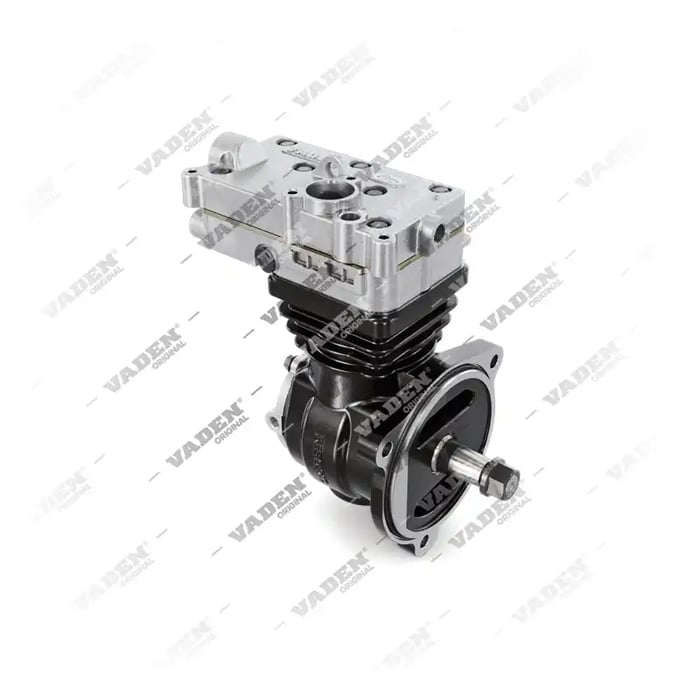
Need the part, not just the answer?
OE-grade air brake compressors and repair kits, manufactured and tested to commercial-vehicle standards.
Shop VADEN partsPublished by VADEN Original. Product links point to the manufacturer’s official catalogue. Specifications are general — always confirm figures against your vehicle’s service manual.