 airbrakecompressor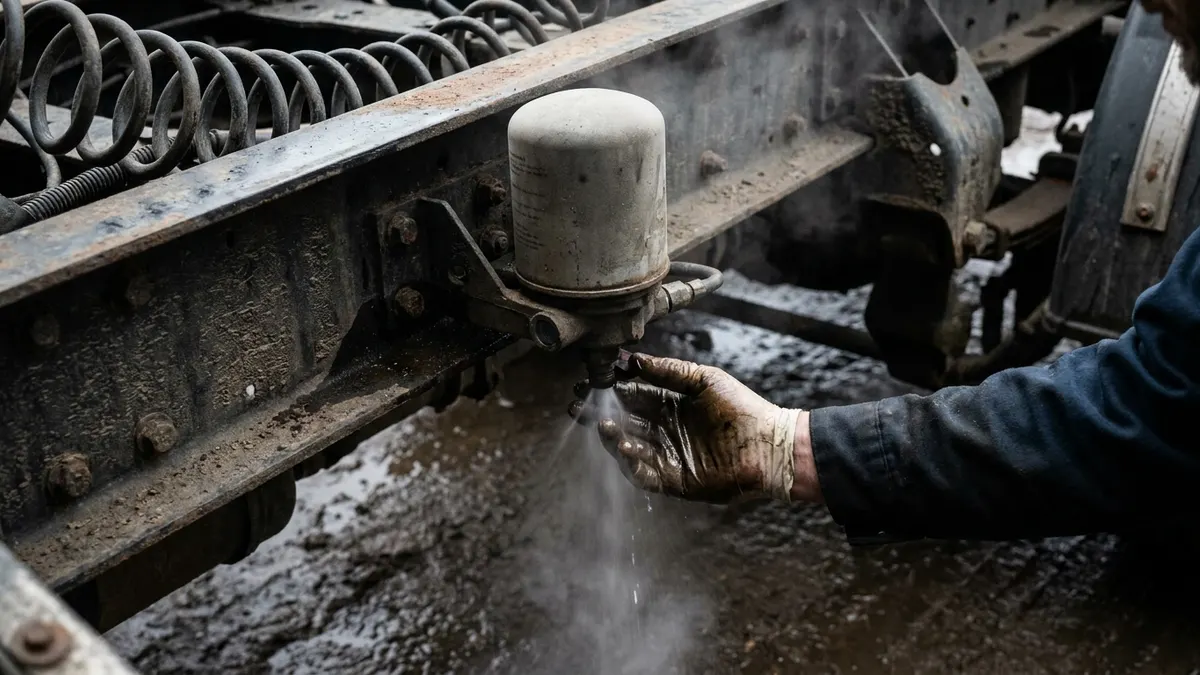
An air compressor that cycles too often is telling you the system cannot hold the air it makes. On a healthy truck the governor cuts out somewhere around 120-135 psi, the compressor unloads, and pressure sits near the fully charged mark of roughly 120 psi until normal brake applications and accessory use drag it down to the cut-in point of about 100-110 psi. If that swing takes seconds instead of minutes, you are chasing one of three things: a leak, a governor whose differential has narrowed or drifted, or an unloader or air dryer fault that vents air back out as fast as the compressor pumps it.
What counts as short cycling
There is no single stopwatch number that fits every vehicle. A coach on air suspension, a dump truck with an air-shift PTO, or a tractor pulling a tired trailer all consume more air than a straight truck idling in the yard. What matters is the pattern, measured with the vehicle parked, chocked, and nothing else operating:
- Normal: pressure holds at cut-out for several minutes with no compressor loading and no air dryer purge.
- Suspect: the dryer purges about once a minute with the truck standing still and no air being used.
- Bad: the compressor spends more time loaded than unloaded, or you hear a purge every few seconds.
An air brake compressor is sized to spend most of its life unloaded. Once it pumps most of the time it runs hotter, carries more oil past the rings, and cokes the discharge line, which is why short cycling that gets ignored usually ends as a compressor and air dryer job instead of a cheap fitting.
Put numbers on it before condemning parts
Charge the system to cut-out, shut the engine off, chock the wheels, release the brakes, and watch the dash gauges against a watch. The leakage limits every driver learns for the pre-trip inspection are the same numbers a technician should use here.
| Test condition | Single vehicle | Combination vehicle |
|---|---|---|
| Engine off, brakes released | 2 psi per minute maximum | 3 psi per minute maximum |
| Engine off, full brake application held | 3 psi per minute maximum | 4 psi per minute maximum |
Which test fails tells you where to look. Excess loss with the brakes released points at the supply side and the park or emergency circuit: tanks, dryer, governor, check valves, supply lines, tractor protection valve, spring brake plumbing. Excess loss only with the pedal applied points at the service side: foot valve, relay valves, service lines, service chambers and diaphragms.
Cause 1: leaks, by a wide margin
Most short-cycling complaints are ordinary leaks that have grown past the point where the compressor can stay ahead of them while the truck stands still. Work the system with soapy water in a quiet shop and check the usual suspects first.
- Air dryer purge valve seeping continuously instead of only at each governor unload.
- Manual tank drain valves and cable-operated drains not seating.
- Gladhand seals and trailer service or supply lines when the truck is coupled.
- Brake chamber diaphragms, especially on the service side after a long-stroke condition.
- Push-to-connect fittings, nylon tubing rubbed through on a frame rail, and heat-hardened rubber hose.
- Relay valve exhaust ports weeping with the brakes released.
A leak big enough to short-cycle a compressor is usually audible with the engine off. If it is not, work section by section instead of wandering the frame; our walkthrough on finding an air leak fast covers isolating the tractor from the trailer and the service circuit from the supply circuit.
Cause 2: the governor differential has closed up
The governor differential is the gap between cut-out and cut-in, and on most trucks it is roughly 20-25 psi. When that gap narrows, the compressor cycles constantly even on a system that is holding air perfectly, because the governor calls for pressure again almost as soon as it unloaded.
Read the real numbers off a gauge you trust rather than a dash gauge you suspect. Note cut-out and cut-in over several cycles, then compare them with the vehicle manufacturer service data. Common findings:
- Cut-in sitting unusually close to cut-out because of a weak or dirty internal spring and piston.
- Cut-out drifting low, so normal accessory use pulls pressure back to cut-in almost immediately.
- Corrosion or oil sludge in the governor bore making it hunt around one point.
- Someone has already turned the adjusting screw to mask a leak.
Governors are inexpensive relative to the labor of chasing the symptom, and they are not meant to be adjusted forever. If the differential will not hold a stable range, replace it and verify the new settings. There is more detail on the mechanism and its adjustment in our guide to the air brake governor.
Cause 3: the unloader or air dryer never lets pressure settle
At cut-out, unloader air holds the compressor inlet valves open so it pumps against nothing while the air dryer purges collected water and oil. Two failures in that circuit look exactly like short cycling.
Unloader leaking or only partly seated
A worn unloader piston, seal, or plunger can bleed off governor signal air, or hold the compressor partly loaded so it never fully rests. The result is a compressor that keeps building and a dryer that keeps spitting. Our page on the air brake unloader valve explains how the signal path and the mechanical stop work together.
Dryer check valve or purge valve leaking backward
If the dryer outlet check valve leaks, wet tank pressure escapes through the purge port each time the dryer opens, and the compressor has to make that air all over again. A saturated desiccant cartridge or an oil-fouled coalescing filter adds load and shortens the life of the next cartridge at the same time.
Quick reference
| What you observe | Most likely cause | Next check |
|---|---|---|
| Purge every few seconds, parked at idle | Downstream leak or leaking dryer check valve | Timed leakage test; soap the dryer and wet tank |
| Cut-in and cut-out only a few psi apart | Governor differential collapsed | Gauge both points and compare to the OE spec |
| Cycles only with a trailer coupled | Trailer or gladhand leak | Repeat the leakage test bobtail |
| Cycles only after a brake application | Service circuit leak | Applied leakage test; soap chambers and relay valve |
| System holds air but the compressor still loads often | Governor or unloader signal fault | Verify unloader air is present at cut-out |
| Oil at the dryer purge, very hot discharge line | Worn compressor, accelerated by short cycling | Discharge line restriction and compressor condition |
When the compressor itself is at fault
A compressor with leaking discharge valves lets tank air bleed back through the head on every cycle, so the tanks fall and the unit reloads sooner than it should. Worn rings and a carbon-restricted discharge line make it worse by driving discharge temperature up. Once you have proven the system holds air and the governor differential is correct, inspect the discharge line for carbon, check the unloader bore, and decide whether a repair kit or a replacement unit is the right call. Fitment by engine and OE number matters at that point, and the OE-grade air brake compressor range from VADEN cross-references the common Bendix, Wabco, Knorr-Bremse and truck OEM applications.
Never widen a governor range to stop a compressor from cycling. You are hiding a leak, and you are moving working pressure away from what the vehicle manufacturer specified for the rest of the brake system.
Fix the leak, restore the correct differential, then confirm the repair the same way you found the fault: charge to cut-out, shut the engine down, and time the pressure drop against the limits above.
Source (VADEN Original): Air Brake Compressor Duty Cycle & Efficiency Guide
Need the part, not just the answer?
OE-grade air brake compressors and repair kits, manufactured and tested to commercial-vehicle standards.
Shop VADEN partsPublished by VADEN Original. Product links point to the manufacturer’s official catalogue. Specifications are general — always confirm figures against your vehicle’s service manual.