 airbrakecompressor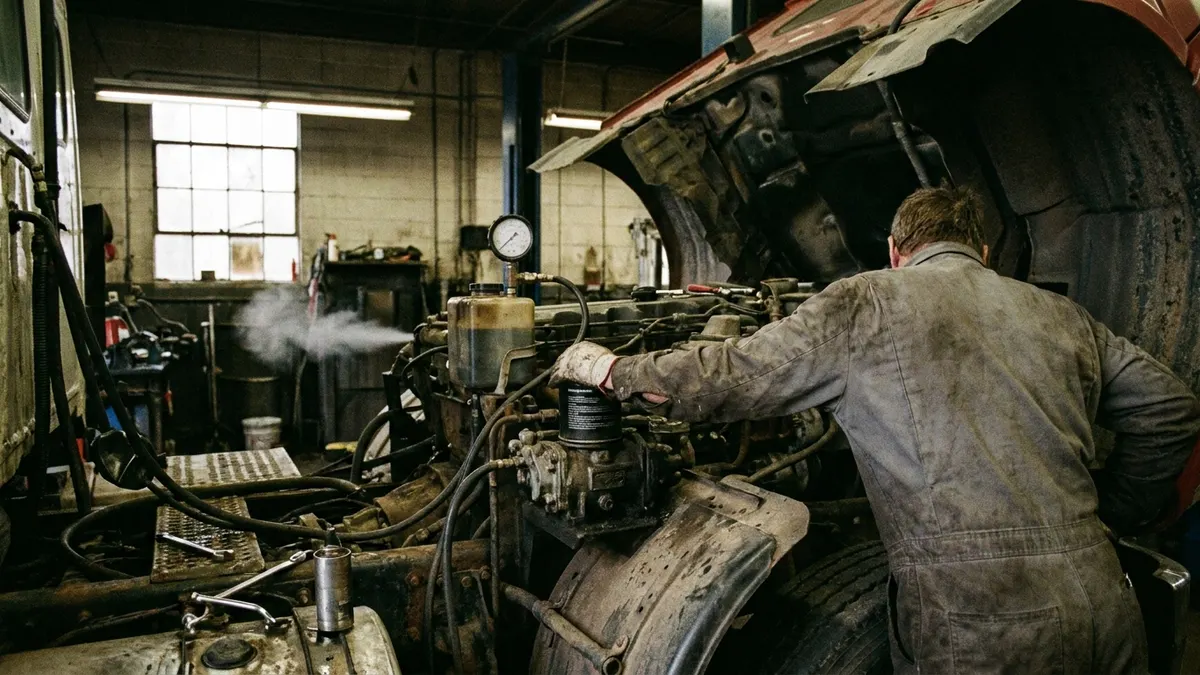
If the air governor is not cutting out, the compressor never receives its unload signal, so reservoir pressure climbs straight past the normal cut-out band of 120-135 psi until the safety valve on the wet tank blows off - that relief valve is usually set near 150 psi. Only three things can cause it: the governor itself, the small signal line between the governor and the compressor, or the compressor's own unloader mechanism. You can separate the three in about ten minutes with a test gauge and a wrench, before you buy a single part.
What cut-out is supposed to do
An air brake compressor is belt- or gear-driven off the engine and turns whenever the engine turns. On most trucks there is no clutch, so the compressor never stops spinning - the governor is what decides whether that spinning actually pumps air into the system.
When reservoir pressure reaches cut-out, the governor sends air out of its unloader port, down a small line, to the unloader pistons on the compressor head. That air holds the inlet valves open so the compressor free-wheels: still turning, no longer building. When pressure falls to cut-in, the governor exhausts the line, the unloaders drop, and the compressor loads again. The gap between the two settings - the differential - is normally about 20-25 psi and is not separately adjustable on most designs.
That same signal usually fires the air dryer purge valve. It gives you a free diagnostic before you touch a tool: if you never hear the dryer let off its sharp blast at the top of the charge cycle, the governor is not cutting out.
Reference pressures on a healthy system
| Function | Typical value | Notes |
|---|---|---|
| Governor cut-out | 120-135 psi | Compressor unloads, dryer purges |
| Governor cut-in | 100-110 psi | Compressor reloads |
| Cut-in / cut-out differential | About 20-25 psi | Fixed by design on most governors |
| Fully charged system | Around 120 psi | Normal running pressure |
| Low-air warning light and buzzer | About 60 psi | Stop and park before it gets lower |
| Spring brakes apply on their own | Roughly 20-45 psi | Emergency behaviour, not a service function |
| Wet tank safety valve | Commonly near 150 psi | Relief device only - never a control |
Step 1: prove the over-pressure is real
Before condemning anything, connect a known-good test gauge to a service port on the wet tank and compare it with the dash reading. A dash gauge reading low makes a perfectly normal system look like it is over-pressurizing, and a gauge reading high sends you chasing a governor that is doing its job correctly. If the test gauge confirms pressure marching past the high end of the cut-out band and the safety valve starts venting, the fault is real and worth chasing.
Step 2: split the system at the unloader line
This is the test that decides governor versus compressor, and it needs no special tooling.
- Chock the wheels. Build pressure until it goes past cut-out, or until the safety valve pops, then shut the engine down. The signal line stays charged as long as tank pressure stays above cut-out.
- With eye protection on, slowly crack the unloader line fitting where it enters the compressor.
- Steady air escapes: the governor and the line are doing their job. The fault is on the compressor side - the unloader mechanism is not responding to a signal it is receiving.
- No air, or only a weak puff: the signal is not arriving. Disconnect the same line at the governor's unloader port and repeat to find out whether the governor is dead or the line is blocked, kinked, crushed, or leaking.
Do not skip the line itself. A split nylon tube or a weeping fitting can hiss convincingly yet never deliver enough pressure to lift the unloader pistons, and in winter a trapped slug of water will freeze solid inside that line and mimic a failed governor every cold morning.
When the governor is the failure
Governors live in oily, dirty air and they fail from contamination far more often than from wear. Typical causes of a no-cut-out condition:
- Sludge, oil, or carbon inside the body holding the piston or exhaust stem in the cut-in position.
- A restricted or plugged reservoir supply port, so the governor never sees true tank pressure and behaves as though the system is still low.
- Ice in the governor or its ports during cold weather.
- A setting that has drifted, or a governor adjusted incorrectly during a previous repair.
- The wrong part number fitted - a unit with a much higher factory setting will look like a no-cut-out fault.
Adjustment is not a repair for a stuck governor. The adjusting screw shifts cut-in and cut-out together over a limited range, so if the unit never cuts out at any pressure, calibration is not your problem. Follow the manufacturer's service sheet for the direction of adjustment rather than guessing, and read up on how the governor works and the correct method for setting cut-in and cut-out before you pull the cap.
When the compressor is the failure
If air is clearly present at the compressor and it still keeps pumping, the unloader mechanism is not doing its work. Common findings when the head comes off:
- Unloader pistons seized in their bores with carbon and varnish.
- Hardened or torn unloader piston seals, letting the signal air leak past instead of lifting the valves.
- Broken or weak unloader springs, a bent plunger, or a missing saddle.
- Scored or worn bores that cannot hold pressure even with new seals.
- Inlet valves so carboned in place that they cannot be held open.
On a high-mileage unit these faults arrive together, because oil carryover and blow-by are what coke the head in the first place. A repair kit is a fair fix on a sound casting with clean bores; where the bores are scored or the head is cracked, replacement is the honest answer, and a like-for-like OE-grade unit from a range of air brake compressors for commercial vehicles will restore the original unload behaviour. The mechanism itself is covered in more detail under the compressor unloader valve.
The safety valve is a warning, not a fix
The pop-off valve in the wet tank exists to protect tanks, hoses, and valve bodies from an over-pressure event. It has a small orifice and it was never designed to bleed a running compressor continuously. Treat repeated venting as a system telling you it is out of control, and never plug, cap, or wire down a safety valve to quiet it.
The damage while you ignore it is real. A compressor running fully loaded at 100 percent duty overheats, carries more oil past the rings, and cokes the discharge line. The air dryer never gets its purge signal, so water and oil collect in the tanks instead of being expelled. Diaphragms, seals, and gauges see pressures above their design range. An inspector who watches a safety valve dumping will treat the vehicle accordingly.
Fast triage
| What you observe | Most likely cause | Next check |
|---|---|---|
| Pressure climbs past cut-out, dryer never purges | No unload signal at all | Crack the unloader line at the compressor |
| Air present at compressor, still building | Stuck or leaking compressor unloader | Remove head, inspect unloader pistons and bores |
| No air at compressor, air at governor port | Blocked, kinked, frozen, or leaking signal line | Blow line through, replace if damaged |
| No air at either point | Governor stuck, contaminated, or supply port blocked | Check governor supply line, replace governor |
| Fault appears only on cold mornings | Moisture freezing in governor or line | Drain tanks, service the air dryer cartridge |
| Dash gauge high, test gauge normal | Faulty gauge, not a governor fault | Replace or recalibrate the dash gauge |
Electronically controlled air systems
Some newer chassis, mainly European, use an electronic air processing or management unit that unloads the compressor through a solenoid, and a few engines drive a clutched or electronically controlled compressor. There is no mechanical governor to adjust on those systems. Pull fault codes first and verify the solenoid feed and the control valve before condemning hardware, because a wiring or sensor fault produces exactly the same symptom as a stuck governor.
Need the part, not just the answer?
OE-grade air brake compressors and repair kits, manufactured and tested to commercial-vehicle standards.
Shop VADEN partsPublished by VADEN Original. Product links point to the manufacturer’s official catalogue. Specifications are general — always confirm figures against your vehicle’s service manual.