 airbrakecompressor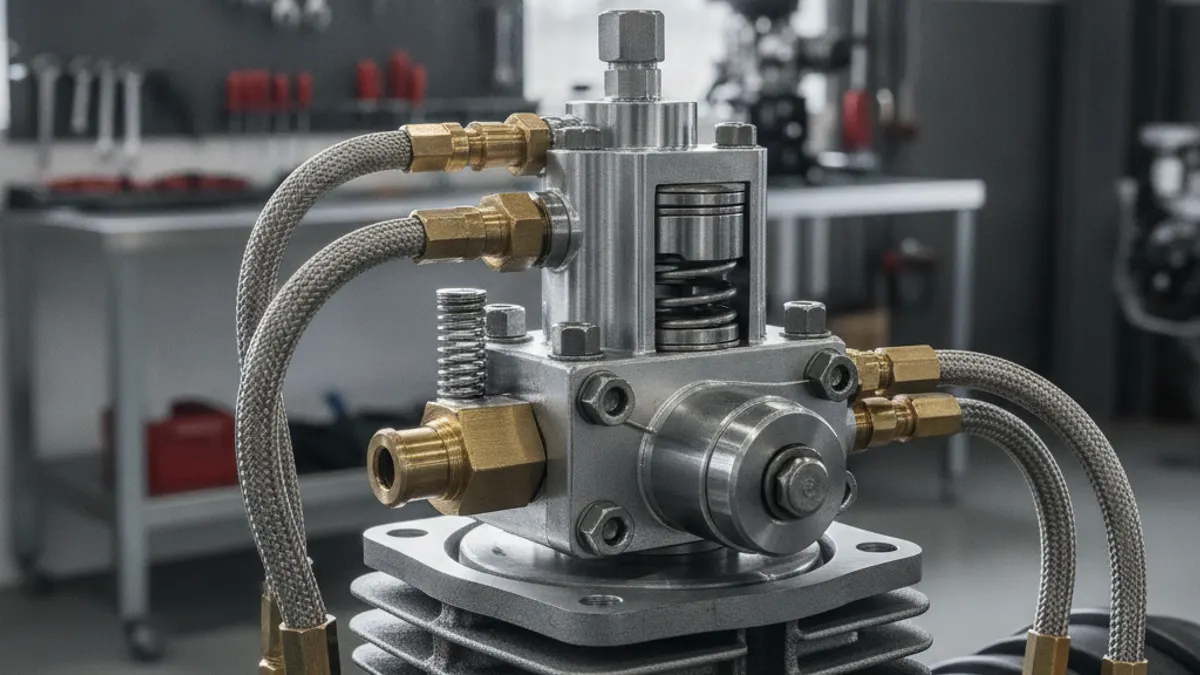
An air brake compressor is belt- or gear-driven off the engine, so it spins the entire time the engine runs and can't simply switch itself off. The air compressor unloader valve is the mechanism that lets it stop pumping air once the system is fully charged: at cut-out pressure the governor sends an air signal that holds the compressor's intake valves open, so the pistons just push air back and forth instead of forcing it into the reservoirs. That "unloaded" state is what keeps the pump from grinding away against a full system and cooking itself. When pressure falls back to cut-in, the unloader releases and the compressor goes back to work.
What the unloader valve actually does
Inside the compressor head (or in a separate unloader housing) sit one or more unloader pistons and plungers that bear down on the inlet/intake valves. Under normal pumping, those inlet valves open and close on each stroke to draw air in and seal it for compression. When the governor delivers its unload signal, air pressure pushes the unloader pistons down, the plungers hold the intake valves off their seats, and the trapped air simply shuttles between the cylinders and the intake with almost no resistance. The compressor keeps turning, but it stops making pressure. Remove the signal and springs return everything to the sealed, pumping position.
The hardware itself is small: a plunger or piston capped by O-rings and a spring, sitting directly under the intake valve. Layouts differ by design — some heads use a single unloader port or saddle, while heavy-duty twin-cylinder units carry a plunger under each intake valve — but the job is identical in every case. Because that hardware lives in the hottest, most oil-exposed corner of the air brake compressor, its seals harden, its plungers gum up with carbon, and it sticks. It is a service item, not a lifetime part.
Related guides: How to Replace an Air Compressor Unloader Kit on the Bench
The loaded / unloaded cycle
The whole system runs on a two-state cycle managed by the compressor governor, which senses reservoir pressure and controls the unloader. Typical numbers vary by vehicle, but the pattern is consistent:
| State | Trigger | What the unloader does | Result |
|---|---|---|---|
| Loaded (pumping) | Pressure below cut-in (~100-110 psi) | Intake valves seal normally | Compressor charges the reservoirs |
| Unloaded (idling) | Pressure reaches cut-out (~120-135 psi) | Governor signal holds intake valves open | Compressor spins but builds no pressure |
This is the "loaded unloaded cycle" you'll see referenced in service manuals. A healthy system cycles between these two states many times a day without the driver ever noticing.
How the governor signals the compressor
The governor is plumbed to a reservoir on one side and to the compressor's unloader port on the other. As reservoir pressure climbs to the cut-out setting, an internal piston in the governor shifts and opens a path that sends air to the unloader. When pressure drops to cut-in, the governor exhausts that line to atmosphere, the unloader springs close the intake valves, and pumping resumes. In short, the governor decides when, and the unloader carries out the how. If either one is faulty, the compressor won't cycle correctly, so it's worth confirming which part is actually at fault before you condemn the pump.
Why unloading matters for compressor life
Unloading isn't a convenience feature — it's the main thing protecting the compressor. When a pump is unloaded, cylinder temperatures drop, load on the bearings and drive falls off, and there's far less pressure trying to push oil past the rings. When the unloader fails to unload and the compressor keeps pumping against a fully charged, sealed system, several bad things happen fast:
- Discharge temperatures spike, which cokes carbon into the discharge line and check valve.
- High cylinder pressure drives oil past the rings, so the compressor starts pumping oil into the air system and fouling downstream components.
- The system safety (pop-off) valve, usually set around ~150 psi, vents repeatedly — a clear sign the compressor never went unloaded.
- Sustained heat and load shorten the pump's service life dramatically.
Many compressors that get replaced for "oil pumping" or premature wear were actually killed by an unloader or governor that stopped cycling. Diagnosing the unloader first can save a pump. It also means that when a pop-off valve vents regularly, the pop-off valve is rarely the part at fault.
Relationship to the air dryer purge
On trucks equipped with an air dryer, the governor's unload signal usually does double duty. The same line that unloads the compressor at cut-out also opens the purge valve on the air dryer. The dryer uses that moment — when the compressor stops pushing new air — to blow its accumulated water and oil out the purge port and regenerate the desiccant with a reverse flow of dry air. That's the sharp "pssht" you hear from under the truck roughly every time it tops off. Because they share the signal, a fault in one can masquerade as a fault in the other: a dryer that never purges, or one that purges continuously, may point back to a governor or unloader problem rather than the dryer itself.
Symptoms of a failing unloader
| Symptom | Likely unloader condition |
|---|---|
| Safety valve pops off; compressor runs hot | Stuck loaded — never unloads at cut-out |
| System builds pressure slowly or not at all | Stuck unloaded / leaking — intake valves held open |
| Constant air leak at the governor unloader port | Unloader seals or plunger bores worn |
| Air dryer purges non-stop or never purges | Unload signal not cycling correctly |
| Oil in the air system, wet reservoirs | Prolonged loaded running past the rings |
It helps to think of these as two opposite failure directions plus a leak. Stuck closed, the unloader never releases the compressor, so pressure climbs past cut-out and the safety valve vents — that is the direction that destroys compressors. Stuck open, it never lets the compressor load, so the truck is slow to build air or never gets there, the low-air warning stays on, and the compressor runs constantly with nothing to show for it. Worn O-rings sit between the two: control air bleeds past, charging is sluggish, and cut-out hunts or cycles far more often than it should. Note that some of these — slow build, oil carryover — overlap with worn rings or a saturated dryer, so confirm the governor cut-out and cut-in first with a test gauge before disassembly.
How to test whether the unloader is working
You can check the unload cycle with nothing more than the dash gauge and your ears. Start the engine and let the system build. As pressure reaches the governor's cut-out setting (~120-135 psi on most trucks), the compressor should stop building and you should hear the air dryer purge with a sharp exhaust. If pressure keeps climbing past cut-out until the safety valve pops (~150 psi), the compressor is not unloading — suspect a governor stuck closed or an unloader stuck loaded. Next, make repeated brake applications to draw the pressure down; cut-in should occur around ~100-110 psi and the compressor should audibly go back to building. A steady hiss at the governor's exhaust port while the system sits fully charged usually points to worn unloader seals bleeding the signal away. Confirm both cut-out and cut-in against the manufacturer's spec before you condemn any single part.
Is it the unloader, the governor, or the compressor?
The governor, the unloader, and the compressor's own intake valves all sit in the same signal path, so test them in that order. If the governor is not switching control air at the right pressures, a perfectly good unloader will look faulty. If the governor does switch correctly at both cut-in and cut-out and the compressor still refuses to stop or start pumping, the fault has to be in the unloader plungers, seals, or intake valves. Pull the head at that point and you will usually find the evidence directly: gummed plungers, hardened O-rings, or carbon holding an intake valve off its seat.
Repair or replace
The unloader pistons, plungers, saddle, inlet valves, and their seals are wear items. On many compressors they can be renewed without replacing the whole pump, using OE-grade air brake compressor repair kits that include the correct unloader components and gaskets for a proper reseal. Where only the unload mechanism is at fault, a dedicated OE-grade unloader valve kit restores clean cut-out and stops the overheating cycle before it reaches the pistons. Match the kit to your compressor model — single- and twin-cylinder heads use different plunger and seat geometry — and renew the intake valve seats at the same time if they show carbon or pitting; it is a low-cost part protecting a high-cost compressor. If the bores are scored, the head is cracked, or the pump has been overheated and is pumping oil badly, that's the point to fit a replacement air brake compressor rather than chase a rebuild that won't hold. Whichever route you take, verify the governor cut-out and cut-in settings afterward so the new unloader actually cycles as designed.
Keeping an unloader alive
The unloader lasts longest on clean, dry air and clean oil. A failing air dryer that lets moisture and oil vapour reach the compressor head shortens seal life and lays down the carbon that sticks plungers, so a neglected cartridge quietly shortens the unloader's life as well as the pump's. Keep the dryer cartridge fresh, drain the tanks on schedule, and inspect the unloader components whenever the head is off for valve service. If a compressor is cycling far more often or far less often than it used to, the unloader and the governor are the first two parts worth checking.
Need the part, not just the answer?
OE-grade air brake compressors and repair kits, manufactured and tested to commercial-vehicle standards.
Shop VADEN partsPublished by VADEN Original. Product links point to the manufacturer’s official catalogue. Specifications are general — always confirm figures against your vehicle’s service manual.