 airbrakecompressor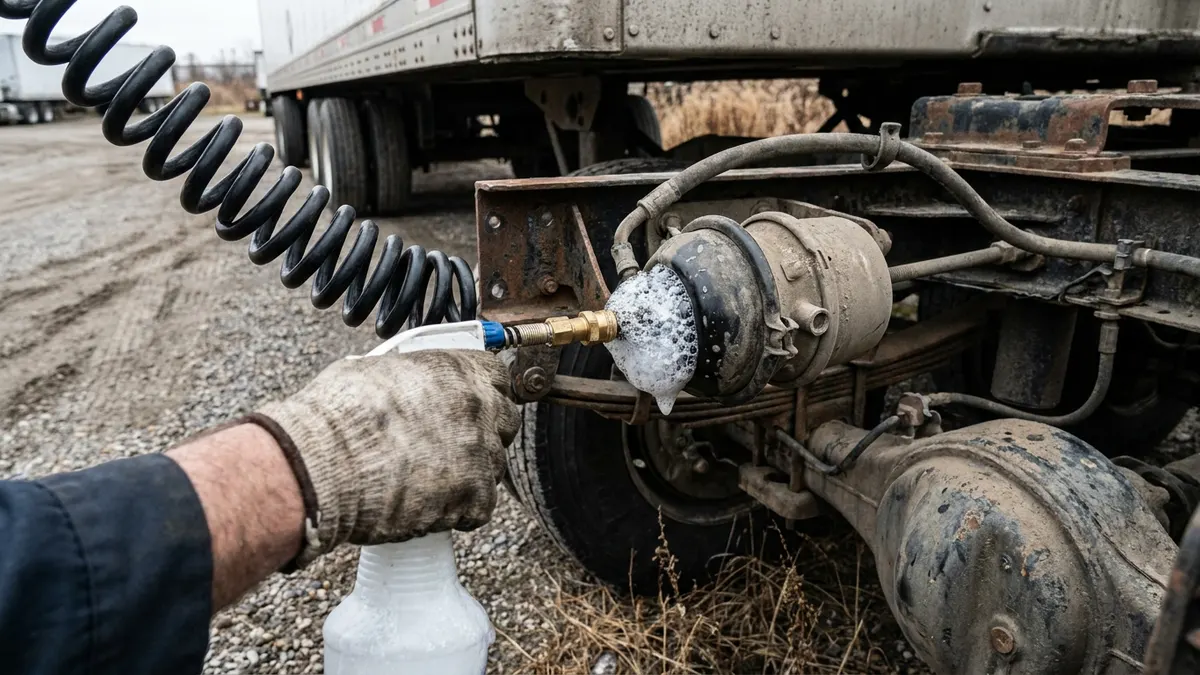
If your air gauges read low or zero in the morning, the system is leaking somewhere — an air brake system is a sealed pneumatic circuit, and nothing in it is supposed to vent to atmosphere while the truck sits. That said, every system leaks a little, so the useful question is not did it drop but how fast. With the engine off and the brakes released, a single vehicle should lose no more than about 2 psi per minute and a combination no more than about 3 psi per minute; with the treadle held at roughly 90 psi, the limits are about 3 and 4 psi per minute. Anything faster is a findable leak, and the usual suspects are the air dryer purge valve, the governor, a ruptured brake chamber diaphragm, or a chafed line or loose fitting.
Is overnight bleed-down ever normal?
Run the math on the legal limits. A truck that passes the leak test at exactly 2 psi per minute is still shedding 120 psi in an hour. After eight or ten hours in the yard, that truck reads zero — and it is legal. A genuinely tight system will hold most of a full charge until morning, but a system that is merely within spec will not. That is why inspectors time a one-minute drop rather than reading the gauge after a night parked.
The bleed-down itself is designed to be safe. As supply pressure falls through roughly the 20-45 psi band, the spring brake chambers lose the air holding their power springs compressed and the parking brakes set themselves, usually popping the dash knobs out on the way. That is a fail-safe, not a parking method. Set the parking brake deliberately every time and chock the wheels on any grade.
One more distinction worth drawing early: a truck that will not hold pressure overnight is a different animal from one that keeps dropping pressure with the engine running. If your gauges sag while you are driving, or the compressor never reaches cut-out, start with the causes of an air brake system losing pressure instead.
Measure the leak before you chase it
- Chock the wheels. You will be releasing the parking brakes with the engine off.
- Build the system to governor cut-out — typically somewhere in the 120-135 psi range depending on the vehicle — then shut the engine down.
- Give it a minute to settle. The dryer will purge and the tanks will equalize; a small initial drop right after shutdown is normal.
- Push the park knobs in to release the brakes and time the gauge for one full minute. This is the static or released test.
- Now apply and hold the foot valve at about 90 psi and time another full minute. This is the applied test, and it pressurizes the service circuit all the way out to the chambers.
- Compare both numbers against the table below.
Allowable leakage rates
| Test condition | Single vehicle | Combination |
|---|---|---|
| Brakes released (static) | about 2 psi per minute | about 3 psi per minute |
| Brakes applied, held near 90 psi | about 3 psi per minute | about 4 psi per minute |
These are the figures used in the CDL air brake check and in roadside inspection criteria. Treat them as the ceiling, not the target — a well-maintained system will sit well under them, and multi-trailer combinations are held to the combination limits at minimum. Note also that federal rules prohibit audible leaks at connections regardless of the timed rate, so a hiss you can hear across the shop is a defect even if the gauge barely moves.
Where the air actually goes
| What you observe | Likely source | How to confirm |
|---|---|---|
| Steady hiss at the air dryer after shutdown | Purge valve stuck open, fouled seat, or a leaking governor signal line | Soap the purge exhaust; check for oil contamination in the cartridge |
| Air escaping from the governor exhaust port | Worn governor seat or diaphragm | Soap the port with the system charged and the engine off |
| Drops only with the park knobs pushed in | Spring brake side: park valve, relay valve, hoses, or spring chamber section | Repeat the timed test with knobs out and compare |
| Drops only while the treadle is applied | Service circuit: foot valve delivery, relay or quick-release valve, service lines, chamber diaphragms | Applied leak test, then soap each chamber and valve exhaust |
| Wet tank empties but secondary holds, or the whole system drains together | Leaking check valve, corroded tank drain valve, or compressor inlet valve leaking back through the intake | Isolate tanks one at a time; listen at the compressor air filter |
| Air at the chamber clamp band or drain hole | Ruptured diaphragm | See brake chamber leaking air for the applied and released checks |
| Only bleeds down when the trailer is hooked | Hardened gladhand seals or a leak on the trailer | Disconnect and cap the lines, then retime the drop |
| Suspension sits down overnight along with the tanks | Leveling valve or air bag, pulling the supply down until the pressure protection valve closes | Soap the bags and leveling valve linkage |
Tracing a slow leak
Slow leaks are quiet by definition, so work in a quiet shop with the system fully charged and the engine off. Soapy water in a spray bottle still finds most of them; an ultrasonic detector earns its keep on a noisy yard or for leaks buried behind the frame. Isolate by section — cap the trailer supply, then test the tractor alone — so you are not soaping 60 feet of plumbing to find one fitting. Pay attention to nylon tubing where it crosses frame rails, passes near the fifth wheel, or runs close to the exhaust; chafe-through and heat damage account for a large share of leaks that only show up over hours. Our walkthrough on how to find an air leak fast covers the sequence in more detail.
Fixing it properly
Once you have the source, repair rather than compensate. Rebuild kits are appropriate for governors, relay valves, and treadle valves when the bores are clean; chambers, dryer cartridges, and cracked fittings get replaced. If the dryer is passing oil, the compressor is the root cause and the new cartridge will foul again within weeks. When you need OE-grade replacements, VADEN Original's air brake system components catalogue cross-references the major OE part numbers for compressors, valves, and repair kits.
Never mask a leak by raising governor cut-out pressure, plugging a port, or leaving a supply valve closed. The system is sized around a specific reserve volume, and defeating a valve to stop a hiss removes the margin that keeps the low-air warning meaningful at roughly 60 psi.
Finally, retest after the repair. Recharge to cut-out, shut down, and run both the released and applied timed checks again. A truck that now holds within a psi or two per minute will still be softer in the morning than it was at shutdown — but it will not be sitting on its springs with empty tanks.
Need the part, not just the answer?
OE-grade air brake compressors and repair kits, manufactured and tested to commercial-vehicle standards.
Shop VADEN partsPublished by VADEN Original. Product links point to the manufacturer’s official catalogue. Specifications are general — always confirm figures against your vehicle’s service manual.