 airbrakecompressor
Fit a clutch servo repair kit only when the failure is confined to soft parts and the hardware behind them is sound. If the hydraulic or air bore is scored or corroded, if the air piston or its guide is damaged, or if the body is distorted, cracked or has pulled threads, the rebuild is a waste of a bay — fit a complete servo. The kit is a fraction of the price of a new unit, but the labour to get the servo off, refit it and bleed the circuit is identical either way, so a rebuild that comes back costs more than the part you were trying to avoid buying.
What a clutch servo repair kit actually contains
The clutch servo, also called a clutch booster or air-assisted clutch actuator, is an air-over-hydraulic device. Hydraulic pressure from the clutch master cylinder moves the pushrod directly and also opens a control valve that admits air from the vehicle air system behind a large-diameter air piston. That air does most of the work; the relationship between the two halves is covered in how an air-assisted clutch works.
A typical kit is a soft-parts kit:
- Hydraulic piston seals or cups and the hydraulic bore O-rings
- Air piston seal — a lip seal or a rolling diaphragm, depending on the design
- Control valve seals, and on some designs the valve seat insert and its spring
- Pushrod seal, dust boot or bellows, and the breather element
- Circlips and retaining rings
- A sachet of rubber-compatible assembly grease
What is almost never in the box: the body casting, the bores themselves, the air piston, the pushrod and clevis, and on many part numbers the complete control valve housing. Some suppliers list two levels — a seal kit, and a fuller kit that adds the piston or valve assembly. Strip the unit first and check the pack contents against what you actually found, because a seal kit will not rescue a servo that needs hardware.
Failures a seal kit genuinely fixes
| Symptom | Usual cause | Verdict |
|---|---|---|
| Fluid weeping past the pushrod boot, reservoir level falling | Worn hydraulic piston seal | Kit, if the bore is clean |
| Continuous air escaping from the exhaust port with the pedal at rest | Control valve seal no longer seating | Kit, if the seat is undamaged |
| Air escaping only while the pedal is held down | Air piston seal bypassing | Kit, if the air bore is clean |
| Heavy pedal, weak assistance, no external leak | Internal air bypass past a hardened seal | Kit, subject to bore inspection |
| Slow pushrod return, clutch slow to re-engage | Swollen seals, dry or lightly corroded bore | Borderline — inspect closely |
| Rust or water found inside the air section at strip-down | Wet air supply, pitted bore | Replace the servo |
| Weeping at the joint between the air and hydraulic sections | Distorted or corroded body face | Replace the servo |
When a rebuild is a waste of the bay
Judge the unit on its hardware, not on the price of the kit. Replace outright when any of these appear:
- Scored or grooved bores. Run a fingernail down both bores. Light polishing marks are acceptable; a ridge you can catch, or a witness line where the piston has been sitting, will cut the new seal within weeks.
- Corrosion or pitting. Aluminium bodies pit where moisture from the air supply has been standing. Pitting in a bore or on a valve seat cannot be honed out — the material and the sealing geometry are not there to recover.
- Damaged air piston or guide. Scuffing, an ovalled skirt or a torn diaphragm land means the piston is scrap, and most kits do not supply one.
- Distorted or cracked body. Over-torqued mountings, an impact, or a previous rebuild with the wrong fasteners leaves a joint face that will not seal reliably.
- Worn pushrod, clevis or mounting eye. Elongated pin holes change effective stroke and load the piston off-centre in the bore.
- Second failure or unknown history. A servo that has already been through one kit and come back is telling you something.
Pricing the two routes honestly
| Cost element | Repair kit route | Complete servo route |
|---|---|---|
| Part cost | Small fraction of a complete unit | Full unit price |
| Removal and refitting labour | Identical | Identical |
| Bench time | Strip, clean, inspect, assemble, test — and unbillable if you then condemn the unit | None |
| Fluid and bleeding | Same | Same |
| Risk of comeback | High if the bore was marginal; the second removal is on you | Low |
| Warranty | Seals only, short term | Complete unit, longer term |
| Downtime | Extra day if the strip reveals hardware damage and a servo then has to be ordered | One ordered part, one visit |
The arithmetic is simple. The kit wins when the strip-down confirms clean hardware, because the part cost is the only figure that moves. It loses badly when a technician commits to the rebuild before inspection, because the removal labour gets spent twice and the vehicle is off the road for a second day.
Inspect before you commit
- Confirm the servo is at fault. A sinking pedal with a falling fluid level can be the master cylinder, and weak assistance can be a supply problem. Work through clutch servo failure symptoms first.
- Check the air supply. The clutch circuit is fed through a pressure protection valve so the brake circuits keep priority, and assistance fades whenever system pressure is low. A healthy system sits around 120 psi, with the governor cutting out in the 120-135 psi band and cutting back in around 100-110 psi. Fix a low-pressure fault before condemning anything.
- Remove the servo, cap the lines, and strip it on a clean bench.
- Assess both bores under good light, then the air piston, the valve seat, the pushrod, the clevis and the body faces.
- Decide then — not at the parts counter beforehand.
If you rebuild, rebuild it properly
Assemble clean, use only the rubber-compatible grease supplied with the kit rather than general-purpose petroleum grease, and fit fresh circlips. Use the hydraulic fluid specified by the vehicle manufacturer for the clutch circuit and never mix grades. Set pushrod free play to the OEM figure, bleed the circuit fully, then verify on a charged system that nothing escapes from the exhaust port with the pedal both released and held.
Then deal with why it failed. Water and compressor oil carried through a tired air dryer swell seals and corrode bores faster than any amount of mileage will. Drain the reservoirs and check the condition of the supply — see water in air tanks. Fitting a new servo into a wet, oily air system only resets the clock.
The short version
Clean bores, sound air piston, true body: fit the kit. Any scoring, pitting, corrosion, piston damage or body distortion: fit a complete servo. Unknown history or a second failure: fit a complete servo.
For European heavy-vehicle applications both routes are available from the manufacturer, with complete clutch servo units and matching repair kits cross-referenced to the original equipment numbers, so the decision can be made on the bench rather than on what happens to be in stock.
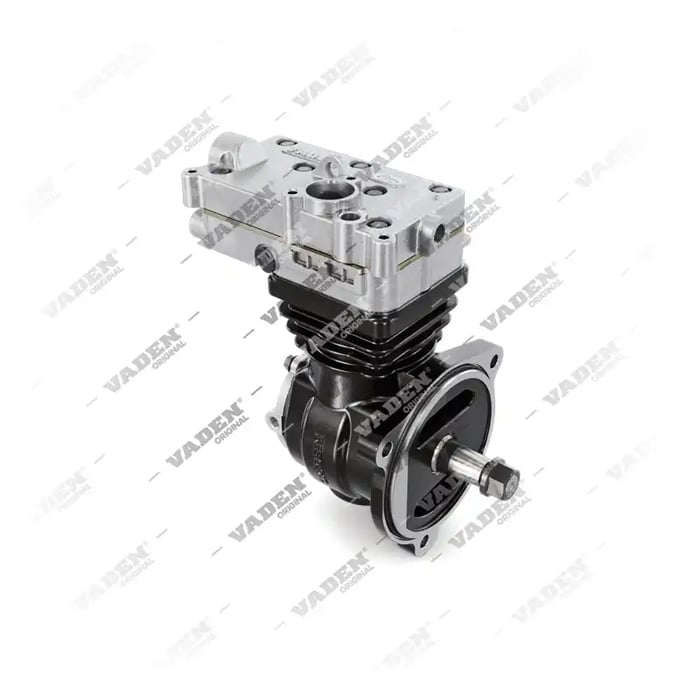
Need the part, not just the answer?
OE-grade air brake compressors and repair kits, manufactured and tested to commercial-vehicle standards.
Shop VADEN partsPublished by VADEN Original. Product links point to the manufacturer’s official catalogue. Specifications are general — always confirm figures against your vehicle’s service manual.