 airbrakecompressor
On a heavy truck, an air-assisted clutch uses compressed air from the vehicle's own air system to supply most of the force that releases the clutch, while the pedal supplies only a hydraulic control signal. A master cylinder at the pedal sends fluid to a clutch servo bolted to the bellhousing; inside that servo the fluid pressure opens an air valve, and reservoir air acting on a large piston adds its force to the same pushrod that moves the release fork. That is why a weak compressor or a leak in the auxiliary air circuit normally reaches the driver as a hard clutch pedal and a gearbox that will not take a gear, rather than as a brake complaint.
The three clutch actuation layouts
Before diagnosing anything, establish which layout the vehicle has. All three release the same dry friction clutch; what differs is where the release force comes from and what commands it.
Plain hydraulic master and slave cylinder
The pedal acts on a master cylinder, a single hydraulic line runs down to a slave cylinder on the bellhousing, and a short pushrod works the release fork. There is no air connection anywhere in the circuit. This layout is common on medium-duty chassis, midibuses and light tractor units where the clamp load is modest enough for a driver's leg to overcome. On some designs the slave cylinder is concentric, mounted inside the bellhousing around the input shaft, so you see only a hydraulic line disappearing into the housing and no external fork linkage at all.
Hydraulic master with an air-assisted clutch servo
This is the layout on most European and Asian-built heavy tractors and coaches that still have a clutch pedal. The pedal and master cylinder are unchanged, but the unit on the bellhousing is far larger, because the air cylinder bore dominates the body, and it carries three connections instead of one: a hydraulic inlet from the master cylinder, a plastic air supply line from the chassis, and a breather or exhaust port, usually with a small filter element. The servo drives an external pushrod into the release fork. If an air line lands on the gearbox housing next to the clutch, you are looking at an air-assisted clutch.
Automated manual transmission clutch actuator
On a two-pedal truck the clutch is still a dry friction clutch, but there is no master cylinder and, in most applications, no clutch pedal at all. A pneumatic actuator on the bellhousing carries an air line, a multi-pin electrical connector and usually an integral travel sensor; the transmission ECU meters air into it to engage and disengage. The air still comes from the same auxiliary circuit, so the low-air behaviour is the same underneath. It simply presents as a shift fault and a transmission warning instead of a heavy pedal.
| Layout | Unit on the bellhousing | Connections at that unit | Clutch pedal | Behaviour when air is low |
|---|---|---|---|---|
| Plain hydraulic | Small slave cylinder, short pushrod | One hydraulic line | Yes | Unaffected |
| Air-assisted servo | Large cylindrical servo body | Hydraulic line, air line, breather | Yes | Pedal goes hard, clutch may not fully release |
| AMT actuator | Actuator module with sensor | Air line, multi-pin connector | Usually none | Shift faults, no gear engagement |
How the servo multiplies pedal effort
- The driver presses the pedal and the master cylinder raises hydraulic pressure in the line to the servo.
- That pressure acts on a small control piston in the hydraulic section of the servo.
- The control piston lifts an internal follower valve off its seat, closing the exhaust path and opening the supply path.
- Reservoir air from the auxiliary circuit enters the large chamber behind the main air piston.
- Air piston and hydraulic piston act on one common pushrod, which moves the release fork, release bearing and pressure plate.
- On pedal release the valve closes the supply and reopens the exhaust, and the chamber vents through the breather. That is the short hiss you hear at the bellhousing on every shift.
The valve is a following type, so the air pressure admitted tracks the hydraulic control pressure. The driver keeps genuine pedal feel and can still feather the clutch even though air is carrying most of the release load. It also explains the classic partial failure: with the air side dead, the hydraulic piston alone still moves the pushrod a little, so the pedal travels normally but the clutch never fully releases and the gears grind.
Where the servo gets its air
The compressor charges through the governor and the air dryer into the supply reservoir. From there a multi-circuit protection valve splits the supply: two circuits for the service brakes front and rear, one for the parking and trailer supply, and one auxiliary circuit for everything else, including the clutch servo, air suspension, PTO, seat and horn. On European-build chassis these ports are numbered by circuit. The clutch servo therefore sits at the end of the accessory branch, downstream of the dryer and of the protection valve, and it only ever sees the pressure that branch is allowed to have.
That protection valve is what makes the clutch the first casualty of an air problem. It is built so the brake circuits fill first: the auxiliary port does not open until the brake circuits have reached its set opening pressure, and on falling pressure the auxiliary port closes before brake supply is starved. Both FMVSS 121 and ECE R13 require that behaviour, so a burst accessory line cannot empty the brake reservoirs. On a truck that only builds to 80 psi because the compressor is tired, the brakes take priority and the clutch branch stays shut or barely charged. The driver is fighting a solid pedal long before the low-air warning device sounds at around 60 psi, and long before the spring brakes begin to set themselves somewhere in the 20 to 45 psi range.
Why an air fault arrives as a clutch complaint
| Driver report | Usual cause | Where to look |
|---|---|---|
| Pedal hard first thing, normal once charged | Overnight leak-down, auxiliary circuit closed until the brake circuits refill | Leak-down test, check valves, dryer purge |
| Pedal heavy all day, system never reaches about 120 psi | Compressor or governor not charging the system | Governor cut-out in the 120 to 135 psi band, compressor output |
| Full system pressure, clutch still heavy | Protection valve stuck closed, kinked air line, servo valve not opening | Pressure at the servo inlet with the pedal applied |
| Continuous hiss at the servo breather | Internal seal failure in the servo | Servo body and vent, clutch fluid level |
| Clutch drags and gears grind, pedal travel normal | Servo not developing full stroke, or pushrod out of adjustment | Pushrod stroke against the OEM figure |
Gauge the truck before condemning a servo. Charge the system, confirm the governor cuts out in the 120 to 135 psi band and cuts back in around 100 to 110 psi, then measure the air actually arriving at the servo inlet with the clutch pedal applied. If supply is present and the servo still will not stroke, the fault is in the unit; if it is not, the fault is upstream and the clutch is only the messenger. A system that will not hold overnight is a supply problem first, covered under air brake system losing pressure.
Inspection and replacement points
- Air line. The nylon tube runs close to the bellhousing and the exhaust. Look for chafe, heat damage and a collapsed bend at the last clip.
- Breather. A clogged breather slows release and makes the clutch drag. One that hisses continuously with the pedal up means an internal seal has failed; the wider pattern is set out under clutch servo failure symptoms.
- Hydraulic side. The clutch circuit has its own reservoir. Use only the fluid the OEM specifies, brake-specification fluid on most chassis and mineral oil on a few, and never mix them; the wrong fluid swells seals and jams the control piston.
- Air quality. A failed or overdue air dryer sends water and oil down the auxiliary branch. Oil carryover attacks servo seals exactly as it attacks brake valves.
- Pushrod stroke and free play. Set to the manufacturer's figure at every clutch service. Excess stroke masks a tired servo, too little keeps the release bearing loaded.
- Kit or complete unit. A seal kit restores worn piston and valve seals in a sound body, but a scored, corroded or oval bore will not hold pressure. VADEN Original lists clutch servo units and repair kits against the OE numbers stamped on the servo body, which is the only reliable way to match one.
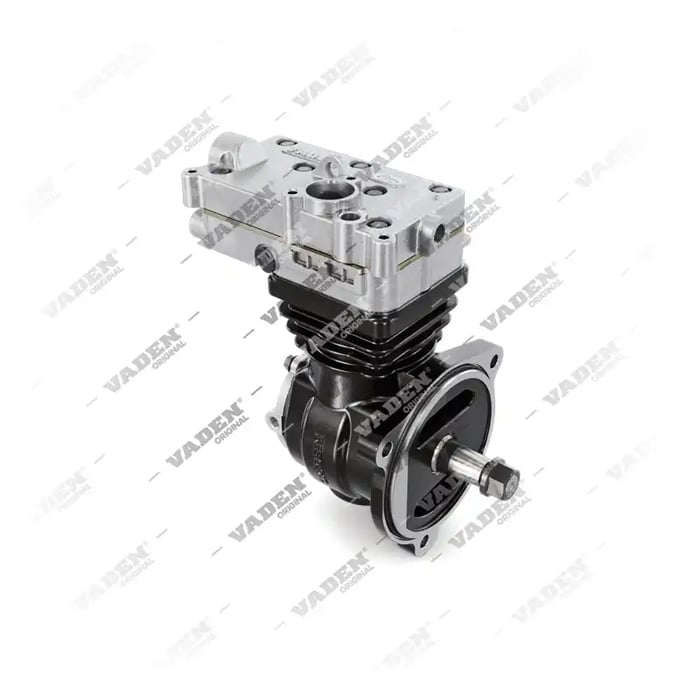
Need the part, not just the answer?
OE-grade air brake compressors and repair kits, manufactured and tested to commercial-vehicle standards.
Shop VADEN partsPublished by VADEN Original. Product links point to the manufacturer’s official catalogue. Specifications are general — always confirm figures against your vehicle’s service manual.