 airbrakecompressor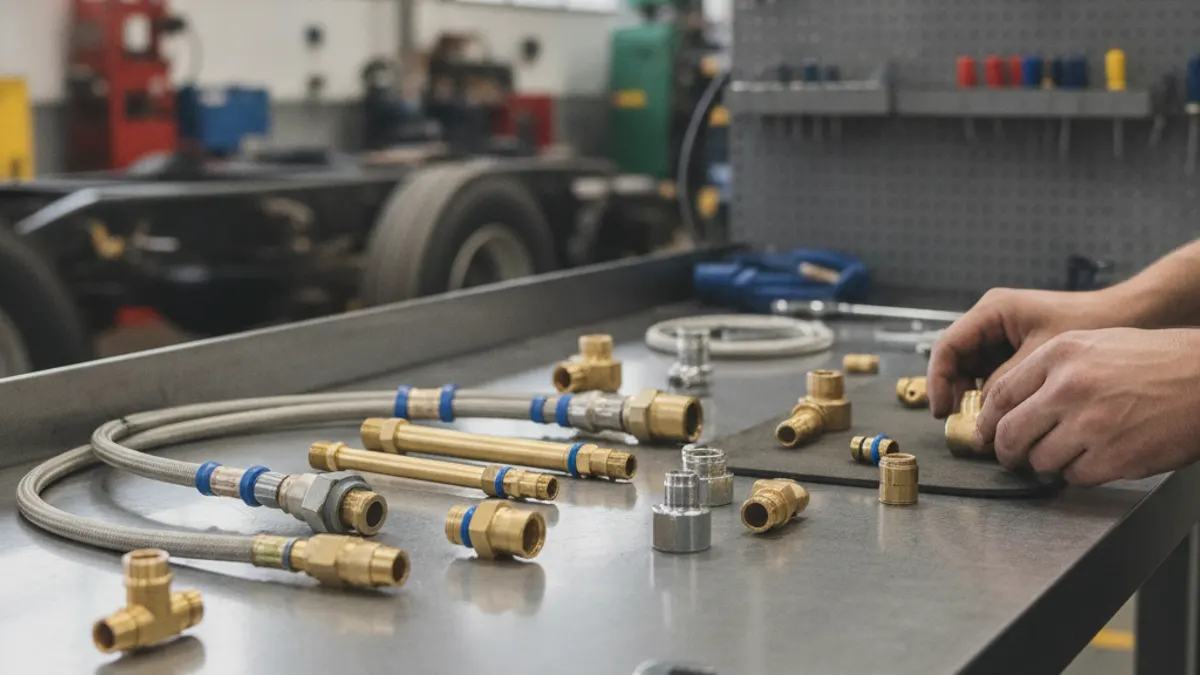
Air brake fittings are the brass or composite connectors that join DOT-approved nylon tubing to the valves, tanks, chambers and hoses of a commercial vehicle's pneumatic brake system. On North American trucks the tubing is nylon air brake tube built to SAE J844, and the fittings must be DOT-approved types — push-to-connect or compression with a tube support insert — not ordinary hardware-store brass. Get the tube size, the fitting type and a square cut right, and the line will run for the life of the truck. Get any one of them wrong and you have a slow leak that will not clear up on its own.
What "DOT" actually means on a fitting
FMVSS 106 is the federal standard covering brake hose, tubing and end fittings. Tubing sold for air brake service is marked along its length with the manufacturer, the size and the SAE J844 (or DOT) designation, and approved fittings carry a manufacturer mark as well. The practical difference between a DOT air brake compression fitting and a plumbing compression fitting is the tube support insert — a small brass sleeve that goes inside the nylon tube so the ferrule has something solid to crush against. Without it, the nut squeezes the tube shut, then the tube cold-flows under pressure and starts weeping.
Two more rules get broken constantly: never use plumbing PTFE tape on air brake threads, and never substitute copper-tube compression parts on nylon. Tape shreds and the debris ends up in valve seats and the air dryer. Use a small amount of liquid pipe sealant, or fittings with pre-applied sealant, kept a couple of threads back from the end.
Nylon tubing sizes and where each one goes
Air brake tubing is sized by outside diameter, not ID. North American trucks use fractional inch sizes; European chassis and most EU trailers use metric tubing to DIN 74324 with metric threads. Do not mix the two — 1/2 in is about 12.7 mm and will not seal reliably in a 12 mm fitting, and it will feel like it went in fine right up until it blows out.
| Tube OD (in) | Nearest metric | Typical use |
|---|---|---|
| 1/8 – 5/32 | 3 – 4 mm | Gauge and signal lines, pressure switches, small pilot lines |
| 1/4 | 6 mm | Dash control valve lines, air horn, small actuators, low-air warning switch feeds |
| 3/8 | 10 mm | Service and emergency lines along the frame, brake chamber and relay valve feeds |
| 1/2 | 12 mm | Supply lines, tank-to-tank interconnects, larger chamber feeds |
| 5/8 | 16 mm | Main reservoir and dryer-to-wet-tank delivery lines on many chassis |
| 3/4 | 18 – 20 mm | Large supply runs, air suspension feeds on heavy or multi-axle units |
Undersizing a line is a quiet performance killer. Feeding a 30/30 spring brake through a 1/4 in line instead of 3/8 in adds fill and release time you will feel as sluggish braking, and it can throw off timing between axles. When in doubt, match what the OEM schematic calls for rather than what fits the hole.
Push-to-connect vs compression fittings
| Type | How it seals | Best for | Watch out for |
|---|---|---|---|
| Push-to-connect (PTC) | Stainless gripper ring plus an internal O-ring on the tube OD | Fast repairs, tight spaces, most modern OEM plumbing | Needs a clean, square, unscratched tube OD; O-ring damage from a burr causes a bubble leak |
| DOT compression (brass nut, ferrule, tube support) | Ferrule crushed onto the tube, supported from inside by the insert | High-vibration points, older chassis, permanent installs | Insert must be used and fully seated; overtightening splits the tube |
| Reusable / field-attachable hose ends | Threaded socket and nipple gripping rubber or thermoplastic hose | Flex points, gladhand hoses, chamber jumper hoses | Only DOT-approved ends on brake hose; assemble to the marked insertion depth |
PTC is faster and, done properly, just as reliable. Compression is more forgiving of a slightly imperfect tube surface. Both are legal. What is not legal is a barbed fitting and a worm clamp on a nylon air brake line, still the most common improvised repair on the roadside.
Cutting and assembling a leak-free line
- Measure with slack. Route the tube first, then cut. Leave enough length for chassis flex and one future repair, but not so much that it loops into a low spot where water collects.
- Cut square with a tubing cutter. Use a shear-type nylon tube cutter, not side cutters and not a hacksaw. An angled or pinched end is the single most common cause of a new-line leak.
- Deburr and inspect the OD. Wipe the last inch clean. Any nick, ridge or flat spot in the sealing area will leak past the O-ring.
- Mark the insertion depth. For push-to-connect, mark the tube with a felt pen — roughly 5/8 in on small sizes, up to about an inch on the large ones. Check the fitting maker's chart for the exact figure and push until the mark disappears at the fitting face.
- For compression, build it in order. Nut, then ferrule, then tube support pressed fully into the tube end. Seat the tube against the shoulder, run the nut down finger tight, then tighten to the manufacturer's turn count — usually a fraction of a turn past finger tight. Do not overtighten.
- Tug test, then leak test. Pull firmly on the tube. Build the system to governor cut-out — typically somewhere around 120 to 135 psi, with cut-in near 100 to 110 psi — and go over every joint with soapy water.
Where nylon tubing must never go
The compressor discharge line is the exception to everything above. Discharge air leaves the compressor hot enough to melt or carbonize nylon, so that run is steel, copper or high-temperature reinforced hose specified for the job. Keep it as short and as straight as practical, avoid low spots and sags that trap condensate and carbon, and never wrap it in a way that stops it shedding heat. A restricted or coked discharge line is a classic cause of an air dryer that purges constantly and a system that will not build. Elsewhere, keep nylon clear of exhaust components and turbo piping, or shield it.
Routing, support and chafe protection
Support the tube roughly every two to three feet and at every direction change. Use proper cushioned clamps or loom, not zip-ties cinched hard enough to dent the tube. At articulation points — cab tilt, fifth wheel area, steer axle, air suspension — leave a generous loop so the line is never in tension. Add sleeving anywhere the tube crosses a frame edge, bracket or wiring harness. On the trailer side, treat the coiled lines and gladhands as consumables and inspect the crimps and hose ends at every pre-trip.
Finding leaks after a repair
Soapy water in a spray bottle finds most of them. For the rest, build to full pressure — a healthy system sits around 120 psi when fully charged — then shut the engine down and time the drop against the standard limits. Keep an eye on the gauge as you work: the low-air warning light and buzzer should come on by about 60 psi, and if it does not, that is a defect in its own right.
| Condition | Single vehicle | Combination |
|---|---|---|
| Static (engine off, brakes released) | 2 psi per minute | 3 psi per minute |
| Applied (service brakes held) | 3 psi per minute | 4 psi per minute |
If you are still losing air after the fittings check out, the problem is usually upstream in a valve, the dryer purge or a chamber diaphragm rather than in the plumbing. Work through it methodically using the losing pressure diagnosis and the broader hoses and fittings reference before you start replacing lines.
A line that leaks the day you install it is almost always a bad cut or a missed insertion depth. A line that starts leaking months later is almost always chafe, vibration or heat. Fix the cause, not just the joint.
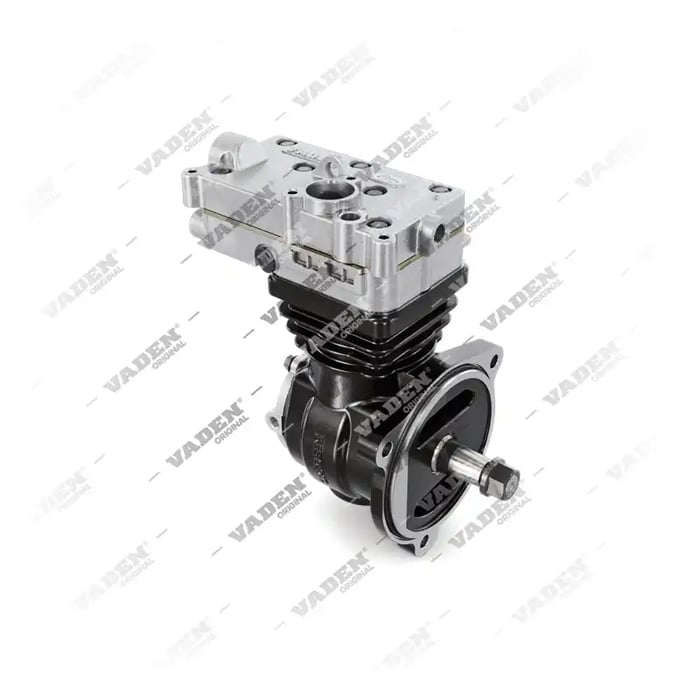
Need the part, not just the answer?
OE-grade air brake compressors and repair kits, manufactured and tested to commercial-vehicle standards.
Shop VADEN partsPublished by VADEN Original. Product links point to the manufacturer’s official catalogue. Specifications are general — always confirm figures against your vehicle’s service manual.