 airbrakecompressor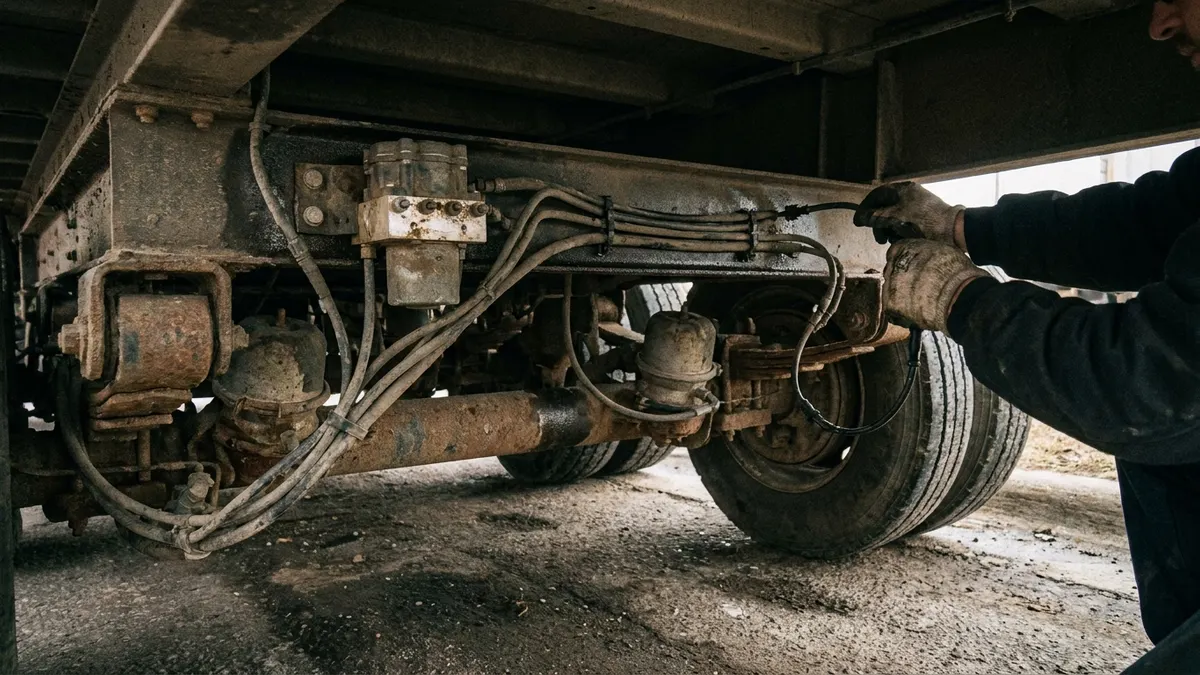
An ABS modulator valve is an electro-pneumatic valve fitted between the relay valve and the brake chamber that controls how much air actually reaches that wheel end during a stop. When the ABS ECU sees a wheel decelerating far faster than the vehicle, it energizes the valve's solenoids to hold chamber pressure, dump part of it, then let it rebuild — several times per second — so the wheel keeps rolling and the driver keeps steering. The modulator never creates pressure of its own and never applies a brake by itself; it can only restrict or vent air the driver has already commanded with the foot valve.
Where the modulator sits in the circuit
Air brakes are pneumatic, so everything downstream depends on stored air. The compressor charges the reservoirs through the governor and air dryer, cutting out somewhere in the 120–135 psi range and cutting back in around 100–110 psi, leaving a healthy system sitting near 120 psi. When the driver applies the treadle, a signal line tells the relay valve to open and feed reservoir pressure to the chambers. The ABS modulator is spliced into that delivery line, mounted as close to the chamber as the frame and axle allow. Hose length matters here — every extra foot between valve and chamber adds delay to both the dump and the reapply.
Layouts vary. Some axles use a combined relay-modulator valve mounted centrally; others use a stand-alone modulator per wheel end. Trailers are commonly built as 2S/1M or 2S/2M (sensors/modulators), while tractors typically run 4S/4M and up. Note that only the service side is modulated. Spring brakes begin to apply as pressure falls below roughly 45 psi and are fully applied near 20 psi, and no modulator can pulse that — a stop made on the spring brakes has no anti-lock protection at all.
How the valve modulates pressure
Inside a typical modulator are two solenoid pilots operating a pair of diaphragm valves: one controls the inlet from the relay valve, the other controls an exhaust port open to atmosphere. With both coils de-energized the valve is transparent — the wheel brakes exactly as the driver asked. Energizing one or both coils produces the anti-lock cycle.
| State | Hold (inlet) solenoid | Dump (exhaust) solenoid | What happens at the chamber |
|---|---|---|---|
| Normal braking | Off | Off | Air passes straight through; pressure follows the treadle |
| Hold | On | Off | Inlet closed; pressure frozen at its current value |
| Dump | On | On | Chamber air vents to atmosphere; braking force drops, wheel spins back up |
| Reapply | Off | Off | Pressure rebuilds toward the applied value and the cycle repeats |
The ECU decides which state to command from wheel speed sensor and tone ring signals, comparing each wheel against the others many times per revolution. On tractors with traction control, a separate valve can introduce air to the drive axle brakes to check a spinning wheel — but that is an ATC function, not something the service modulator does.
Symptoms of a failing modulator
Because the ECU monitors coil circuits continuously, most modulator faults show up as a warning lamp and a stored code long before the driver feels anything. Do not assume a lit lamp means the valve — read the codes first, then confirm.
| What you see | Usual cause |
|---|---|
| ABS lamp on, code for open or shorted modulator coil | Corroded or water-filled connector, chafed harness, failed solenoid winding |
| Constant air leak at the valve's exhaust port | Debris or corrosion holding the exhaust diaphragm off its seat |
| One wheel drags or releases late after every application | Contaminated valve slow to return to pass-through; also check chamber and slack adjuster |
| No solenoid click or chuff during the key-on self-check | Dead coil, lost power or ground, ECU output fault |
| Wheel still locks on gravel or ice with lamp off | Sensor gap or tone ring problem more often than the modulator |
A lit ABS lamp is a citable defect at roadside and it means the vehicle is stopping without anti-lock on at least one channel. For lamp behavior and what the codes mean, see the guide to the ABS warning light on trucks.
Testing before you replace
- Pull active and stored codes with a diagnostic tool or the blink-code procedure for that ECU, and note which channel is flagged.
- Cycle the key and listen at the suspect valve. Most systems energize each solenoid briefly during the self-check, giving an audible click or chuff.
- Inspect the connector for green corrosion, spread terminals and water intrusion, and pull-test the harness where it crosses the frame or air lines.
- Measure coil resistance at the valve, both coils, and compare with the manufacturer's specification — typically a low single-digit to mid single-digit ohm value. Open or grossly out-of-range means the valve is done.
- Command the channel with a scan tool while a helper holds a brake application. You should hear the valve dump and hear pressure release at that chamber only.
- Swap the connectors between two same-axle modulators if the tool allows. If the fault follows the connector, the problem is wiring; if it stays with the valve, replace the valve.
Replacing a modulator valve
- Park on level ground, chock the wheels, and drain the reservoirs so no line is under pressure before anything comes loose.
- Tag every port and line. Supply, delivery and exhaust are easy to confuse once the valve is off the bracket.
- Fit the new valve with the exhaust port pointing down and unobstructed, use fresh O-rings or thread sealant as specified, and torque fittings and mounting hardware to the OEM figures rather than by feel.
- Keep delivery hose length the same as original. Lengthening it slows response on that wheel.
- Match the part properly — port sizes, thread type, voltage and connector style all vary between builds. Replacement ABS solenoid modulator valves are catalogued by OE reference for that reason, and cross-referencing the number cast or labelled on the old valve is faster than guessing from the axle.
- Charge the system, leak-check every joint with soap solution, clear the codes, and run the tool's actuation test on that channel. Finish with a low-speed road test on a surface where you can confirm the lamp stays out.
What shortens modulator life
These valves rarely wear out from cycling. They fail from what gets into them and what happens around them. Oil and water carried past a saturated air dryer desiccant leave sludge on the diaphragms and seats, and that sludge is what keeps an exhaust cracked open or slows a valve's return. Road salt and pressure washing kill connectors. Vibration chafes harnesses against air lines and frame edges. Keeping the dryer serviced on schedule, draining tanks that should not be holding water, and dressing the wiring properly at every repair will do more for modulator life than any parts choice.
One last point on diagnosis: an anti-lock system can only work with the air it is given. If the truck is not holding a full charge, if a chamber is out of stroke, or if foundation brakes are out of adjustment, fix that first. A modulator cannot compensate for a brake that was never going to do its share of the work.
Need the part, not just the answer?
OE-grade air brake compressors and repair kits, manufactured and tested to commercial-vehicle standards.
Shop VADEN partsPublished by VADEN Original. Product links point to the manufacturer’s official catalogue. Specifications are general — always confirm figures against your vehicle’s service manual.