 airbrakecompressor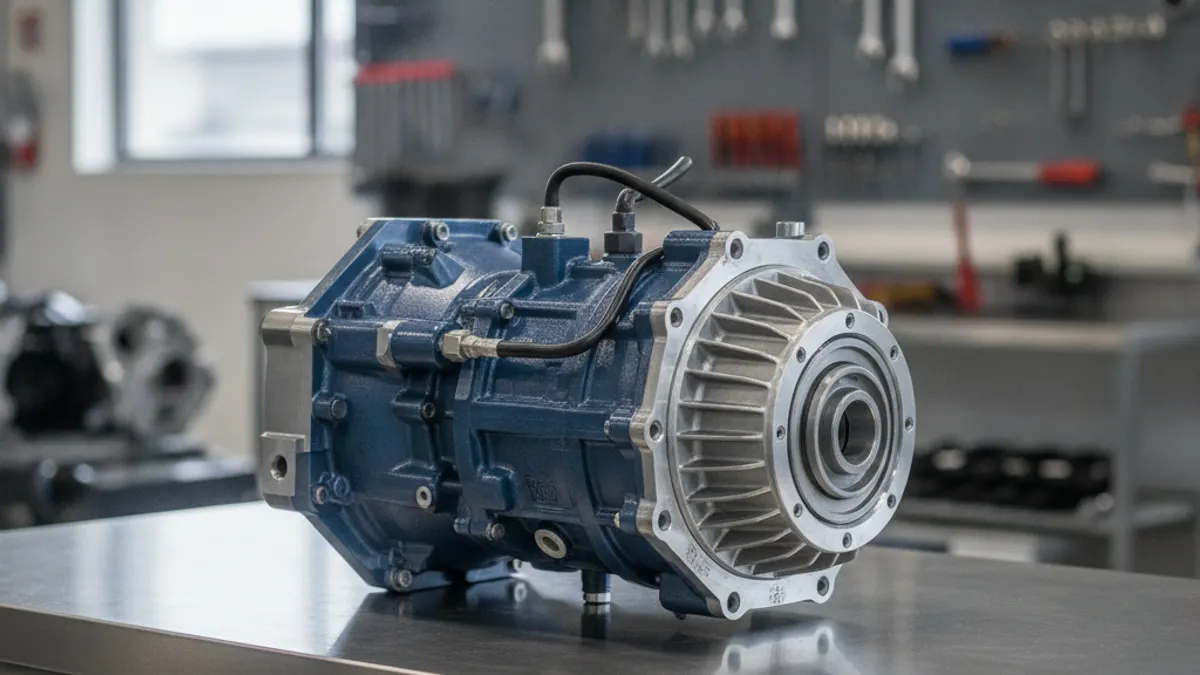
A transmission or driveline retarder is a secondary, wear-free braking device that slows a heavy truck by absorbing driveline energy and converting it to heat, so the service brakes stay cool. Hydraulic (fluid) retarders mount on or inside the transmission; driveline retarders are usually electromagnetic eddy-current units clamped onto the propeller shaft between the gearbox and the drive axle. Both act only through the driven wheels, both are commanded by a hand lever, stalk, or the first part of brake pedal travel, and neither can hold a parked vehicle: they make no braking force at zero speed. On an air-braked truck they work alongside the pneumatic foundation brakes, never in place of them.
What a retarder actually does
Every truck descending a grade has to shed the same amount of energy. The only question is where it goes. With the foot valve, it goes into the drums or rotors as heat and the linings pay for it. A retarder intercepts that energy upstream — at the transmission output or the driveshaft — and dumps it into engine coolant or into the air, so the foundation brakes stay cool and stay available for the stop that matters.
For a fleet that is the practical point: retarders do not replace service brakes, they preserve them. On long descents they are the difference between reaching the bottom with a full set of brakes and reaching it with faded, glazed linings. If you are chasing a brake fade problem on a truck that runs grades daily, an inoperative retarder is worth checking early.
Hydraulic (transmission) retarders
A hydraulic retarder is a rotor and a stator in a sealed housing. When you call for retardation, oil is admitted between the two. The rotor throws oil at the stationary stator vanes, the oil resists, and the drag is felt as braking torque. The energy becomes heat in the oil, which passes through a heat exchanger into the engine cooling system and out through the radiator.
Two mounting positions are common. A primary (input-side) retarder turns at engine or converter speed and stays effective in low gears at low road speed. A secondary (output-side) retarder turns at driveshaft speed, is strongest at highway speed, and tapers off as the truck slows. Many automatic transmissions in vocational and transit work carry an integral output retarder; European heavy tractors commonly use an intarder-style unit that shares the transmission oil circuit.
Braking effort is staged: selecting a higher stage admits more oil and raises torque. Because the heat ends up in the coolant, the control unit derates retardation as coolant temperature climbs — a truck with a marginal radiator, a plugged charge air cooler, or a lazy fan clutch loses retarder power exactly when it is needed most.
Driveline (eddy-current) retarders
An electromagnetic driveline retarder sits in the propeller shaft line. Rotor discs spin between fixed electromagnet coils; energising the coils induces eddy currents in the rotors, and the magnetic drag slows the shaft. Heat goes straight into the air off the finned rotors, so there is no coolant load — but there is a heavy electrical load, so the alternator and batteries have to be in good condition.
They are simple, retrofittable, and common on buses, refuse trucks, and vehicles that cannot easily take a transmission-mounted unit. Their weakness is heat soak: once the rotors glow after a long descent, output falls off until they cool. They also add driveline mass, so shaft balance and centre bearing condition matter.
Retarder vs engine brake vs exhaust brake
| Device | Where it acts | Where the heat goes | Relative power | Notes |
|---|---|---|---|---|
| Exhaust brake | Exhaust stream, restricts backpressure | Exhaust and coolant | Lowest | Cheap, quiet, best at high engine rpm |
| Compression-release engine brake | Cylinder head, valve actuation | Exhaust and coolant | Moderate to high | Loud; restricted in many towns |
| Hydraulic transmission retarder | Transmission input or output shaft | Engine coolant via heat exchanger | Highest sustained | Quiet; derates when coolant is hot |
| Eddy-current driveline retarder | Propeller shaft | Ambient air off the rotors | High, but fades when hot | Heavy electrical draw; retrofittable |
In practice these are layered, not chosen. An integrated braking strategy brings in the exhaust brake first, then the compression-release brake, then the retarder, all from one stalk or from downhill cruise speed hold. For a fuller side-by-side of the three families, see our Jake vs exhaust vs retarder comparison.
How the air system ties in
Retarder controls on many trucks are air-operated, fed from an auxiliary circuit downstream of a pressure protection valve. That is deliberate: if supply pressure falls, the protection valve isolates the accessory circuit so the primary and secondary brake circuits keep the air that is left. A healthy system cycles the governor between roughly 100–110 psi cut-in and 120–135 psi cut-out, and a fully charged truck sits around 120 psi; the low-air warning is required to come on by about 60 psi. A weak compressor or a leak that drags running pressure below the normal band can therefore knock out the retarder before the driver notices anything else.
Retarders also talk to ABS. Because retardation acts only through the drive wheels, full retarder torque on a wet, icy, or gravel surface can break the drive axle loose and start a jackknife. Well-designed systems cut retarder output the moment the ABS controller sees drive-wheel slip. Do not defeat that logic, and do not lean on the retarder in poor traction.
A retarder is a speed-reducing device, not a stopping device and never a parking device. Braking torque falls with shaft speed and reaches zero at a standstill — the spring brakes, applied by exhausting air, are what hold the vehicle.
Using a retarder correctly on a grade
- Select the descending gear before the grade, while you still have engine speed to work with. A retarder cannot rescue a truck already overspeed in too high a gear.
- Set the retarder to a stage that holds your target speed with the foot valve released. If you are still gaining speed on the top stage, you are in too high a gear.
- Snub with the service brakes for the extra speed the retarder cannot handle — firm applications down to target speed, then release and let things cool.
- Watch coolant temperature on hydraulic units. If it climbs toward the top of the normal band, back off a stage and take more of the load on gearing.
- Switch the retarder off, or expect it to be cut automatically, on wet, icy, or loose surfaces.
Common faults and what they point to
- Weak or no retardation, no warning lamp: low oil level in a hydraulic unit, a sticking proportioning valve, or lost air supply to the control valve.
- Retardation that quits after a minute: thermal derate. Suspect cooling capacity — restricted radiator core, failed fan clutch, air in the coolant, or a fouled heat exchanger.
- Coolant loss with oil contamination, or oily coolant: internal heat exchanger leak on a hydraulic retarder. Stop using it and have it inspected.
- Driveline vibration that appeared after retarder work: rotor or shaft balance, worn centre bearing, or incorrect phasing on an eddy-current installation.
- Dim lights or low charging while retarding: normal load on an electromagnetic unit, but excessive if batteries or alternator are tired.
- Fault codes with no retarder response: most units sit on the vehicle datalink — read codes before condemning hardware.
Does a retarder change your brake inspection?
No. Auxiliary braking earns no credit at a roadside inspection: pushrod stroke, lining thickness, and air loss rate are judged the same on a retarder-equipped truck. A retarder makes linings last longer; it does not make an out-of-adjustment brake legal. Keep the foundation brakes in spec, and take torque, pressure, and temperature limits for a specific unit from the vehicle manufacturer's current service manual.
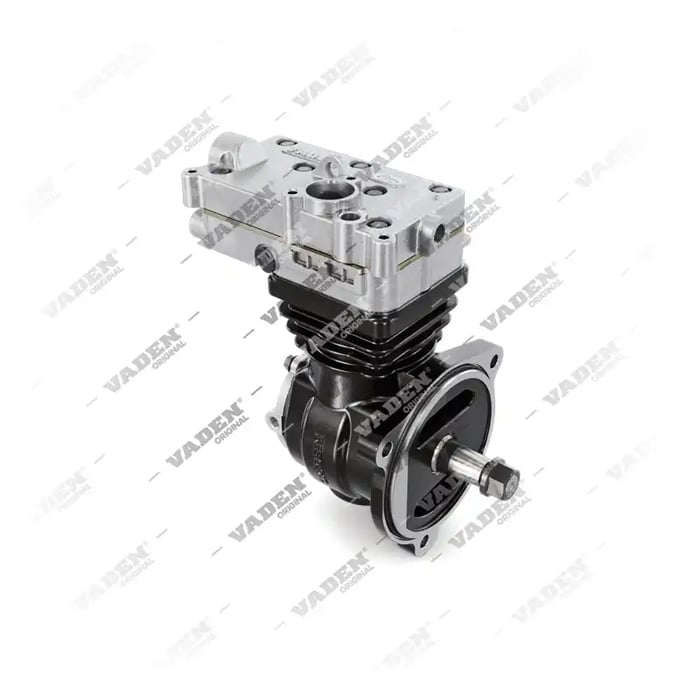
Need the part, not just the answer?
OE-grade air brake compressors and repair kits, manufactured and tested to commercial-vehicle standards.
Shop VADEN partsPublished by VADEN Original. Product links point to the manufacturer’s official catalogue. Specifications are general — always confirm figures against your vehicle’s service manual.