 airbrakecompressor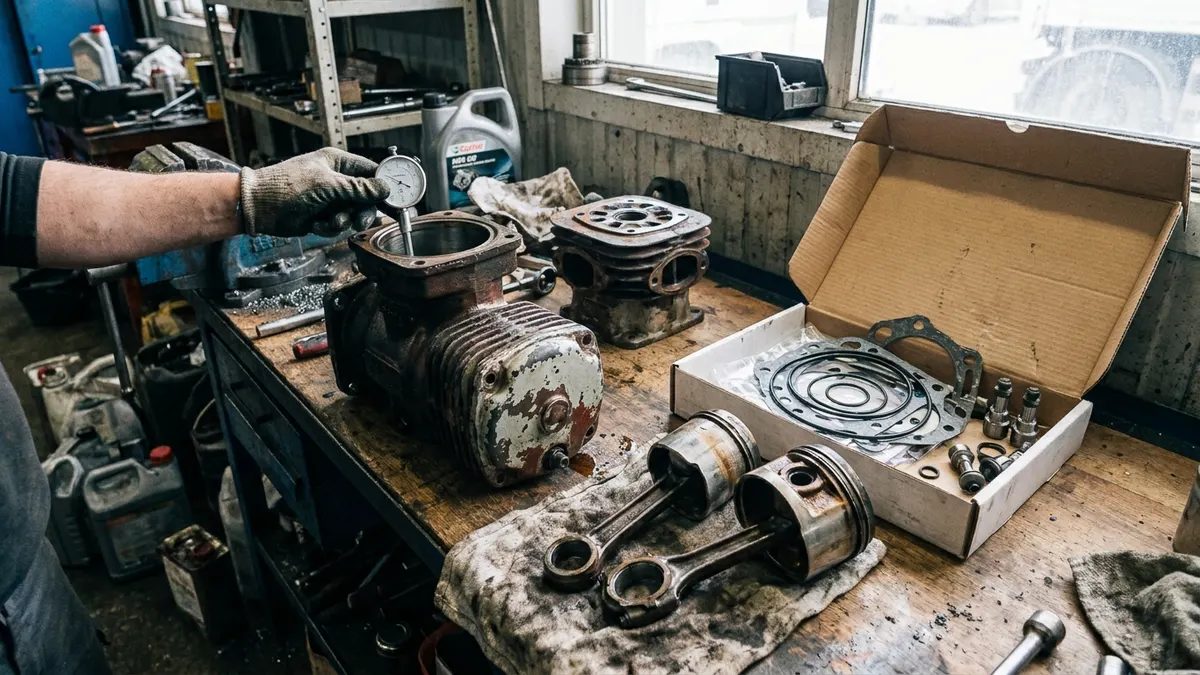
Worn compressor piston rings let engine oil past the piston into the air side, and let compressed air blow back down into the crankcase. That produces two symptoms at once: oil showing up downstream at the air dryer, wet tank and discharge line, and a compressor that takes longer than it should to pump the system up — sometimes struggling to reach a normal governor cut-out of 120 to 135 psi. Before you order a ring kit, prove the rings are the fault. Several cheaper problems look identical from the driver's seat.
What the rings do in an air brake compressor
An engine-driven air brake compressor is a small reciprocating pump, and it uses a ring pack much like an engine does: one or two compression rings at the top of the piston that seal the air charge during the compression stroke, and an oil control ring lower down that scrapes crankcase oil back into the sump. The compressor is fed from the engine's oil supply — pressure-fed through the mounting flange or a dedicated line — and on most heavy-duty units it shares engine coolant as well. Those rings are the only barrier between pressurized engine oil and the air that ends up in your tanks.
Rings wear with hours, but they usually die early from heat and carbon. A compressor loaded more than roughly a quarter of the engine's running time — because of system leaks, a leaking unloader, or a governor that will not cut out — runs hot, cokes oil in the ring grooves and the discharge line, and the rings seize in place. Once they stop moving, they stop sealing.
Symptoms of worn piston rings
- Oil at the air dryer purge: a wet oily ring on the ground under the dryer, or a soaked desiccant cartridge.
- Oil and grey emulsified sludge when you drain the wet tank, instead of clean condensate.
- Slow pressure build. The common benchmark on a dual system is roughly 85 to 100 psi in about 45 seconds at fast idle; well beyond that with no audible leaks points at the pump.
- Constant cycling — pressure falls to cut-in (typically 100 to 110 psi), the compressor loads, and it never gets far ahead of demand.
- Hard carbon in the discharge line and at the compressor head, sometimes enough to choke the port.
- Swollen O-rings and diaphragms in downstream valves, because oil attacks the rubber.
None of that is proof by itself. Every compressor passes a trace of oil, and a healthy air dryer is designed to handle it. The picture that matters is oil plus falling output, and it is worth reading the full breakdown of causes in why an air brake compressor pumps oil before condemning anything.
Confirm ring wear before you tear anything down
Rule out the look-alikes
- Restricted intake. A plugged compressor air filter or collapsed inlet hose creates vacuum in the bore that will pull oil past healthy rings. Check the filter or inlet source first — it is the cheapest fix on the list.
- Oil arriving with the intake air. Many compressors draw from the engine's intake tract. A leaking turbo seal or a crankcase ventilation system dumping oil mist into the charge air feeds the compressor oil it never made itself.
- Blocked oil return. Drain-back designs rely on gravity return through the mounting flange. Sludge or a kinked return line floods the compressor crankcase and the rings simply cannot keep up.
- Engine blowby. High crankcase pressure pushes oil up the bore. Measure it before blaming the compressor.
- Leaks and duty cycle. A system that loses more than about 2 psi per minute static on a straight truck, or 3 psi on a combination, keeps the compressor loaded and cooking. Fix leaks first, then reassess.
- Unloader or governor faults. A leaking unloader assembly, or a governor stuck in the unloaded position, produces low output with no ring wear at all. These are bench-checkable in minutes and cost far less than a teardown.
Measure what you can
With the head off, the evidence is usually obvious. Try to move each ring in its groove with a pick — carbon-locked rings tell you the story immediately. Look down the bore for vertical scoring, mirror glazing and a wear ridge at the top of ring travel. Then take numbers: ring end gap measured with the ring squared in the bore, ring side clearance in the groove with a feeler gauge, and bore taper and out-of-round with a bore gauge. Compare every reading against the published limits for that specific compressor model — do not borrow specs from another family, because bore sizes and ring thickness vary even within one manufacturer's range.
What a piston ring kit covers
| Component | In a ring kit | Why it matters |
|---|---|---|
| Compression rings (per cylinder) | Yes | Seal the charge above the piston; restores output |
| Oil control ring and expander | Yes | Stops oil carryover into the air side |
| Head, valve plate and base gaskets | Usually | You cannot reuse them once the unit is split |
| Flange and adapter O-rings | Usually | Seals the oil and coolant interfaces at refit |
| Inlet and discharge valve plates | Sometimes | Worn valves cause low output on their own |
| Unloader plungers, springs, seals | Separate kit | Governs load/unload; common leak point |
| Pistons, pins, connecting rods | Overhaul kit only | Needed if the pistons are scuffed or grooves are worn |
| Crank bearings and shaft seals | Overhaul or reman | End-play and seal wear are separate failures |
Match the kit by compressor model and casting or part number, not by appearance. Single and twin-cylinder units in the same family share castings but not ring dimensions, and some kits are supplied in oversize where the bore is designed to be honed. OE-grade air brake compressor repair kits are catalogued against the original compressor references from Bendix, Wabco/ZF, Knorr-Bremse and the truck OEMs, which is the safest way to get the right ring pack the first time.
Ring kit or replacement compressor
Rings are a sound repair when the bore is within taper and out-of-round limits, unscored, and the crank end-play and bearings check good. They are the wrong repair when the bore is scored or plated (many modern bores cannot be honed), the head is cracked or the deck is warped, or the unit already has high hours on a previous overhaul. Weigh it against labour: the compressor comes off the engine either way, along with coolant lines, oil feed and the drive gear or belt. The trade-off is laid out in more detail in our comparison of rebuilding versus replacing an air compressor.
Installation details that decide whether the repair holds
Clean the ring grooves completely — carbon left behind will lock new rings within weeks. Fit rings with the marked face up, use an expander for the oil control ring, and stagger the gaps around the bore to the manufacturer's pattern rather than lining them up. Use a ring compressor; never tap a piston in. Fit new gaskets, torque the head in the specified sequence and values, and prime the oil feed before the unit turns under load.
Two extra jobs are not optional after an oil-passing failure. Clean or replace the discharge line: hardened carbon in that line restricts flow, drives head temperature up, and is often the reason the previous compressor cooked. And fit a fresh air dryer desiccant cartridge, because an oil-saturated cartridge will not recover and will pass contamination straight back into the tanks.
Clean the rest of the system
Oil that got past the rings is already downstream in the wet tank, the dryer, and the rubber inside relay and control valves. Drain all reservoirs, inspect valve exhausts for oil residue, and replace any component showing swollen seals — full procedure in our guide to air system decontamination. Finish by verifying the repair on the vehicle: time the build from about 85 to 100 psi, confirm governor cut-out and cut-in fall in the 120 to 135 psi and 100 to 110 psi ranges, check leak-down, and confirm the low-air warning still trips near 60 psi with spring brakes applying in the 20 to 45 psi band before the truck goes back into service.
Need the part, not just the answer?
OE-grade air brake compressors and repair kits, manufactured and tested to commercial-vehicle standards.
Shop VADEN partsPublished by VADEN Original. Product links point to the manufacturer’s official catalogue. Specifications are general — always confirm figures against your vehicle’s service manual.