 airbrakecompressor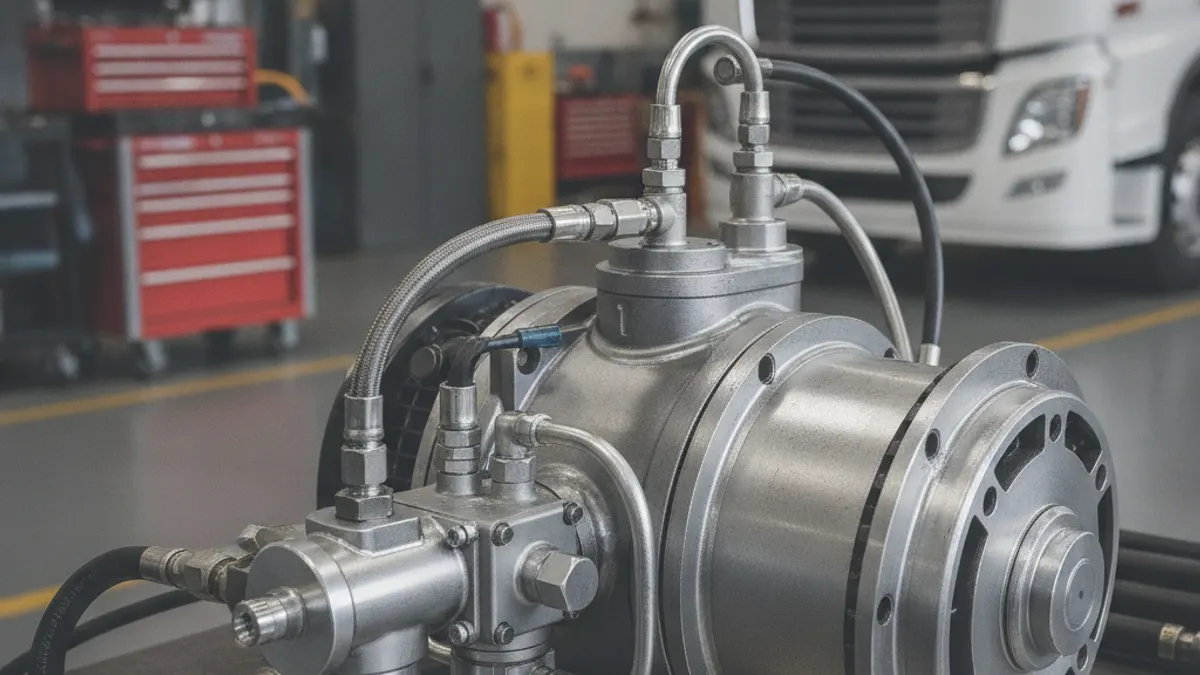
Wabco is an original-equipment supplier of air brake and air management systems for heavy commercial vehicles: compressors, governors, air dryers, brake and relay valves, brake chambers, disc brakes and ABS/EBS electronics. The business is now part of ZF, so newer hardware and literature carry ZF branding while the familiar Wabco part-number format stays in use. On most European-built trucks, buses and trailers the air system is Wabco-designed, and the number on the component, not the vehicle model, is what you order against.
This page covers what the main part families do, how to identify what is fitted, and what matters when you replace one.
Wabco, ZF and the Bendix confusion
The Wabco name traces back to the Westinghouse Air Brake Company, and over the decades the air brake world split into several businesses that share that ancestry. Three names dominate original equipment on commercial vehicles today: Wabco (now ZF), Knorr-Bremse, and Bendix, which is Knorr-Bremse's North American arm. That is why a European chassis and its North American equivalent can carry functionally similar valves under different brands. Wabco also ran a long-standing North American joint venture with Meritor for trailer ABS before taking full ownership, so older trailer units in the field may still carry that period's labelling.
None of this changes the diagnosis. Air brake physics is the same regardless of the badge; only part numbers, port layouts and diagnostic protocols differ. For a side-by-side of the three OE compressor families, see the compressor brand comparison.
The main Wabco part families
| Group | Typical components | Function on the vehicle |
|---|---|---|
| Air supply | Single- and twin-cylinder compressors, governor (pressure regulator), unloader, air dryer with cartridge, purge valve | Generates, regulates and dries the compressed air that feeds the whole system |
| Air distribution | Four-circuit (multi-circuit) protection valve, check valves, pressure protection valves, drain valves | Splits supply into independent circuits and protects each one if another fails |
| Control valves | Dual foot brake valve, relay valves, quick-release valves, hand and park control valves, trailer control valve, load-sensing (ALB) valve | Meters driver demand to the chambers and speeds application and release |
| Actuation and foundation | Service chambers, spring brake (combination) chambers, slack adjusters, pneumatic disc brake calipers | Converts air pressure into clamping force at the wheel end |
| Electronics | ABS modulators and ECUs, tractor and trailer EBS, roll stability, electronic air suspension control | Modulates pressure electronically for stability, wear balance and faster response |
Two families account for most workshop traffic: the air supply group, because it wears with duty cycle and contamination, and the control valves, because seals harden and leak with age and moisture.
Air supply: compressor, governor, dryer
The compressor is engine-driven and turns continuously; the governor decides when it actually pumps. On a North American system the governor typically cuts out somewhere around 120-135 psi and cuts back in around 100-110 psi, with a fully charged system sitting near 120 psi and the low-air warning coming on around 60 psi. European chassis commonly run higher system pressures, so use the chassis manufacturer's current service data rather than a rule of thumb when setting or judging cut-out.
If pressure builds slowly, cycles constantly, or never reaches cut-out, work through the governor and unloader circuit before condemning the compressor. A leaking unloader or a blocked governor signal line mimics a worn compressor closely.
Downstream, the air dryer does the work that keeps every valve in the system alive. It removes moisture and oil aerosol, purges the collected contaminant at each governor cut-out, and on many installations carries the four-circuit protection valve on the same body. A saturated cartridge lets oil and water through to the tanks and valves, where they cause sticking, corrosion and winter freeze-ups. Cartridge replacement on a fixed interval is the cheapest insurance in the whole air system; the air dryer service guide covers intervals and symptoms.
Identifying the part you actually have
Do not order from the vehicle model alone. Wabco components carry a part number on the housing, cast, stamped or on a label, normally shown as a ten-digit number in grouped form. Many housings also carry a production date code, and valves carry port lettering or a flow arrow.
- Read the number off the part, not the invoice. Mid-life running changes are common on long production chassis.
- Match port layout and thread. Metric ports on European hardware, imperial on North American; the same valve function exists in both.
- Check the pressure and flow rating. A relay valve with the wrong crack pressure changes balance between axles even though it bolts straight on.
- Note the mounting and drive. On compressors, gear versus belt drive, flange pattern, coolant and lubrication connections, and single versus twin cylinder all matter.
- Photograph the label before removal. On corroded units the number is often only legible in situ.
Pneumatics versus electronics
Purely pneumatic components (compressors, governors, dryers, relay and quick-release valves, protection valves, chambers) are mechanical replacements: match the number, fit clean, leak test, road test.
ABS modulators, EBS modules and trailer EBS units are a different job. They hold parameters such as axle configuration, wheel and tyre data, chamber sizes and suspension type, which must be written or matched, and many require an end-of-line procedure and a diagnostic session before the warning lamp will extinguish. Fitting a used or unparameterised unit from another vehicle turns a two-hour job into a two-day one.
If the part has an electrical connector on it, budget for a diagnostic tool and the correct parameter set as part of the repair.
OE-grade replacement: what to demand from a supplier
Replacing a Wabco-supplied component with an OE-grade equivalent is normal fleet practice, and for compressors especially it is often the pragmatic choice. What separates a sound replacement from a warranty claim is verifiable equivalence, not price:
- Dimensional and interface equivalence: mounting flange, drive gear or pulley, port positions, thread sizes and head configuration.
- Duty-cycle capability: displacement and cooling arrangement suited to the original application, not merely a similar-looking casting.
- Material and machining quality at the bore, valve plate and bearings; weak units fail here first, usually as oil carryover into the dryer.
- Documented cross-reference to the original number, published rather than quoted verbally.
- Warranty terms in writing, ideally with a stated inspection or test procedure.
Whichever route you take, replace the air dryer cartridge at the same time as a compressor, drain and inspect the tanks, and check the discharge line for oil coking. A new compressor pushed into a contaminated system inherits the problem that killed the old one.
Quick symptom-to-component map
| Symptom | Check first | Then |
|---|---|---|
| Slow build, never reaches cut-out | Governor and unloader, supply line restriction | Compressor condition, dryer purge stuck open |
| Oil in tanks or at dryer purge | Dryer cartridge saturation | Compressor oil carryover |
| Water in tanks despite a dryer | Cartridge age, purge valve operation | Compressor duty cycle, system leaks |
| Brakes slow to release | Relay and quick-release valve exhausts | Kinked lines, foot valve return |
| Pressure drop in one circuit only | Multi-circuit protection valve, that circuit's lines | Chamber diaphragm, valve seals |
| ABS or EBS lamp on | Fault codes via diagnostic tool | Sensor gap, wiring, modulator |
Work the pneumatics with a gauge set and soapy water before reaching for parts. Most Wabco-equipped systems labelled "compressor failure" turn out to be a leaking control valve, a saturated dryer, or a governor doing exactly what a bad signal line told it to do.
Where the gauge does clear the valves and point back at the pump itself, OE-grade air brake compressors are identified by engine family and mounting flange rather than by the badge on the truck.
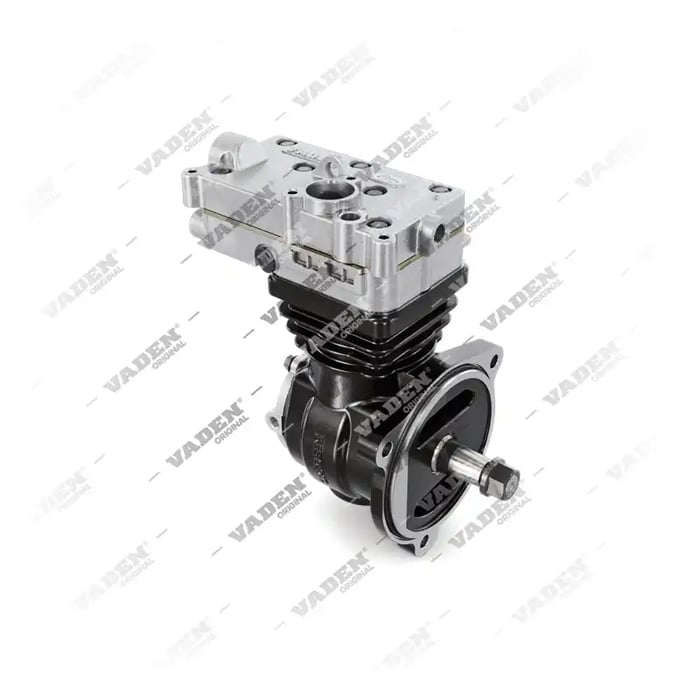
Need the part, not just the answer?
OE-grade air brake compressors and repair kits, manufactured and tested to commercial-vehicle standards.
Shop VADEN partsPublished by VADEN Original. Product links point to the manufacturer’s official catalogue. Specifications are general — always confirm figures against your vehicle’s service manual.