 airbrakecompressor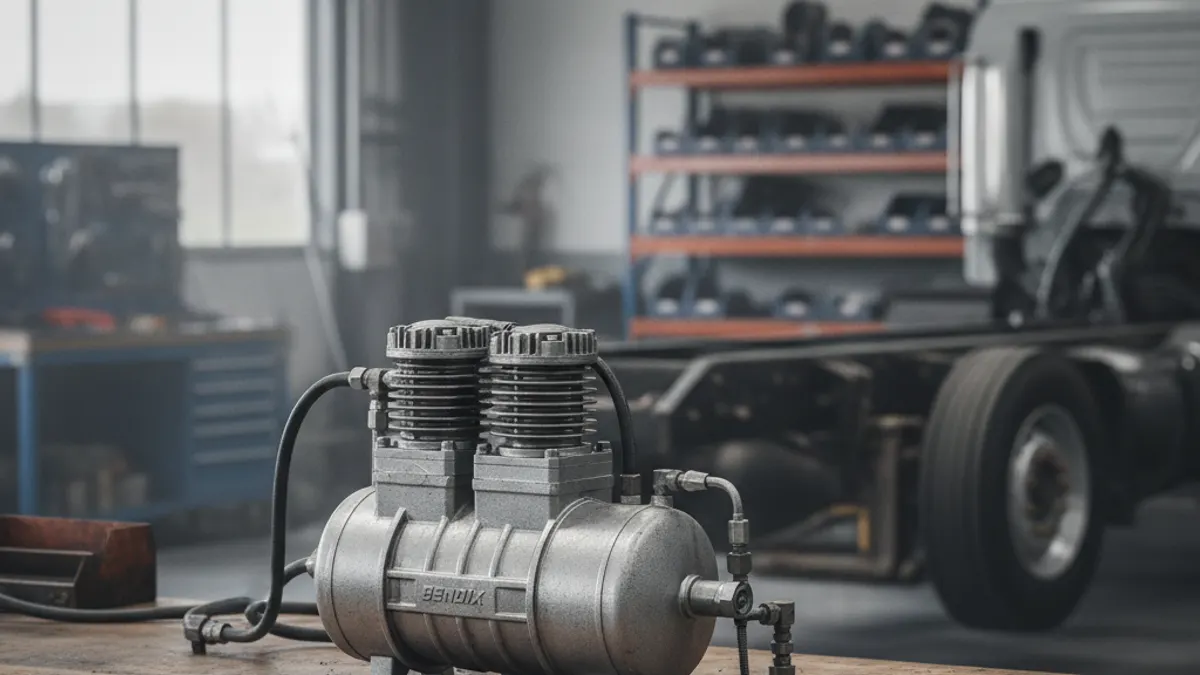
Bendix, Wabco (now part of ZF) and Knorr-Bremse supply most of the air brake compressors fitted as original equipment to heavy trucks, buses and coaches: Bendix dominates North American engines, while Wabco and Knorr-Bremse dominate European and export platforms. None of the three is a single part. A "Bendix air compressor" is a family of engine-driven reciprocating pumps — Tu-Flo, BA and DuraFlo are the best-known lines — that feed compressed air into a pneumatic brake system, and Wabco and Knorr-Bremse are organised the same way. Cross-referencing between them, or across to an OE-grade aftermarket unit, only works when the mounting flange, drive method, cooling, oil feed and port layout all match. The brand cast into the housing tells you very little about fitment on its own.
Who actually makes what
The three names cover most OE fitments, but the corporate lines have shifted and the catalogues have not always followed. Bendix Commercial Vehicle Systems has been part of the Knorr-Bremse Group since the early 2000s, so a Bendix-badged compressor and a Knorr-Bremse unit can share engineering while still using entirely separate part numbering and hardware. Wabco was acquired by ZF Friedrichshafen in 2020, and current parts may be badged Wabco, ZF, or both. None of that changes what sits on the engine, but it does explain why the same casting sometimes appears under two numbering systems.
| Make | Typical market and platforms | Common families | Part number style |
|---|---|---|---|
| Bendix | North American highway tractors and vocational trucks; Cummins, Detroit, PACCAR, Mack and Volvo NA engines | Tu-Flo (single and twin), BA series, DuraFlo, BX series | Piece number stamped or cast on a machined pad on the crankcase, often paired with an engine-maker number |
| Wabco / ZF | European trucks, buses and trailers; MAN, DAF, Iveco, Mercedes-Benz, Volvo, Renault | Single- and twin-cylinder ranges, air- and water-cooled heads | Ten-digit number, normally split into blocks on the housing tag |
| Knorr-Bremse | European and Asian trucks and buses; Scania, MAN, Mercedes-Benz, DAF, Volvo | LK-prefixed design numbers, single and twin cylinder | LK design number cast in, plus a separate K-prefixed order number on the label |
Reading the number on the unit
Before you cross-reference anything, take the number off the compressor itself rather than off a parts invoice. On Bendix units the piece number is usually stamped on a machined pad on the crankcase, sometimes alongside a build date. Wabco and Knorr-Bremse units carry a data label or an etched plate on the crankcase or head with the full order number; the cast-in number you can still read through the grime is often only the design or foundry number, not the service part number.
The engine maker's own number matters too. Cummins, Mercedes-Benz, Scania and DAF all issue their own part numbers for the same physical compressor, and that number is usually what the fleet has in its maintenance system. A useful cross-reference works in both directions: engine-maker number to compressor-maker number, and back again. If the two disagree, trust the plate on the unit you removed.
What has to match for a compressor to fit
Most "wrong part" returns are not a wrong brand — they come down to one of the interface details below. Work through the list with the old unit in front of you.
| What to check | Why it matters |
|---|---|
| Mounting flange and bolt pattern | Two-, three- and four-bolt flanges and SAE pads are not interchangeable; bolt circle and pilot diameter must both match. |
| Drive type | Gear-driven units bolt to the timing case and need the correct gear, spline or keyed taper; belt-driven units need the right pulley and shaft. |
| Rotation direction | Some castings are handed. The wrong rotation can starve the oil feed. |
| Cooling | Air-cooled versus water-cooled head. A water-cooled unit needs live coolant ports; an air-cooled unit on a high-duty application will run hot. |
| Inlet arrangement | Naturally aspirated (own filter, or a feed from the engine air cleaner) versus boosted from the charge side. Feeding a non-boost unit with turbo pressure causes oil passing. |
| Oil and coolant feed | External pressure line versus feed through the mounting flange. A blocked or mismatched gallery is the fastest way to kill a new compressor. |
| Discharge port size and thread | Metric versus imperial, plus enough discharge line length to shed heat before the air dryer. |
| Unloader arrangement | Integral unloader with a remote governor, or a governor mounted directly on the compressor head. The control plumbing must match. |
| Rated output | Match or exceed the original displacement class. Undersizing means a higher duty cycle and more oil carried into the dryer. |
Output is normally quoted in cubic feet per minute at a stated compressor speed, and the figure only means anything at that speed. Highway units broadly span the low teens to the low twenties cfm at rated speed, with vocational and coach applications toward the top of that band, but take the published figure for the specific model from the maker's own data rather than assuming two units in the same family share output. If you are weighing a smaller single against a twin, the trade-offs are covered in single vs twin cylinder air compressors.
Where OE-grade aftermarket units fit in
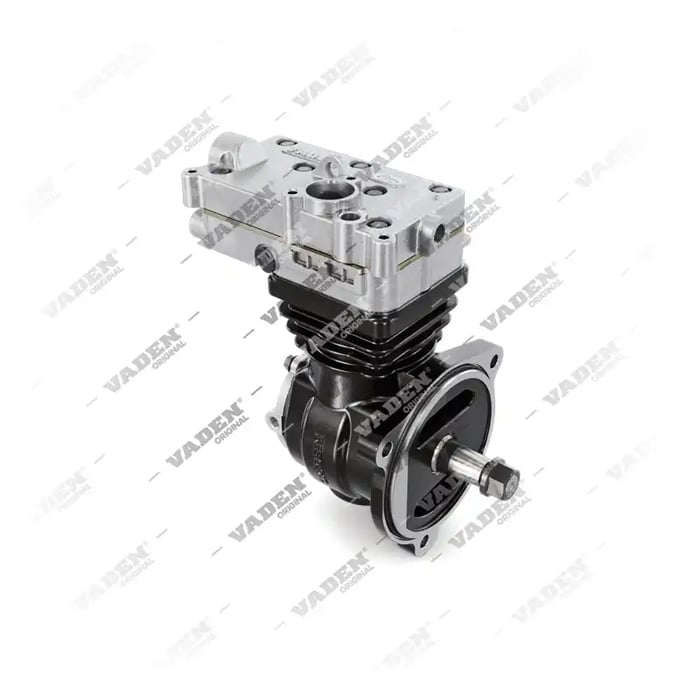
There are three realistic sources: a new OE-branded unit, a remanufactured OE core, or a new OE-grade aftermarket compressor built to the same interface and output specification. The third option has grown because it offers new castings and new wear parts rather than a rebuilt core of unknown history, at a price between the other two. VADEN Original, for example, manufactures OE-grade air brake compressors cross-referenced to Bendix, Wabco and Knorr-Bremse numbers, which is the practical way to search when all you have is the number stamped on the old unit.
Whatever you buy, judge it on the same criteria: correct interface, matched or better output, hardened liner and crankshaft, and a warranty that covers the unit fitted to the engine rather than only over the counter. The wider sourcing argument is set out in OE vs aftermarket truck air compressors.
Before you order a replacement
Confirm the old compressor is genuinely at fault. A system that will not build to a normal fully charged pressure of around 120 psi, or that cuts out low, is just as often a leaking governor, a stuck unloader, a failed dryer purge valve or a plumbing leak. Compressors that pass oil are frequently the victim of a restricted inlet or a saturated dryer rather than the cause of the problem. With a test gauge on the service reservoir, check that the governor cuts out within the usual 120-135 psi band, cuts back in at roughly 100-110 psi, and that the low-air warning still trips at around 60 psi.
Then plan the swap properly: drain the tanks, replace the discharge line rather than reusing a carboned one, fit a new dryer cartridge at the same time, and prime the oil feed before cranking. The full procedure is in the air brake compressor replacement guide.
Always work to the vehicle manufacturer's current service manual for torque, clearance and pressure values. Published ranges are a sanity check, not a specification.
Need the part, not just the answer?
OE-grade air brake compressors and repair kits, manufactured and tested to commercial-vehicle standards.
Shop VADEN partsPublished by VADEN Original. Product links point to the manufacturer’s official catalogue. Specifications are general — always confirm figures against your vehicle’s service manual.