 airbrakecompressor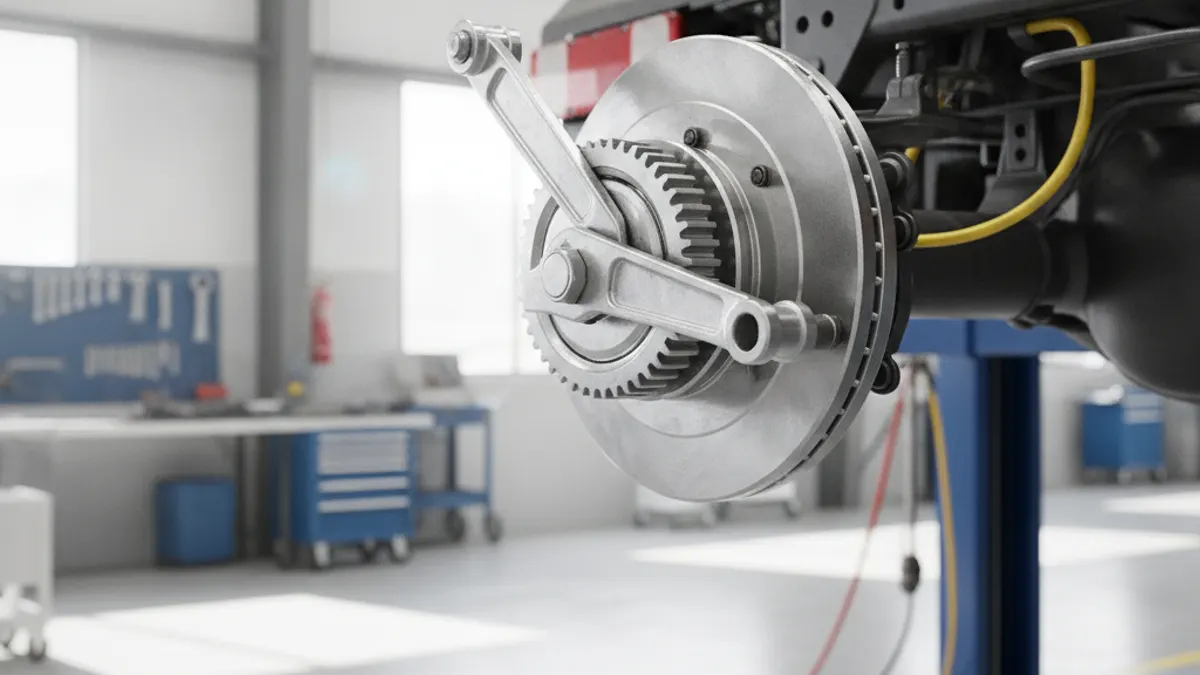
A Meritor slack adjuster is the lever that connects the brake chamber pushrod to the S-camshaft on a pneumatic foundation brake, and the automatic version (ASA) also takes up lining wear on its own so pushrod stroke stays inside the legal limit. Meritor, formerly Rockwell and part of Cummins since 2022, supplies these units as original equipment on heavy trucks, buses and trailers, alongside its own S-cam drum brakes and air disc brakes. Ordering the right replacement comes down to matching four specs and setting the correct installation angle. Servicing it correctly comes down to grease and stroke measurement, not repeated manual adjusting.
What the slack adjuster does
Air pressure pushes the chamber pushrod out, the pushrod swings the slack adjuster arm, the arm rotates the S-camshaft, and the cam spreads the brake shoes against the drum. Because the adjuster is a lever, its center-to-center length sets the torque applied at the cam. That is why substituting a different length changes brake balance across an axle even when the part bolts on without complaint.
On an automatic unit, an internal one-way clutch senses that the arm has swung past its designed free-stroke window and indexes the worm gear a few degrees to compensate. A control arm, or link, anchored to a fixed point provides the reference the mechanism measures against; that anchor is usually the chamber mounting bracket or a bracket on the axle. If the link is bent, loose or anchored to the wrong point, the adjuster will either under-adjust, giving long stroke and weak braking, or over-adjust, dragging the shoes and overheating the drum. The general mechanism is covered in our slack adjuster overview.
The supply side sets the ceiling
None of this works without stable air pressure. The compressor and governor charge the reservoirs, with cut-out typically in the 120 to 135 psi range and cut-in around 100 to 110 psi, and the low-air warning device has to signal at roughly 60 psi. A vehicle that never reaches full charge gives weak, uneven braking that no amount of slack adjuster work will cure, so confirm the supply system before condemning foundation components.
Identifying the correct Meritor slack adjuster
Do not order by axle model alone. Pull the old unit, or measure it in place, and confirm each of the following.
| Spec | What to check | Why it matters |
|---|---|---|
| Spline count | Count the internal splines in the camshaft bore; 10, 28 and 37 spline are the common heavy-duty counts | The wrong count will not seat, and forcing it damages the cam spline |
| Center-to-center length | Cam bore center to clevis pin center, typically in the 5 to 7 inch range | Sets applied cam torque and side-to-side brake balance |
| Control arm and anchor | Link length, bracket location, and whether the anchor bolts to the chamber bracket | Determines the reference the automatic mechanism measures against |
| Hand and installation angle | Left or right hand, plus the specified arm-to-pushrod angle | Roughly 90 degrees at full application is the target on most installations |
| Body style and clearance | Straight or offset body, clearance to the chamber, frame and suspension | Interference causes false stroke readings and broken control arms |
| Chamber type | Type 20, 24 or 30 service, or 24/30 and 30/30 spring brake | Chamber size and stroke class set the readjustment limit |
Meritor automatic units are commonly cataloged under R80-series part numbers, usually stamped or cast into the body. When the casting is unreadable, measure rather than guess: a half-inch length difference is easy to miss by eye and shows up later as a pull under braking.
Foundation brakes the adjuster works with
Most Meritor slack adjusters ride on the company's S-cam drum foundation brakes, including the Q Series and Q Plus families in sizes such as 16.5 x 7 inch and 16.5 x 8-5/8 inch on tractor drive axles, and narrower 15 x 4 inch assemblies on some steer and trailer positions. Each shoe pivots on a fixed anchor pin at one end and rides the cam head at the other, with return springs pulling the shoes clear when air is released.
Meritor also builds air disc brakes for steer and drive positions. Air disc calipers adjust internally through the caliper's own mechanism, so there is no external slack adjuster to set or grease, which is a quick identification cue on an unfamiliar spec. For the drum side in detail, see S-cam foundation brakes.
Stroke limits
An automatic slack adjuster is doing its job only if pushrod stroke stays short. Charge the system to governor cut-out, shut the engine down, release the parking brakes, let reservoir pressure settle to about 90 to 100 psi, then hold a full brake application and measure pushrod travel. The values below are the readjustment limits for standard clamp-type chambers used in roadside inspection.
| Chamber type | Standard stroke limit | Long stroke limit |
|---|---|---|
| Type 12 | 1-3/8 in | 1-3/4 in |
| Type 16 | 1-3/4 in | 2 in |
| Type 20 | 1-3/4 in | 2 in |
| Type 24 | 1-3/4 in | 2 in, or 2-1/2 in on 3 in maximum-stroke units |
| Type 30 | 2 in | 2-1/2 in |
| Type 36 | 2-1/4 in | Not commonly cataloged |
Long stroke chambers are identified by a square-cornered access plug or a trapezoidal marking on the housing, as well as by the size stamping. When 20 percent or more of the service brakes on a vehicle are defective, including brakes at or beyond the readjustment limit, the vehicle is placed out of service.
Installation and setup
- Clean and inspect the camshaft splines. Pitted or twisted splines mean the camshaft is due as well, because a new adjuster on a worn spline will not hold its setting.
- Check camshaft end play and bushing condition. Excess play lets the cam wander and produces erratic stroke that no adjuster can correct.
- Fit the adjuster, set the specified angle between the arm and the pushrod, then connect the control arm to its anchor without preload.
- Bring the linings to light drum contact with the adjusting hex, then back off per the manufacturer's procedure so measurable free stroke is present.
- Cycle the brakes several times at full application and re-measure stroke at both ends of the axle. Readings should be within about a quarter inch of each other.
Cranking the adjusting hex to chase long stroke is the classic mistake. On an automatic unit it only masks a seized cam bushing, a collapsed spring brake, a worn internal clutch, or lining at the end of its life. The correct sequence is laid out in how to adjust a slack adjuster.
Maintenance
Grease the adjuster at every preventive maintenance interval with the chassis grease specified for the application, and keep pumping until fresh grease appears at the boot or seal, because that purge is what pushes moisture and grit out of the gear cavity. Grease the camshaft tube bushings on the same schedule, inspect clevis pins and bushings for elongation, check the control arm for bends, and look for cracked or missing dust boots. A dry cam tube on a trailer that sits outdoors is the most common reason a serviceable automatic adjuster gets blamed and replaced.
Choosing a replacement
Slack adjusters are safety-critical, and price differences usually reflect worm gear hardness, internal clutch quality, and how well the housing is sealed against water and road salt. Look for units that state spline count and center-to-center length on the box, ship with the correct control arm and hardware, and carry a documented material and test specification. Replace them in axle pairs so both ends respond identically, and record installed stroke readings in the maintenance file as a baseline for the next technician.
On axles already converted to air disc brakes there is no slack adjuster to measure; adjustment happens inside the caliper, so the wear check moves to pad thickness and the condition of the air disc brake calipers.
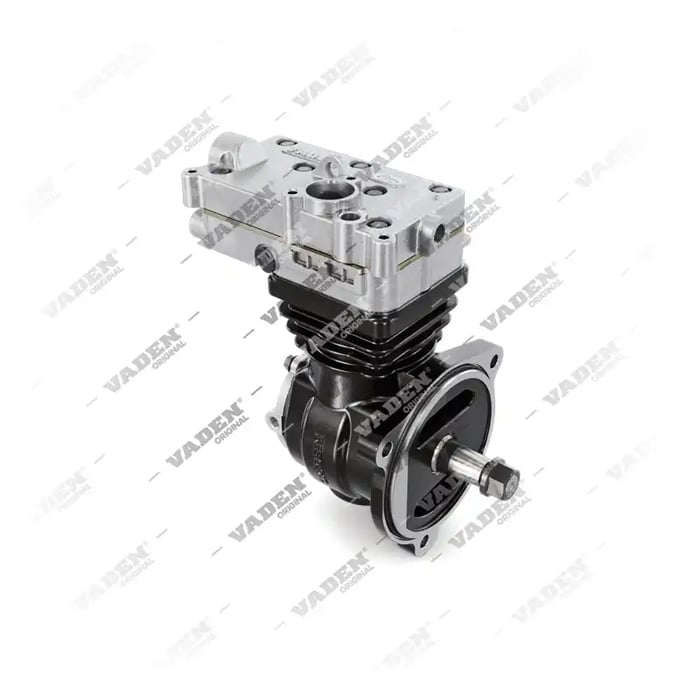
Need the part, not just the answer?
OE-grade air brake compressors and repair kits, manufactured and tested to commercial-vehicle standards.
Shop VADEN partsPublished by VADEN Original. Product links point to the manufacturer’s official catalogue. Specifications are general — always confirm figures against your vehicle’s service manual.