 airbrakecompressor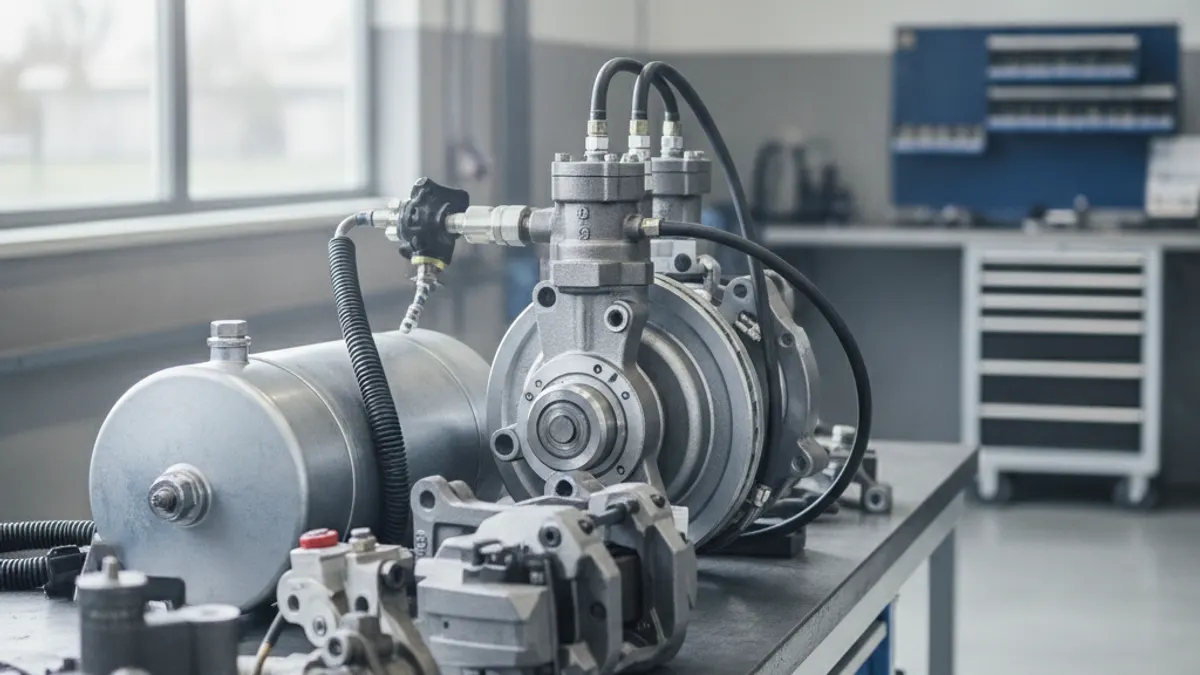
Knorr-Bremse is an original-equipment air brake supplier for heavy commercial vehicles, building compressors, air treatment units, control valves, brake chambers and disc brakes for most European truck and bus manufacturers. If you are working on a Mercedes-Benz Actros, a MAN TG-series, a DAF, an Iveco or a great many coaches, the compressor, the air processing unit and the foundation brakes may well be Knorr-Bremse castings, usually sold under the vehicle manufacturer's own part number rather than the Knorr brand. In North America the same group trades as Bendix, which is why the two ranges share a good deal of design ancestry.
The practical answer for a technician is that a Knorr-Bremse installation is a conventional pneumatic air brake system, not a hydraulic one. The pressure thresholds, the leak-test method and the diagnostic order are the same as on any other heavy vehicle. What changes is the packaging, the part numbering and how much electronic control sits on top of the pneumatics.
How the system is laid out
Air is generated by an engine-driven reciprocating air compressor mounted to the engine and driven by gear or belt. Compressed air leaves the compressor hot and carrying moisture and a little oil vapour, travels down the discharge line, and passes through the air treatment stage before it reaches the reservoirs. For the wider circuit picture, see how air brake systems work.
On modern installations that treatment stage is an air processing unit (APU): a single casting that combines what used to be three or four separate devices.
- The governor, which decides when the compressor loads and unloads
- The desiccant air dryer cartridge, which strips moisture and oil vapour
- The multi-circuit protection valve, which splits supply between circuits and protects the brake legs if one fails
- On many units, a pressure limiter and a heated purge valve for cold climates
From the APU, air feeds the front service circuit, the rear service circuit, the parking and spring brake circuit, and the auxiliary circuit that supplies air suspension, clutch servo, seats and other consumers. The auxiliary leg is deliberately the lowest priority and is cut off first, so the braking circuits always keep their air.
The main component groups
| Component group | Function | Typical service concern |
|---|---|---|
| Single or twin-cylinder compressor | Generates system air, engine driven | Oil carry-over, slow build-up, knocking under load |
| Air processing unit | Governs, dries and splits the air supply | Saturated desiccant, purge valve leak, no cut-out |
| Dual-circuit foot brake valve | Meters driver demand into both service circuits | Internal leak at the exhaust, poor pedal feel |
| Relay and quick-release valves | Speed up apply and release at the axles | Slow release, dragging brakes, weeping exhaust port |
| Trailer control module | Manages trailer supply and control lines | Trailer lag, failure to charge the trailer |
| Spring brake and combination chambers | Service braking plus parking force from a spring | Diaphragm rupture, corroded housing, seized pushrod |
| Air disc brakes | Foundation braking via caliper and rotor | Seized guide pins, uneven pad wear, adjuster faults |
| EBS ECU and axle modulators | Electronic brake control, ABS, load sensing | Fault codes, wheel speed sensor faults, wiring |
EBS: the electronic layer
On an EBS (electronic braking system) vehicle the foot brake valve still produces a pneumatic signal as a backup, but the primary demand is an electrical signal sent to axle modulators that build the required pressure locally at each axle. That gives faster response, better balance between tractor and trailer, and integration with ABS, traction control, stability control and emergency braking functions.
In the shop this means gauges alone will not tell the whole story. A dragging brake or a pressure imbalance may be commanded electronically rather than caused mechanically, so read fault codes first and confirm with pressure test points. The pneumatic backup circuit still exists, still has to pass a leak test, and is what keeps the vehicle stoppable if the electronics drop out.
Pressures you should expect
European data is quoted in bar and North American data in psi, but the working window is broadly the same across manufacturers.
| Condition | Approximate value |
|---|---|
| Governor cut-out, compressor unloads | about 120-135 psi (8.3-9.3 bar) |
| Governor cut-in, compressor loads | about 100-110 psi (7-7.6 bar) |
| Normal fully charged running pressure | about 120 psi (8.3 bar) |
| Low-air warning light and buzzer | about 60 psi (4 bar) |
| Spring brakes begin to drag or apply | about 20-45 psi (1.5-3 bar) |
These are typical ranges for orientation only. Exact cut-out, warning and spring brake release pressures are set by the vehicle manufacturer and vary by chassis and market, so take the figures from the current service documentation for that vehicle before condemning a component.
Identifying parts correctly
Knorr-Bremse units carry a cast or stamped identification on the housing, usually a letter-and-digit code, and alongside it you will often find the vehicle manufacturer's own number, because the same unit is also sold as a Mercedes, MAN or DAF part. Two habits save a lot of wasted freight.
- Record every number before removal. Photograph the casting, the label and the port layout. Once a part is off and dirty, etched numbers are often unreadable.
- Never match by appearance. Two compressors can look identical and still differ in displacement, drive type, cooling arrangement, unloader configuration or port thread.
Original unit or OE-grade replacement?
Air brake components are safety-critical and regulated, in Europe under ECE R13, which sets braking performance requirements for the whole vehicle. A replacement has to let the vehicle continue to meet that standard, which is a question of specification rather than of the badge on the box. Check that the replacement matches on:
- Displacement and delivery rate, so build-up time stays within spec
- Port sizes, thread forms and port orientation
- Mounting flange pattern and drive gear or pulley arrangement
- Cooling arrangement, air-cooled or water-cooled head, and coolant port layout
- Unloader and governor signal configuration
- Seal and material specification suited to the operating temperature and engine oil
A unit built and tested to those parameters behaves like the original. One that misses on any single point shows up later as slow build-up, oil carry-over or short service life, which is the real substance behind the OE versus aftermarket comparison.
Service points worth knowing
The dryer cartridge is a scheduled item, not a failure item. Most manufacturers specify replacement roughly annually, and sooner in humid climates or high duty cycles. A saturated cartridge passes moisture and oil downstream and eventually costs you valves and modulators. Water in the tanks at a routine drain points straight at it.
Oil in the discharge line points upstream. Oily residue at the purge or in the first reservoir usually means the compressor rings or unloader are passing oil, or that a system leak is keeping the compressor loaded far too long. Find the leak before condemning the compressor.
Disc brake guide pins seize. On sliding calipers the mechanism must move freely, or you get uneven pad wear, pull under braking and heat damage to the rotor. Boot condition is the early warning; a split boot lets water in and the pin is usually already going.
Where to start when something is wrong
Whatever the badge on the casting, the order is the same. Confirm the governor cuts out and cuts in at the specified pressures. Time the build-up from cut-in to cut-out and compare it against spec. Run a static and an applied leak-down test. Check that the dryer purges audibly at cut-out. Only then start removing parts. A large share of reported compressor failures on European trucks turn out to be a leak, a saturated dryer or a governor that is not signalling properly, all cheaper and faster to fix than a compressor replacement.
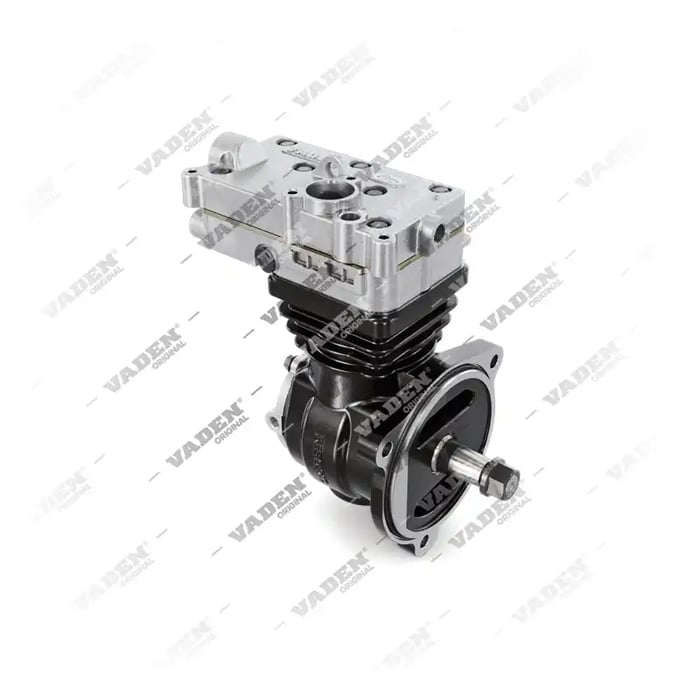
If the governor, dryer and circuit all check out and build-up time is still long, the compressor really has worn, and compressor units for European trucks cover the Mercedes, MAN and DAF fitments these systems sit on.
Need the part, not just the answer?
OE-grade air brake compressors and repair kits, manufactured and tested to commercial-vehicle standards.
Shop VADEN partsPublished by VADEN Original. Product links point to the manufacturer’s official catalogue. Specifications are general — always confirm figures against your vehicle’s service manual.