 airbrakecompressor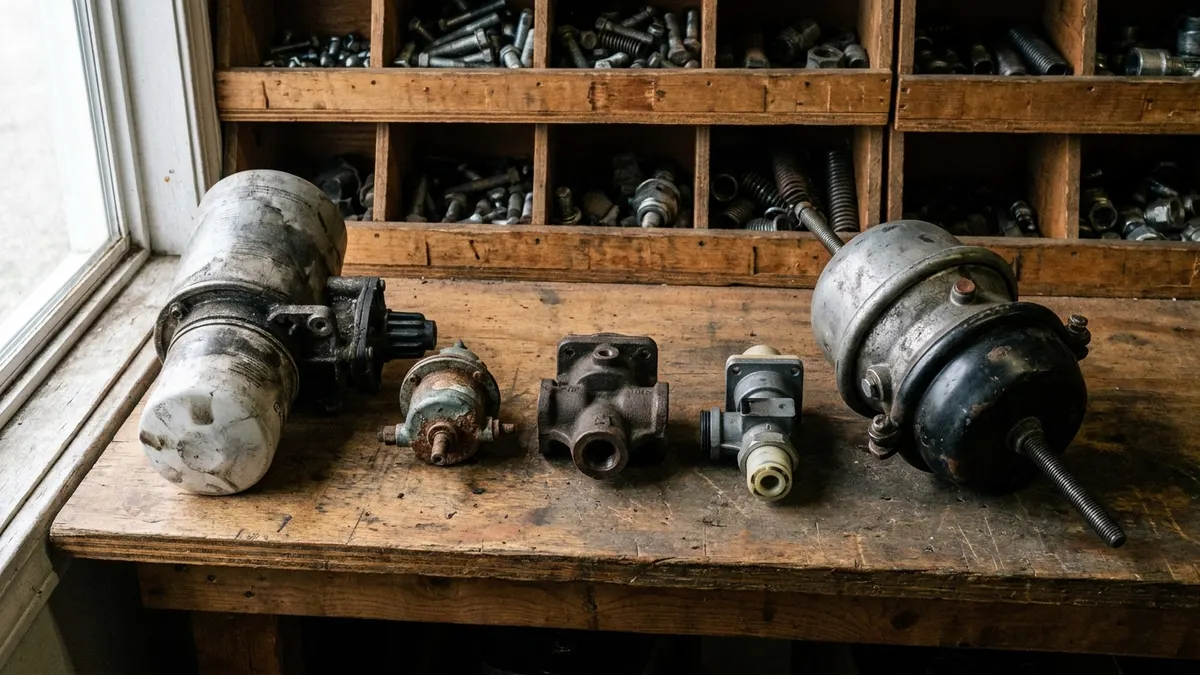
For most air brake components the real dividing line is not OEM versus aftermarket — it is validated versus unvalidated. A compressor, governor, brake chamber or valve built to the same dimensional tolerances, tested to the same pressure and endurance standards, and backed by a real warranty will do the same job as the part that came off the truck. What gets fleets in trouble is the unvalidated end of the market: soft castings, out-of-spec unloader travel, diaphragms that harden early, and cross-reference tables that were guessed rather than measured.
These are pneumatic systems, not hydraulic ones. A weak part does not leak fluid on the ground where you can see it — it quietly costs you air, so the compressor runs longer, the dryer sees more moisture, and the failure shows up as slow recovery or a low-air warning on a grade.
Three very different things get called "aftermarket"
- Dealer / OEM-boxed parts. The truck maker's part number, the truck maker's price. Almost never made by the truck maker.
- OE-supplier parts. Bendix, Wabco/ZF, Knorr-Bremse, Haldex, Meritor, MGM, Midland and others sell the same production-line parts in their own packaging. Same part, different label, usually less money.
- Independent manufacturers and remanufacturers. This is where the quality spread is widest — genuinely excellent OE-grade builders sit on the same shelf as no-name white-box parts with no test data behind them.
Lumping all three together is why the debate stays confused. The useful question is never "is it OEM?" but "who validated it, and against what?"
What actually differs
| Factor | Dealer / OE-supplier | OE-grade aftermarket | Unbranded budget part |
|---|---|---|---|
| Castings and machining | Spec-controlled alloy, held tolerances | Same spec when the maker publishes it | Unknown alloy, wide tolerance, porosity risk |
| Seals and elastomers | Qualified for oil, heat and ozone | Usually equivalent compounds | Generic rubber; early hardening common |
| Validation testing | Endurance, leak and cycle testing documented | Documented if the maker will show it | Typically none |
| Cross-reference data | Authoritative | Good when built from measured samples | Copied, often wrong |
| Warranty | Defined term, honoured through the dealer | Defined term, honoured by the maker | Vague or unenforceable |
| Traceability | Batch and serial traceable | Batch traceable | None |
Where quality aftermarket genuinely matches OE
Mechanical wear parts. These designs are mature, the performance requirements are public, and the geometry can be measured. Compressors and their repair kits, governors, unloader kits, brake chambers, slack adjusters, air dryer cartridges, relay and quick-release valves, drums, shoes and linings — a competent manufacturer with proper metallurgy and a test bench builds these to the same standard the OE supplier does. The comparison is covered in more depth for the pump itself in our guide to OE versus aftermarket truck air compressors.
The practical test is whether the maker will tell you what it validated. A manufacturer that publishes displacement, port layout, drive configuration and its own measured OE cross-reference — the way a dedicated air brake builder does across its air brake system parts catalogue — is a very different proposition from a listing that just repeats a number it found online.
Where OE is still worth the premium
- ABS and EBS hardware. Modulator valves, ECUs, wheel-speed sensors. Calibration, diagnostic behaviour and software handshakes matter more than castings here.
- Trucks still under factory warranty. A non-OE part in a system that later fails gives the claims department an argument you do not need.
- Very recent designs. Electronically controlled or clutched compressors and late-model air disc park modules, where nobody has had time to reverse-engineer properly.
Compliance: the rulebook does not know the brand
FMVSS 121 in North America and ECE R13 in Europe set vehicle-level performance requirements. Neither says anything about who made the part. At a roadside inspection the officer measures pushrod stroke against the limit for the chamber type, checks for audible leaks, confirms the low-air warning device activates around 60 psi, and confirms the system builds and holds air — governor cut-out somewhere in the 120-135 psi band, cut-in around 100-110 psi, a fully charged system sitting near 120 psi, and spring brakes that set as pressure falls into roughly the 20-45 psi range. If a part cannot hold those behaviours it fails, OE badge or not. If it can, nobody asks. Verifying governor cut-in and cut-out after any compressor or governor change is the single most useful post-repair check.
How to buy with confidence
- Start from the number stamped on the part you removed, not the truck's build year alone.
- Confirm the physical interface: mounting flange, drive type and gear or pulley, coolant and oil port positions, discharge port size and thread.
- For chambers, confirm size and whether it is standard or long stroke; for slack adjusters, confirm spline count and arm length.
- Ask what the warranty term actually is and who administers it.
- Ask whether the cross-reference came from a measured sample or a copied table.
- On a reman unit, ask which components are replaced every time versus inspected and reused.
- Buy the supporting parts with it — gaskets, discharge line, dryer cartridge — so one job does not become two.
The cost maths people get wrong
The part price is rarely the biggest number. Removing and refitting a compressor means draining the system, pulling the drive, dealing with coolant and oil lines and bleeding the system back up, as set out in the air brake compressor replacement guide. A second failure does not just cost you a second part — it costs the labour again, plus the downtime.
Judge the part by what a repeat failure would cost, not by what the box costs. On any component you cannot reach in an hour, that maths favours the validated part almost every time.
A useful working rule: buy OE or OE-supplier for anything electronic or still under factory warranty, and buy the best-validated part you can document for everything mechanical. That combination gets fleets OE-level reliability without dealer-level parts spend — which is what the argument was really about all along.
Need the part, not just the answer?
OE-grade air brake compressors and repair kits, manufactured and tested to commercial-vehicle standards.
Shop VADEN partsPublished by VADEN Original. Product links point to the manufacturer’s official catalogue. Specifications are general — always confirm figures against your vehicle’s service manual.