 airbrakecompressor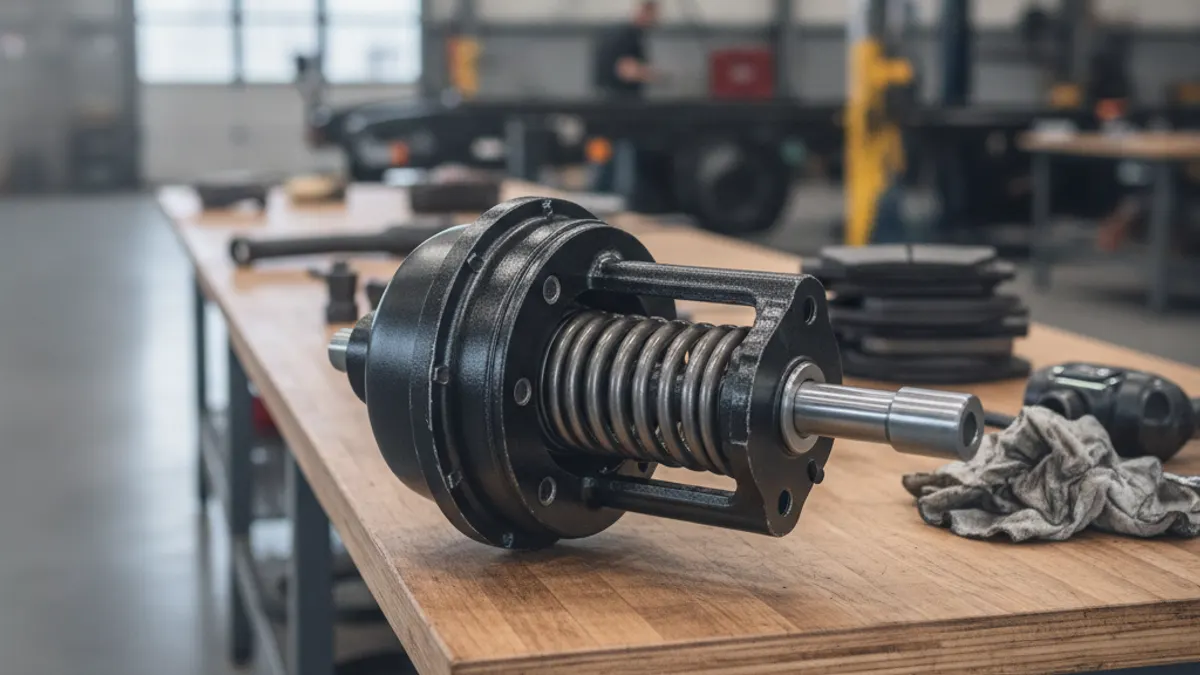
A trailer brake chamber is the pneumatic actuator bolted to the axle that turns air pressure into mechanical force at the slack adjuster and S-cam. On virtually every road trailer it is a dual chamber: a service section fed by the relay valve for normal stops, and a piggybacked spring section that applies the parking and emergency brake when air is lost. Trailer chambers are almost always Type 30/30 or 24/24 with a long-stroke service diaphragm, and because they hang low in the road spray, corrosion takes far more of them out of service than wear does.
Why trailers run spring brakes on every axle position
A tractor can get away with service-only chambers on the steer axle because the rear axles carry the parking function. A trailer has no such option: once it is uncoupled, the only thing holding it is mechanical spring force. Regulations require the trailer to hold on its own parking system and to apply automatically if the supply line breaks or the tractor pulls away. The spring section does that job: the coil spring is compressed and held off by air in the parking cavity, and it applies mechanically as soon as that air is lost.
On a standard tandem-axle van trailer, all four chambers are spring brake units. On tri-axle and spread-axle configurations you may see spring brakes on only two of the three axles, with plain service chambers on the third. That is legal in many jurisdictions and is done to save weight and cost, but it changes how much holding force you have on a grade. Verify what the trailer was built with before you order parts; putting a service-only chamber into a spring-brake position leaves you short of parking capability.
The spring section stays fully released with the trailer supply line charged. A healthy air system sits around 120 psi, with the compressor governor cutting out somewhere in the 120-135 psi band and cutting back in around 100-110 psi. As pressure falls, the dash low-air warning comes on near 60 psi; the trailer springs then begin to drag as pressure drops through roughly 45 psi and are fully applied by about 20 psi. Those figures vary by valve calibration, so treat them as a working range rather than a setting. This is why a trailer with a slow supply leak drags long before anything locks up solid. For the opposite complaint, see spring brakes that will not release.
Chamber sizes and stroke on trailer axles
Chamber "size" is the effective diaphragm area in square inches, not a physical dimension. A Type 30 has about 30 in² of working area, so at 100 psi it develops roughly 3,000 lbf of push before linkage losses. Combined with slack adjuster length, that is what sets torque at the brake.
| Type | Effective area | Typical trailer use | Typical readjustment limit |
|---|---|---|---|
| 20 | ~20 in² | Light trailers, some lift-axle positions | 1.75 in |
| 24 | ~24 in² | Van and reefer trailers, 24/24 spring units | 1.75 in standard, 2.00 in long stroke |
| 30 | ~30 in² | Most common highway trailer size, 30/30 spring units | 2.00 in standard, 2.50 in long stroke |
| 36 | ~36 in² | Heavy haul, tipper and low-bed trailers | 2.25 in |
Confirm the limit against the current CVSA out-of-service chart for the exact chamber marking. The values above are the widely used figures, not a substitute for the chart or the trailer maker's service data.
Long-stroke chambers matter more on trailers than anywhere else, because trailer brakes see less frequent adjustment and more lining wear per service interval. A long-stroke unit is identified by a square air inlet port boss on the service side and, on most makes, a differently shaped identification tag carrying an "LS" or stroke marking. Never fit a standard-stroke chamber where a long-stroke was specified: the reserve stroke disappears, the brake goes out of adjustment sooner, and an inspector will measure it that way. The numbering system is covered in the brake chamber sizes guide.
Matching stroke to ABS and EBS behavior
On an ABS trailer, the modulator valve dumps and reapplies air at the chamber several times per second. Excess pushrod stroke means the chamber travels further before the lining touches, and that lag shows up as slower reapply and uneven wheel control. On an EBS trailer the effect is worse, because the ECU compares wheel behavior against a demanded deceleration; consistently long stroke on one axle can push the system into permanent compensation or set a fault.
Two rules follow. Keep stroke consistent across the axle set, since a difference of more than about a quarter inch between sides on the same axle shows up as pull or uneven lining wear. And when you replace one chamber, measure stroke on all of them and replace in pairs across an axle if the old units are the same age. Air reaches all of them through the relay and the trailer control valve group feeding that circuit, so a lazy valve can imitate a chamber problem. Check valve response and timing before condemning hardware.
Corrosion and road-spray failure modes
Trailer chambers sit directly in the salt spray thrown off the tires. The usual failure sequence: the clamp band and the crimped spring housing corrode, moisture gets past the breather tubes into the parking cavity, the internal spring rusts, and the unit either seizes part-applied or the diaphragm perishes. What to look for:
- Audible leak at the chamber with the trailer charged and brakes released, usually a service diaphragm or a cracked port fitting.
- Leak only with the pedal applied, pointing to the service diaphragm or pushrod seal.
- Leak only with the parking brake applied, pointing to the seal between the two sections or the piggyback diaphragm.
- Sluggish release on one wheel, from a corroded pushrod, a seized return spring or a plugged breather tube.
- Blocked or missing breather tubes, the leading cause of internal corrosion. They must be routed downward and kept clear.
Do not open a spring section. The parking spring stores enough energy to cause serious injury, and modern units are non-serviceable by design: the housing is sealed and the correct response to a failure is replacement. If the trailer must be moved with a seized unit, cage the spring using the release bolt supplied with the chamber, following the caging procedure, and remember that the trailer then has no parking brake at that wheel.
Buying and fitting notes
When ordering, match five things: chamber type (24/24, 30/30, 30/36), stroke rating, pushrod length and thread, mounting stud pattern and stud length, and port orientation or clocking. Trailer builders clock the ports differently to clear frame rails and air lines, so an otherwise identical part can be unfittable. Torque the mounting nuts and the clamp band to the manufacturer's figures, fit a new clevis pin instead of reusing a worn one, and re-set slack adjuster stroke afterward. Finish with a leak check at full system pressure and a static applied-pressure check before the trailer goes back into service.
Need the part, not just the answer?
OE-grade air brake compressors and repair kits, manufactured and tested to commercial-vehicle standards.
Shop VADEN partsPublished by VADEN Original. Product links point to the manufacturer’s official catalogue. Specifications are general — always confirm figures against your vehicle’s service manual.