 airbrakecompressor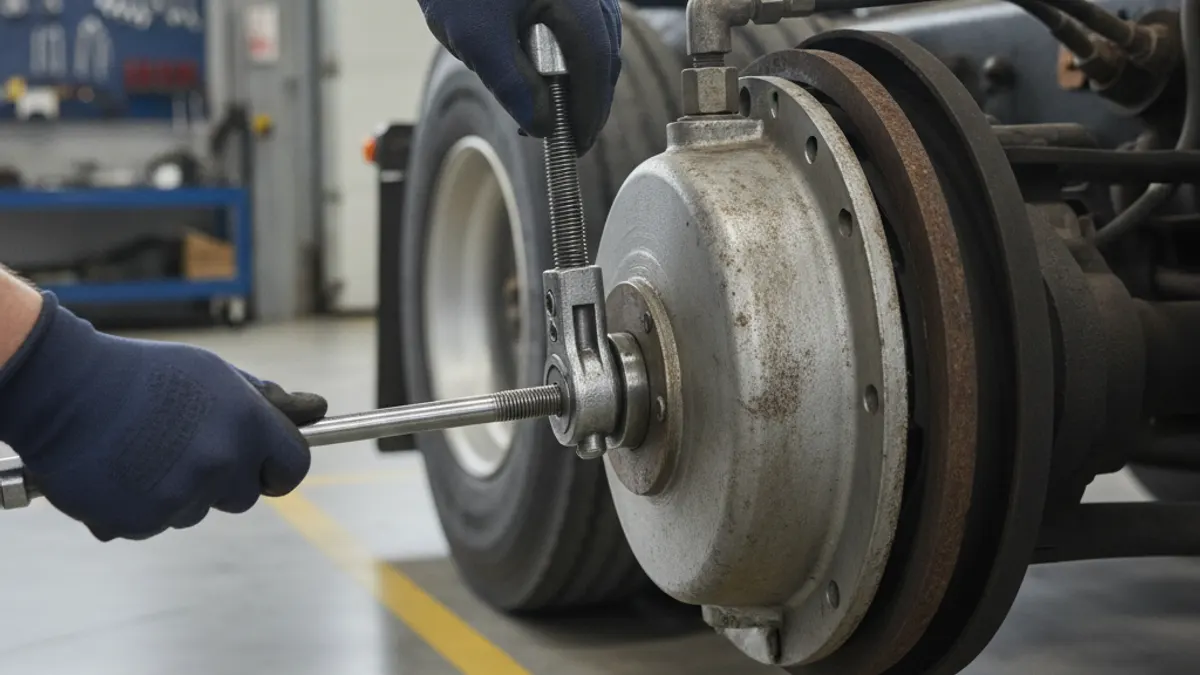
When a spring brake won't release, it means the parking (spring) brake chamber is not receiving enough air pressure to compress its power spring and pull the pushrod back. In the vast majority of cases the fix starts with one question: is the system fully charged? Build air back up toward normal operating pressure (a fully charged system sits around 120 psi), push the yellow diamond parking valve back in, and listen for the brakes to release. If they don't, the problem is in the air delivery path — a bad valve, a blocked line, or a failed chamber — not in the foundation brake itself.
Spring brakes work opposite to how most people assume. A heavy coiled power spring wants to apply the brake at all times. System air pressure is what holds that spring compressed and the brake released. Lose the air — parking the truck, a leak, or a burst line — and the spring drives the brake on. That safety design is exactly why a no-release condition points straight at a loss or blockage of air on the parking side.
How the Spring Brake Release Circuit Works
The rear axles on a tractor use combination brake chambers: a service side (fed by the foot brake through the relay valve) and a spring side (fed by the parking circuit). The dash-mounted yellow valve controls a supply line that runs through the park and release control system, often including a tractor protection valve and quick-release or relay valves, out to each spring chamber. Push the knob in and air travels to the chambers, compressing the springs and releasing the brakes. Pull it out — or lose pressure — and that air dumps to atmosphere, letting the springs apply.
Understanding this circuit tells you where to look. If air can't get from the dash valve to the chamber, or if the chamber can't hold it, the spring stays applied.
The Most Common Causes, in Order
| Cause | Symptom | First check |
|---|---|---|
| Low system air pressure | Brakes won't release; low-air warning (~60 psi) may be active | Build tanks back toward full charge, then push park valve in |
| Faulty dash park control valve | Knob won't stay in, or no air passes when pushed in | Listen for air at the valve; test with gauge downstream |
| Bad relay or quick-release valve | One axle releases, the other stays applied | Feel/listen for air delivery at each chamber port |
| Plugged, kinked, or frozen air line | No air reaches one or both chambers | Inspect and clear supply line; check for ice in winter |
| Ruptured spring chamber diaphragm | Constant air leak at chamber; brake won't release fully | Replace the spring brake chamber assembly |
| Seized foundation hardware | Chamber gets air but shoes stay dragging | Inspect slack adjuster, S-cam, and shoe return |
1. Low Air Pressure (Start Here Every Time)
Spring brakes typically begin to release somewhere around 60 psi and are not fully released until the system is up near normal operating pressure and climbing toward a fully charged ~120 psi. If the compressor hasn't built enough air — a fresh cold start, a slow leak overnight, or a compressor that isn't keeping up — the springs simply won't retract. If your truck struggles to build air at all, work through why an air brake compressor won't build pressure before condemning valves.
2. Dash Park Control Valve
The yellow parking valve can fail internally so it won't pass air even when pushed in, or it won't latch. If you have full system pressure but pushing the knob does nothing, put a gauge on the line downstream of the valve. No pressure downstream with the knob in means the control valve is at fault.
3. Relay and Quick-Release Valves
These valves speed air to the chambers. A stuck or corroded relay or quick-release valve can block delivery to one axle while the other releases normally — a classic "one side stuck" complaint. Cracking a fitting at the suspect chamber to check for delivered air isolates it quickly.
4. Blocked or Frozen Lines
A pinched, chafed, or ice-plugged supply line starves the chamber. In cold weather, moisture that collects in the system freezes inside valves and lines and blocks the release air — the leading winter no-release cause. This is closely related to frozen air brakes in winter. Draining tanks daily and maintaining the air dryer prevents most of it.
5. Ruptured Spring Chamber
If the diaphragm inside the spring side tears, the chamber can't hold the release air — you'll hear a steady leak at the chamber and the brake won't pull off. The chamber is replaced as a unit. Never attempt to open or cut apart a spring chamber; the caged power spring stores enough energy to cause serious injury or death.
Caging a Spring Brake — Last Resort Only
Every spring chamber has a release stud (caging bolt) that lets you mechanically compress the spring so a disabled truck can be moved off the road. This is an emergency measure only.
- Chock the wheels — with the brakes caged you have no parking hold.
- Locate the release stud, nut, and washer, usually stored on the chamber.
- Insert the stud, seat it in the internal window, and turn a quarter turn to lock it.
- Tighten the nut against the chamber to draw the spring back and release the brake, following the chamber maker's torque spec.
- Never drive at road speed on caged brakes — cage, move the vehicle a short distance, and repair.
A caged spring brake provides no parking or emergency braking on that wheel. Treat caging as a recovery step, then fix the root cause before returning the truck to service.
When valves in the park, release and emergency circuit are the culprit, replace them with OE-grade components rather than the cheapest box on the shelf — a leaking park control or relay valve will strand the truck again. VADEN's park, release and emergency valve range covers the dash controls and relay valves that most often cause a no-release condition.
A Quick Diagnostic Flow
- Build full air pressure and confirm the gauge reads near normal operating range.
- Push the yellow parking valve in and note whether any brakes release.
- If none release, suspect the dash valve or system-wide blockage.
- If one axle or one wheel stays applied, chase the relay/quick-release valve, line, or chamber serving that spot.
- Check for audible leaks at chambers and valves — a steady hiss points to a ruptured diaphragm or cracked valve.
- In winter, warm the vehicle and check for ice before condemning parts.
Most no-release complaints come down to air that never arrives. Confirm pressure first, then follow the air to the chamber. If a wheel still won't turn after the chamber clearly has air, the fault has moved to the foundation — a seized slack adjuster, S-cam, or shoes not returning — which is a mechanical repair, not a pneumatic one.
Need the part, not just the answer?
OE-grade air brake compressors and repair kits, manufactured and tested to commercial-vehicle standards.
Shop VADEN partsPublished by VADEN Original. Product links point to the manufacturer’s official catalogue. Specifications are general — always confirm figures against your vehicle’s service manual.