 airbrakecompressor
The "service trailer brake system" warning means the towing vehicle has lost a reliable electrical connection to the trailer's braking electronics. In plain terms, the tractor or truck can no longer confirm that the trailer's brake controller, ABS, or brake-signal circuit is working, so it flags you to service it. The cause is electrical roughly nine times out of ten: a dirty or damaged connector, chafed or broken wiring, a corroded ground, or a failed control module, not a problem inside the air brake plumbing itself.
This message shows up on light- and medium-duty trucks towing trailers with integrated brake controllers, on pickups with in-dash controllers, and in a related form on heavy trucks running trailer ABS or EBS. Whatever the platform, the fix follows the same logic: restore a clean, powered, grounded electrical path between the vehicle and the trailer.
What the warning is actually telling you
Modern tow vehicles constantly monitor the trailer brake circuit. The controller sends a signal and expects to see the correct electrical load and feedback from the trailer's magnets or brake module. When that feedback disappears, drops out intermittently, or reads out of range, the system sets a fault and displays "service trailer brake system." On a heavy truck, the equivalent is a trailer ABS lamp that stays lit, meaning the trailer's anti-lock system has faulted and reverted to standard braking.
The check starts the moment you couple up. At key-on the trailer's ABS module powers up, runs a self-test, briefly lights the trailer's own ABS lamp, and reports its status back to the tractor. The dash message appears when that handshake fails — no power reaching the trailer module, no valid data coming back, or an active fault the trailer itself has reported.
Important distinction: on an air-braked rig, this warning does not mean your foundation brakes have failed. The pneumatic side, your compressor, tanks, relay valves, and chambers, still applies the brakes when you press the pedal. What you may have lost is the electronic layer: trailer ABS, load-proportional braking, or the controller that meters trailer brake effort. That layer matters for stability and stopping distance, so the warning is real, not cosmetic. Most trailer ABS modules default to normal, full braking with no wheel-speed control when they fault, which means a trailer wheel can lock in a panic stop and the trailer can push or swing.
Most common causes, ranked
| Cause | Why it happens | Typical fix |
|---|---|---|
| Corroded or bent connector pins | Road salt, water, and vibration attack the 7-way (or heavy-duty) connector | Clean pins, straighten, apply dielectric grease |
| Chafed or broken harness wiring | Wires rub through on frame edges or get pinched near the pintle or fifth wheel | Locate break, repair or replace harness section |
| Bad ground | Rust or a loose ground bolt breaks the return path | Clean and re-torque the ground point |
| Low or sagging system voltage | Trailer ABS modules are voltage-sensitive; a weak feed or heavily loaded electrical system starves the module | Measure voltage at the trailer connector, key on |
| Blown fuse or tripped circuit | Short in the trailer circuit pops the brake-controller fuse | Find the short, then replace the fuse |
| Trailer ABS/EBS module fault | Failed wheel-speed sensor, module, or internal valve fault | Scan for codes, repair the flagged component |
| Failed brake controller | In-cab controller module fails or loses configuration | Reset, reconfigure, or replace the controller |
How to check it, step by step
Work from the cheapest, most likely cause toward the expensive ones. Most of these faults are found at the connector.
- Watch the trailer's own ABS lamp at key-on. It should light briefly while the module self-tests, then go out. A lamp that never lights says the module is not being powered at all; one that lights and stays on says the module powered up and found a fault it can report.
- Inspect the connector. Unplug the trailer and look at both the vehicle and trailer sockets. Green or white corrosion, black burn marks, bent or pushed-back pins, and moisture are all suspects. Pay particular attention to the auxiliary/ABS power pin and the ground pin, since those are the two the module needs to boot and report. Clean the pins with a small brass brush, straighten anything bent, and coat with dielectric grease before reconnecting.
- Wiggle-test the harness. With the system powered, flex the harness at the connector and along the frame while watching for the warning to flicker. Intermittent faults almost always come from wiring that moves, especially near the coupling point and at the connector's strain relief.
- Check the ground. The white ground pin and its chassis attachment must be clean and tight. A bad ground mimics almost every other symptom.
- Measure voltage at the connector. With the key on, confirm the trailer is actually receiving full system voltage and a good return. Trailer ABS modules are voltage-sensitive, so a marginal feed can set a fault while the lights still work normally.
- Check fuses. Find the trailer brake or brake-controller fuse in the vehicle's box and confirm it is intact. A repeatedly blown fuse means a short you need to trace, not just replace.
- Test the trailer side. Trailer magnets or the trailer brake module can fail. On air trailers with ABS, this is where you scan the module for stored codes.
- Scan for codes. A diagnostic scan (blink codes on some trailers, or a scan tool on ABS/EBS) points you straight at a failed wheel-speed sensor, module, or valve instead of guessing.
- Swap the trailer. Couple a known-good trailer to the same tractor. If the warning follows the trailer, the fault is in the trailer's wiring, sensors, or module; if it stays with the tractor no matter what you hook to it, look at the tractor's trailer-power circuit, fuse, and connector. This one test splits the problem in half faster than anything else on the list.
What to look at on air-braked trailer ABS
On a commercial trailer, the electronic braking layer is trailer ABS or full EBS. When the tractor's dash shows a trailer ABS fault, the module has usually detected one of these: a wheel-speed sensor reading out of range (dirty or backed-off sensor, damaged tone ring), a modulator valve fault, low supply voltage through the connector, or an internal module failure. The trailer keeps braking normally through the standard air brake system, but anti-lock protection is offline until the fault is repaired.
Two practical notes for air trailers. First, wheel-speed sensor faults are the single most common ABS trigger, and many are just a sensor that has vibrated away from the tone ring or fouled with debris, a low-cost fix. Second, the ABS power feed rides through the same connector and cabling as everything else, so a marginal connection that "works" for the lights can still starve the ABS module and set a fault under load.
Can you keep driving?
A short move to a safe place, yes. Continuing a trip, no, not until it is checked. Your service brakes still work, but you may be running without trailer ABS or without properly metered trailer braking, which lengthens stopping distance and hurts stability in a hard stop or on slick roads. Use judgment on the spot: if the trailer still contributes normally on a low-speed test stop you have braking but probably no anti-lock, so drive gently and increase following distance to the shop; if the trailer feels as though it is contributing nothing at all, park it. A lit trailer ABS lamp is also a documented out-of-service condition at roadside inspection depending on the trailer's build date, so it can end your day at a scale house regardless of how the truck feels.
Rule of thumb: if the warning clears when you wiggle the connector, you have not fixed it, you have found it. Repair the connection properly before you trust it.
What this warning is not
A lot of wasted diagnosis time comes from confusing this message with an air problem. It is not a low-air alarm, not a parking or spring-brake fault, and not a worn-linings indicator. Those announce themselves differently: an air-supply problem — a weak compressor, a governor out of range, or a system bleeding down pressure — shows up as a falling gauge and the low-air buzzer at roughly 60 psi, while a spring-brake fault lights the dash park-brake indicator. The trailer brake warning stays firmly in the electrical and electronic lane, and it is diagnosed with a test light, a meter, and a scan tool rather than a pressure gauge.
Preventing it from coming back
These faults are overwhelmingly about connection quality, so prevention is simple maintenance. Keep the 7-way (or heavy-duty) connector clean and greased with dielectric compound. Route and secure the harness so it cannot rub on frame edges or get pinched at the coupling. Inspect the ground point for rust. On air trailers, keep wheel-speed sensors seated and clean, and address any ABS lamp promptly instead of letting a minor sensor fault snowball. Good connector hygiene prevents the majority of repeat "service trailer brake system" visits.
If the connector, wiring, ground, and fuses all check out and the warning persists, the fault is in a module, either the vehicle's brake controller or the trailer's ABS/EBS unit, and that is where a scan tool and, if needed, a shop take over.
On an air-braked trailer the electrical warning only reports what the pneumatic side is doing, so if the service signal never reaches the chambers, the tractor protection and trailer control valves are the next parts to test.
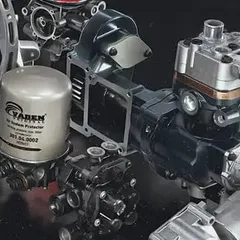
Need the part, not just the answer?
OE-grade air brake compressors and repair kits, manufactured and tested to commercial-vehicle standards.
Shop VADEN partsPublished by VADEN Original. Product links point to the manufacturer’s official catalogue. Specifications are general — always confirm figures against your vehicle’s service manual.