 airbrakecompressor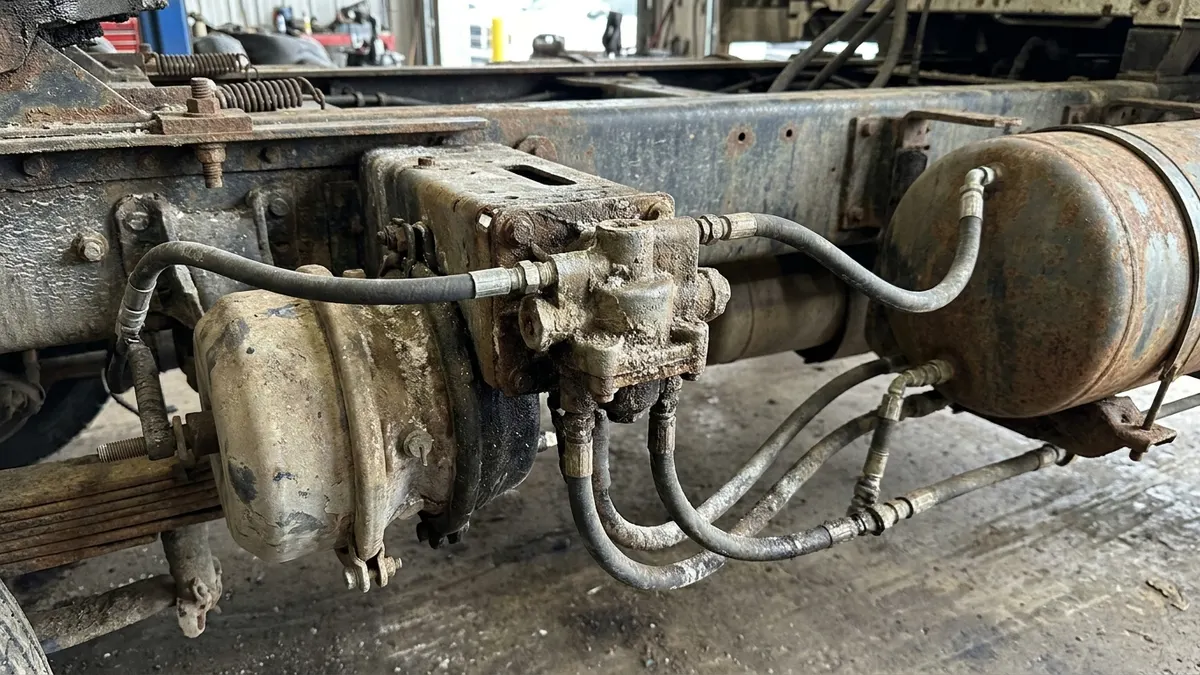
Short answer: a quick release valve only speeds up brake release. It passes the driver's control air straight through to the brake chambers, then vents that air locally the moment the pedal comes up instead of pushing it all the way back to the foot valve. A relay valve speeds up both apply and release, because it uses the control signal only as a command and fills the chambers from a reservoir sitting a few feet away. Put plainly: a quick release valve is a shortcut for exhaust air; a relay valve is a remote foot valve with its own air supply.
Why either valve exists
Air is compressible and slow to move through small-bore tubing. On a tractor, the treadle valve is under the cab and the rearmost brake chambers can be twenty-five feet of line away; on a trailer, further still. If every pound of chamber air had to travel that full distance in both directions, the rear brakes would apply noticeably after the fronts and hang on after the driver lifted off. Both national standards and plain drivability demand application and release timing measured in fractions of a second, front to rear. Quick release valves and relay valves are the two mechanical answers to that problem — one solves the return trip, the other solves both trips.
How a quick release valve works
A quick release valve is about as simple as air brake plumbing gets: one supply port fed by the foot valve, two delivery ports to the left and right chambers, one exhaust, and a rubber diaphragm in the middle. Control air entering the top pushes the diaphragm down onto the exhaust seat, sealing it, and flows out both deliveries. When the driver releases, control pressure drops, chamber air lifts the diaphragm off the exhaust seat, and the chambers dump straight out the bottom of the valve at the axle.
Note what it does not do. It has no reservoir connection, so it cannot supply more air than the control line delivers, and it cannot make the apply stroke meaningfully faster. It also has a small pressure differential built in — the diaphragm needs a slight pressure difference to shift — which is why some quick release valves are specified with a particular differential to balance steer axle timing against the rear.
How a relay valve works
A relay valve has four connections instead of three: supply from a reservoir, service (control) from the foot valve or trailer control line, two or more deliveries to the chambers, and an exhaust. Control air acts on top of a relay piston. The piston moves down, first closing the exhaust passage that runs through its center, then unseating the inlet valve so reservoir air at full system pressure — around 120 psi on a charged system — flows out to the chambers. As delivery pressure builds underneath the piston, it balances the control pressure above and the inlet closes again. That balancing action is why a relay valve delivers roughly what it is commanded, minus a small crack pressure of a few psi (commonly in the 2 to 8 psi range, depending on the valve).
Because the chambers are being filled from a tank a short distance away through large-diameter line, apply time drops sharply. Release is local too, just like the quick release valve. Spring brake control valves are a close relative: a relay valve with an emergency function and anti-compounding built in, holding the parking chambers off above roughly 60 psi and letting the springs set as pressure falls into the 20 to 45 psi band.
Side-by-side comparison
| Characteristic | Quick release valve | Relay valve |
|---|---|---|
| Air source for the chambers | The control line itself | A nearby reservoir at full system pressure |
| Ports | Control in, two deliveries, exhaust | Supply, service/control, two or more deliveries, exhaust |
| Effect on apply time | Little to none | Large — shortens the fill path |
| Effect on release time | Large — exhausts at the axle | Large — exhausts at the axle |
| Flow capacity | Limited by control line size | Sized to the reservoir line; much higher |
| Internal threshold | Small diaphragm differential | Crack pressure, typically a few psi |
| Usual location | Steer axle, between the chambers | Drive axles, trailer, spring brake control |
| Construction | Diaphragm and body | Piston, inlet and exhaust seats, springs |
How a fault in each valve shows up at the wheels
Quick release valve
A hardened, swollen, or oil-soaked diaphragm stops sealing and stops lifting cleanly. The classic complaint is steer axle brakes that hang on: hot front drums or rotors after a run, a burnt smell at the front wheels, and sometimes a pull to one side if only one delivery is bleeding down slowly. A diaphragm that fails to seal the exhaust seat instead gives you air whistling out of the valve body every time the driver applies, weak front braking, and wasted air. Because the valve sits low and forward, road salt and stone damage are common contributing factors.
Relay valve
Relay valve faults are noisier and easier to feel. A sticking piston or contaminated inlet gives noticeable rear brake lag — the fronts bite before the rears catch up — and can leave the trailer or drive axle brakes slow to release, so the unit fights itself and cooks the linings. A leaking exhaust with the pedal applied points at the delivery-side seal; a leak with everything released points at the inlet seat or supply seal. A relay with the wrong crack pressure for the chassis will not fail a leak test at all, but it will throw brake balance off front to rear.
Testing them in the yard
Charge the system to normal operating pressure — governor cut-out is typically 120 to 135 psi — chock the wheels, and work one valve at a time. Soap the exhaust port with the brakes released, then again with a helper holding a steady full application; note which condition leaks. Have the helper apply and release while you listen at each axle for a crisp exhaust burst. Before condemning either valve, measure pushrod stroke and check the slack adjusters, since a dragging brake caused by out-of-adjustment foundation hardware feels identical from the seat.
Replacement and what kills them
Neither valve is a rebuild-in-the-lane item on most fleets; both are replaced as units, torqued to spec, and leak-tested afterward. The real repair, though, is upstream. Oil carried past worn compressor rings and water passing a saturated desiccant cartridge are what turn diaphragms to jelly and glaze relay pistons in the bore. If you are replacing the same valve twice in a year, service the dryer and inspect the compressor discharge line before you fit another one. Match the replacement to the chassis specification rather than to whatever fits the ports, and source complete OE-grade air brake system components so crack pressure and flow capacity stay as the manufacturer intended.
Need the part, not just the answer?
OE-grade air brake compressors and repair kits, manufactured and tested to commercial-vehicle standards.
Shop VADEN partsPublished by VADEN Original. Product links point to the manufacturer’s official catalogue. Specifications are general — always confirm figures against your vehicle’s service manual.