 airbrakecompressor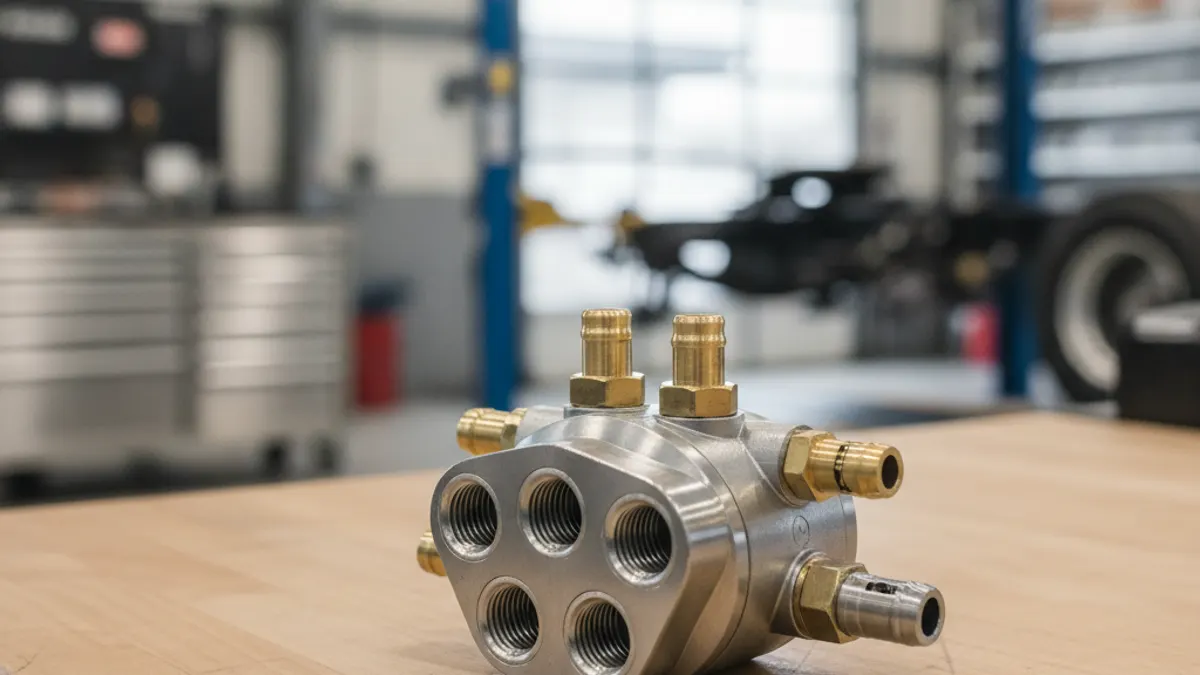
A quick-release valve (QRV) is a small pneumatic valve that lets your front brakes release almost instantly. When you lift off the treadle, instead of pushing the air in the front brake chambers all the way back through the foot valve, the QRV opens an exhaust port right next to the chambers and dumps that air locally. The result is a fast, even brake release and less timing lag at the front axle.
It is one of the simplest valves on the truck, with no springs to adjust and no wiring, but a failed QRV causes real problems: front brakes that drag, a persistent air hiss, or brakes that release unevenly side to side. This guide covers exactly what the valve does, where it lives, how to spot a bad one, and how to replace it.
What the quick-release valve does
In a truck air brake system, application air travels from the treadle (foot) valve down to the brake chambers. On release, that air has to get back out. If it had to travel all the way back up the delivery line to the treadle valve exhaust, the front brakes would release slowly and lag behind the rear. The QRV solves this by sitting close to the front chambers and giving the air a short exit path.
Mechanically it works on pressure differential across a rubber diaphragm:
- On application: incoming air from the treadle pushes the diaphragm down and seals the exhaust port, so pressure passes straight through to both front brake chambers.
- On release: supply pressure drops, chamber air lifts the diaphragm, the delivery port closes, and the exhaust opens. The air trapped at the chambers vents out the QRV in a sharp burst.
Because the valve typically feeds both front chambers from a single delivery line, it also helps balance left and right release timing. This is closely related to the job a relay valve does on the rear axle, though a relay valve additionally speeds up application using reservoir air, while a plain QRV only speeds up release.
Where the quick-release valve sits
You will usually find the QRV mounted high, near the centerline of the front axle area — on the firewall, a frame crossmember, or a bracket close to the front brake chambers. Mounting it high and central keeps the delivery lines to the left and right chambers short and roughly equal so both sides release together.
You can identify it by its ports: one supply/control port on top (the line from the treadle valve) and two delivery ports feeding the front chambers, plus a downward-facing exhaust with a rubber flap or check. That exhaust flap keeps road spray and grit out of the valve.
| Port | Connection | Function |
|---|---|---|
| Supply / control (top) | Delivery line from treadle valve | Application signal in |
| Delivery (two sides) | Front left and right brake chambers | Air out to chambers |
| Exhaust (bottom) | Atmosphere, via flap | Fast local venting on release |
If you are tracing the whole circuit, it helps to understand the full path from compressor to chamber. Our overview of how air brake systems work walks through where each control valve fits between the reservoirs and the foundation brakes.
Symptoms of a failing quick-release valve
A QRV fails in one of two ways: it leaks (bad diaphragm or exhaust seat) or it sticks (diaphragm not seating on the exhaust, or debris holding it open). Watch for these signs:
- Front brakes drag or release slowly. If the exhaust port clogs or the diaphragm sticks closed, trapped air keeps light pressure on the front chambers after you release the pedal. You may feel the truck hold back or notice front drums heating up.
- Constant air leak at the valve. A torn or hardened diaphragm lets air hiss out the exhaust whenever the brakes are applied — or even at rest. This wastes compressor duty and can contribute to the system slowly bleeding down.
- Uneven front braking. If one delivery side leaks internally, the two front chambers see different pressure and the truck can pull under braking.
- Slow release timing. Front brakes that lag noticeably behind the rears on release point to a QRV that is not exhausting quickly.
Keep in mind that a leak at the QRV is not always the QRV itself — a bad treadle valve, a cracked line, or a leaking chamber diaphragm upstream can mimic it. If the whole system is bleeding down overnight, work through the wider diagnosis in air brake system losing pressure before condemning this one valve.
How to test a quick-release valve
Testing is quick and needs no special tools beyond a soapy water bottle and your ears. Chock the wheels and build the system to full pressure (around 120 psi) first.
- Listen on release. Have a helper apply and release the brakes while you stand near the valve. You should hear a single, crisp burst of air from the QRV exhaust each time the pedal is released. A weak or delayed burst means it is not venting properly.
- Check for a continuous leak. With the brakes applied and held, a healthy valve is silent at the exhaust. A steady hiss means the diaphragm is not sealing the exhaust port — an internal leak.
- Soap test at rest. With brakes released, brush soapy water on the exhaust and around the port seams. Growing bubbles confirm a leak past the diaphragm or a cracked body.
- Compare timing. If you have a gauge setup, front chamber pressure should drop to zero nearly as fast as the pedal releases. A slow bleed-down at the chamber points back to the QRV exhaust.
Rule of thumb: a good quick-release valve is quiet when held and loud on release. Reverse that — quiet on release or hissing when held — and the valve is due for replacement.
Replacing the quick-release valve
The QRV is an inexpensive part and one of the easier air valves to swap. Budget roughly 20 to 30 minutes.
- Drain the air. Chock the wheels, then drain the reservoirs so there is no pressure at the valve. Confirm the gauges read zero.
- Mark and disconnect the lines. Tag the supply line and the two delivery lines so you cannot cross them. Crossed delivery lines will not stop the brakes from working but make future tracing confusing.
- Unbolt and remove. Take the valve off its bracket. Note the orientation — the exhaust must point down so it self-drains and stays clear of spray.
- Install the new valve. Use fresh thread sealant on the fittings, mount it exhaust-down, and torque the fittings snug without over-tightening plastic or brass ports.
- Recharge and leak-check. Build back to full pressure, soap-test every fitting, then apply and release several times to confirm a sharp exhaust burst and full front-brake release.
When you buy the replacement, match the port configuration and thread sizes to the original, and favor an OE-grade valve — the diaphragm rubber and seat quality are what determine service life. VADEN's quick-release valve range covers common heavy-truck fitments to OE specification.
Quick-release valve vs. relay valve
These two valves are often confused because both speed up the brakes and both sit out near the axles. The difference is what they accelerate.
| Quick-release valve | Relay valve | |
|---|---|---|
| Speeds up | Release only | Application and release |
| Uses reservoir air? | No — vents chamber air locally | Yes — feeds chambers from a nearby tank |
| Typical location | Front axle | Rear axle / longer circuits |
| Complexity | Simple diaphragm | Multi-port control valve |
On many trucks the front axle uses a QRV while the rear axle uses a relay valve because the rear circuit is longer and benefits from local reservoir air on application. Both are release-timing devices; only the relay valve adds application speed.
The quick-release valve is cheap insurance for good front-brake behavior. If your front brakes drag, hiss, or lag, test this valve early — it is often the fix, and it is one of the least expensive parts in the whole foundation brake circuit.
Need the part, not just the answer?
OE-grade air brake compressors and repair kits, manufactured and tested to commercial-vehicle standards.
Shop VADEN partsPublished by VADEN Original. Product links point to the manufacturer’s official catalogue. Specifications are general — always confirm figures against your vehicle’s service manual.