 airbrakecompressor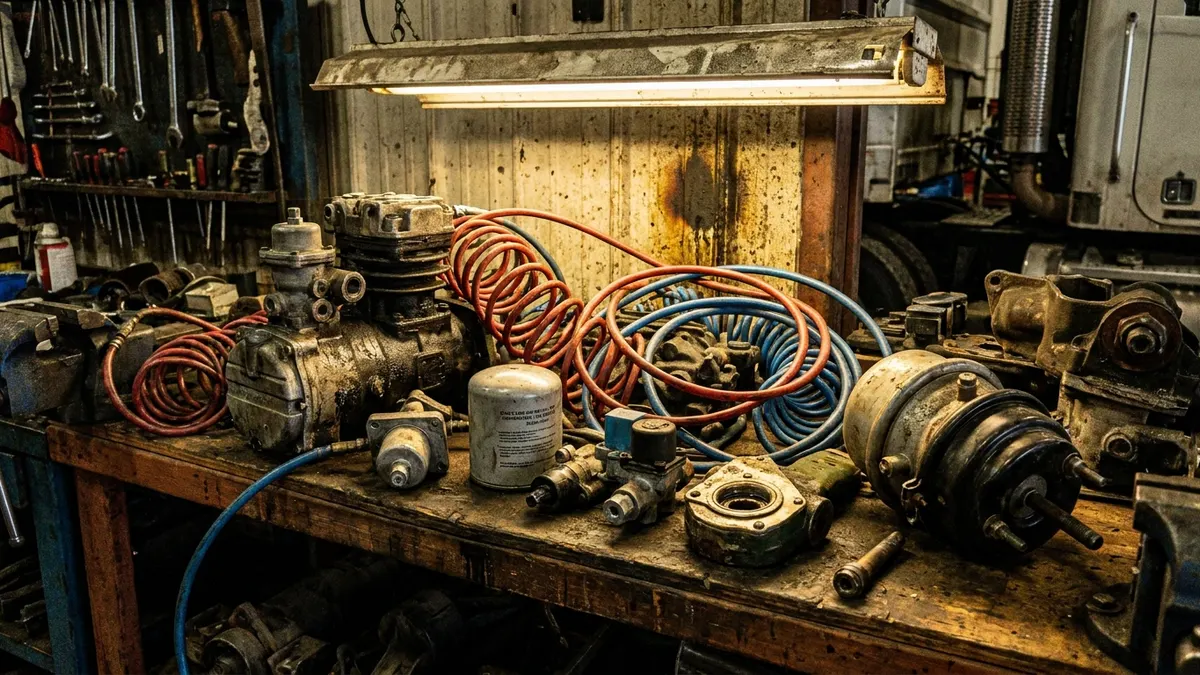
An air brake system is a chain of pneumatic valves that store, route, meter and dump compressed air between the compressor and the brake chambers. The main types are control valves (foot/treadle valve, trailer hand valve, dash control valves), relay and quick release valves that speed up application and release, protection valves (check, multi-circuit protection, tractor protection, pressure protection and safety relief), pressure control valves (governor and compressor unloader), and modulating valves (limiting, load sensing, inversion and anti-compounding). Every valve on a truck does one of three things: it sends air somewhere, it blocks air from going somewhere, or it vents air to atmosphere.
Nothing here works like a hydraulic passenger car brake. There is no sealed fluid column transmitting force from your foot to the wheel end. Your foot only opens a valve; stored air in the tanks does the actual work, and the valve layout is what makes that air arrive at all four or six wheel ends at roughly the same moment.
The quick map: valve by valve
| Valve | Where it sits | What it does | Typical failure symptom |
|---|---|---|---|
| Foot brake (treadle/dual) valve | Cab floor, under the pedal | Meters air from both circuits in proportion to pedal effort | Leak at the exhaust port, brakes drag, uneven circuit delivery |
| Relay valve | Rear axle or trailer, near the chambers | Uses a small signal line to open a large local air path | Slow apply or slow release, brakes hanging on |
| Quick release valve | Steer axle, close to the chambers | Dumps chamber air locally instead of back through the treadle | Front brakes slow to release, audible leak at the exhaust |
| Check valve (one-way) | Between wet tank and service tanks | Lets air in, keeps a downstream leak from draining upstream | Whole system loses air when one tank leaks |
| Multi-circuit protection valve | Downstream of the air dryer | Splits supply into primary, secondary, park and accessory circuits | One circuit failure pulls the others down |
| Tractor protection valve | Rear of the tractor frame | Isolates the tractor if trailer air is lost | Tractor drains out when a gladhand blows |
| Pressure protection valve | Accessory take-off (suspension, seat, horn) | Blocks accessories below a set pressure so brakes get air first | Air suspension steals air from the brake circuits |
| Governor | On or near the compressor | Sets cut-out and cut-in, signals the unloader | Compressor never unloads, or cuts out far too early |
| Unloader valve | Compressor head or dedicated unloader kit | Holds the intake open so the compressor idles unloaded | Constant pumping, hot compressor, oil carryover |
| Spring brake (park/emergency) valve | Frame rail, feeding the park circuit | Charges and releases spring brakes, applies them on air loss | Park brake will not release or drags |
| Safety relief valve | Wet tank | Pops off if pressure climbs past a safe ceiling, usually around 150 psi | Continuous venting from the tank, weeping seat |
Control valves: where driver input enters the circuit
The treadle or foot brake valve is a dual valve in one body. The primary section feeds one circuit directly; the secondary section is relayed off the primary so that if one circuit fails you still get braking on the other. Pedal travel and effort determine delivery pressure, which is why an air brake pedal feels progressive rather than firm.
The trailer control hand valve on the steering column applies trailer service brakes only. It is for testing and low-speed control, not for holding a loaded combination on a grade. Dash control valves are the two push-pull knobs: the yellow diamond releases the tractor spring brakes, the red octagon supplies air to the trailer. Push them in to charge, pull them out to park or to dump trailer supply.
Relay and quick release valves: speed, not force
On a long wheelbase truck, air routed all the way from the cab to the rear chambers and back would make application and release unacceptably slow. A relay valve solves this: the treadle sends only a small pilot signal down the control line, and the relay opens a short, large-bore path from the nearby tank to the chambers. Delivery pressure tracks the signal almost one to one.
A quick release valve does the same trick for release. Mounted close to the steer axle chambers, it vents chamber air straight to atmosphere instead of pushing it back up the line. An anti-compounding valve sits in the same family, preventing the service application and the spring brake force from stacking on one pushrod when a driver applies the pedal with the park brake set.
Protection valves: containing a failure
Modern trucks are legally required to keep braking after a single circuit failure, and protection valves are how that is achieved. Check valves make air one-way, so a burst hose downstream cannot empty the tanks upstream. The multi-circuit protection valve divides supply into primary, secondary, park and accessory circuits, each with its own opening pressure. The tractor protection valve closes the service and supply lines to the trailer when trailer air is lost, which is what saves the tractor's own reservoirs when a gladhand is torn off.
Rule of thumb: if the whole system drains when one component leaks, suspect a check or protection valve before you suspect the leak itself.
Pressure control: governor and unloader
The governor watches reservoir pressure and decides when the compressor works. Cut-out on most commercial systems falls in the 120-135 psi band; cut-in is typically 100-110 psi, giving a fully charged system that sits around 120 psi. At cut-out, the governor sends air to the compressor's unloader, which holds the intake open so the compressor turns without pumping. A governor that never signals unload leaves the compressor pumping continuously, which cooks the discharge line and pushes oil downstream.
Modulating and safety valves
Load sensing or automatic load-sensing brake (ALB) valves reduce delivery to the axle when the vehicle is unladen, cutting empty-truck wheel lockup. Older tractors used a front axle limiting valve for the same reason. An inversion or emergency valve converts falling supply pressure into a spring brake application, which is why the parking brakes set themselves as pressure falls into the 20-45 psi range. Before that happens, the low-air warning buzzer and light trip at roughly 60 psi to give the driver time to stop.
Diagnosing by symptom
- Slow release, brakes dragging: relay valve or quick release valve, or a restricted control line.
- Constant hiss at a valve exhaust port: failed internal seat, most often the treadle or relay.
- Air lost overnight across the whole vehicle: check valve or multi-circuit protection valve not sealing.
- Trailer will not charge: tractor protection valve, red dash knob, or gladhand seals.
- Compressor never rests: governor or unloader, not the compressor itself.
Rebuild or replace
Simple valves with a service kit and clean bores are worth rebuilding. Anything with a scored bore, corroded body or unknown service history is better replaced outright, since a valve that leaks internally will pass a visual check and still bleed the system. When a relay is the culprit, match bore size, crack pressure and port layout to the original; OE-grade replacement relay valves are cross-referenced by the original Bendix, Wabco/ZF, Knorr-Bremse or Haldex number so the timing characteristics stay the same across the axle. Mismatched crack pressures on paired axles are a common cause of brake lag and uneven lining wear.
Need the part, not just the answer?
OE-grade air brake compressors and repair kits, manufactured and tested to commercial-vehicle standards.
Shop VADEN partsPublished by VADEN Original. Product links point to the manufacturer’s official catalogue. Specifications are general — always confirm figures against your vehicle’s service manual.