 airbrakecompressor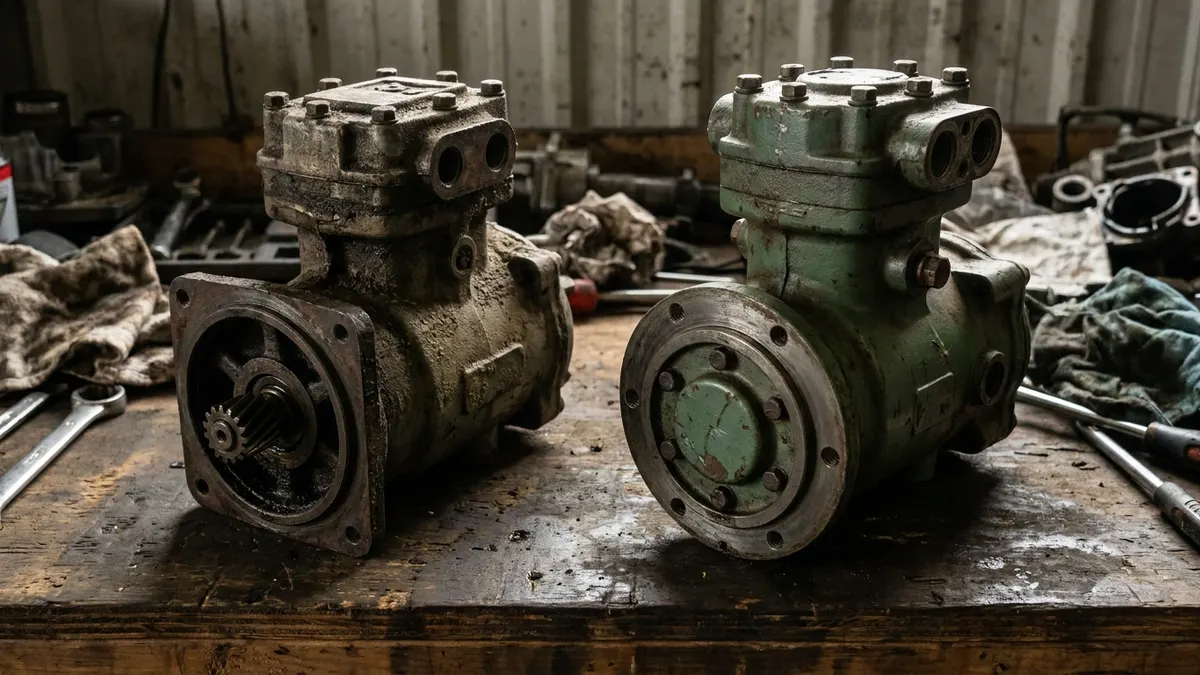
Bendix and Wabco — Wabco's braking business is now part of ZF — build the same class of component: an engine-driven reciprocating piston pump that charges the pneumatic brake system. They are not interchangeable off the shelf. Bendix units are the North American standard, using SAE-style flange mounting with imperial ports and a gear, belt or spline drive; Wabco/ZF units are the European standard, almost always gear-driven from the timing case with metric flanges and metric ports. You cross-reference either one by matching mounting, drive, displacement and port layout, not by the name cast into the crankcase.
Two design traditions, one job
Bendix
The Tu-Flo line is the one most North American techs know — the name refers to the twin-cylinder layout, and the family spans several displacement classes used on everything from vocational chassis to line-haul tractors. Bendix also builds single-cylinder units for lighter duty and a high-output single-cylinder design for applications that need a lot of air without the bulk of a twin. At the top end are heavy twin-cylinder units aimed at coaches, refuse and other high-consumption bodies.
Construction is conventional: cast iron crankcase, cast iron or aluminium head, water-cooled head on most highway applications with air-cooled variants for lower-duty work. The drive gear or pulley usually sits on a tapered shaft and is retained by a nut, so pulling it needs the right puller rather than a hammer. Mounting is typically a two- or four-bolt SAE flange, and discharge and coolant ports are threaded to imperial standards.
Wabco / ZF
Wabco compressors are the OE fitment across most European heavy diesels, supplied to Mercedes-Benz, MAN, DAF, Volvo, Renault and Iveco, and appearing on some engines sold worldwide. Single-cylinder units cover mid-range engines and lighter tractors; twin-cylinder units cover heavy line-haul and high-demand bodies.
They are nearly always flange-mounted to the timing case and gear-driven, with the drive gear bolted or pressed to the shaft. Water-cooled heads are close to universal, and on many later designs both oil feed and coolant pass through the mounting flange itself rather than through external lines — one of the biggest practical differences when you look at a bare casting on the bench. Modern units frequently include an energy-saving unloading arrangement that holds the compressor off-load while the engine runs, reducing parasitic drag once the system is charged.
Where they actually differ
| Attribute | Bendix | Wabco / ZF |
|---|---|---|
| Cylinders | Single and twin; Tu-Flo family is twin | Single and twin, split by engine size |
| Mounting | SAE two- or four-bolt flange, imperial hardware | Metric flange, three- or four-bolt, timing-case mounted |
| Drive | Gear or pulley on tapered shaft; some spline drives | Gear, usually bolted or pressed to the shaft |
| Cooling | Water-cooled head common; air-cooled variants exist | Water-cooled head near universal, some cooled crankcases |
| Oil and coolant routing | Often external lines to head and crankcase | Frequently through the mounting flange |
| Governor location | Commonly bolted directly to the compressor | Commonly remote, in-line or on the air dryer assembly |
| Output stated as | Cubic feet per minute at a stated compressor speed | Litres per minute at a stated compressor speed |
| Ports | Imperial pipe threads | Metric threads |
Output, and how each brand rates it
Headline output figures are the least useful part of the comparison, because the two markets quote them differently. North American data sheets give cubic feet per minute at a nominal compressor speed; European data sheets give litres per minute, often at a different reference speed. Comparing the raw numbers without normalising the test speed will mislead you.
What matters on the vehicle is fill time against the system's demand. The yardstick most fleets use in North America is build-up from roughly 85 to 100 psi in 45 seconds or less at fast idle on a dual system. If the truck meets that with the engine at operating temperature and no leaks, the compressor is doing its job whatever the badge says. Cylinder count follows demand rather than brand loyalty — see single versus twin cylinder compressors for how that choice is made.
Unloading and governor control
Both designs unload the same way in principle: the governor senses reservoir pressure and, at cut-out, sends air to lift the inlet valves or open an unloader passage so the compressor pumps without building pressure. It reloads at cut-in. Typical settings are cut-out around 120 to 135 psi and cut-in around 100 to 110 psi, with a fully charged system sitting near 120 psi, the low-air warning coming on around 60 psi, and spring brakes applying somewhere in the 20 to 45 psi band as pressure falls further.
Fitting a different compressor does not change any of those numbers — the governor sets them. What does change is where the governor lives and what unloader hardware you need. Bendix practice puts the governor on the compressor body; Wabco practice often puts it remote or integrates it into the dryer. Unloader kits, head gaskets and valve plates are family-specific, so ordering the right service kit depends on identifying the exact compressor variant, not just the make.
Cross-referencing either one to a replacement
Work through the physical attributes in this order:
- Read the data plate or casting numbers on the crankcase and head. Record everything, including suffixes — variants within one family differ only by a suffix.
- Count the cylinders and note the head layout, including the number and position of discharge ports.
- Measure the mounting flange: bolt count, bolt circle, spigot diameter and whether oil and coolant pass through the flange face.
- Identify the drive: gear or pulley, taper or spline, shaft diameter, keyway, retaining nut thread and rotation direction as viewed from the drive end.
- Check port threads and orientation for discharge, coolant in and out, oil feed and any unloader signal port.
- Confirm the unloader and governor arrangement so the replacement can be controlled by the existing plumbing.
With those six items in hand, an OE-equivalent unit can be identified reliably. Manufacturers that build to OE specification, including VADEN's range of OE-grade air brake compressors, publish cross-reference tables keyed to the original casting and part numbers so the match can be verified before the old unit comes off. Engine-first lookup is often faster than brand-first lookup, as covered in the cross-reference by engine guide.
Never assume a compressor fits because the flange bolts line up. A drive gear with the wrong tooth count, backlash or shaft taper will destroy itself and can take the timing gear train with it.
So which one should you fit?
Fit the family the engine was designed around. Bendix on an engine engineered for Bendix mounting and drive, Wabco/ZF on an engine engineered for Wabco mounting and drive. Cross-brand conversions exist on custom and repower builds, but they need an adapter plate, a matched drive gear, re-routed oil and coolant, and revised plumbing — a fabrication job, not a parts swap. For a standard repair, the real decision is not Bendix versus Wabco; it is choosing a correctly cross-referenced unit of the right displacement, in good condition, installed with a clean discharge line and a healthy dryer behind it.
Need the part, not just the answer?
OE-grade air brake compressors and repair kits, manufactured and tested to commercial-vehicle standards.
Shop VADEN partsPublished by VADEN Original. Product links point to the manufacturer’s official catalogue. Specifications are general — always confirm figures against your vehicle’s service manual.