 airbrakecompressor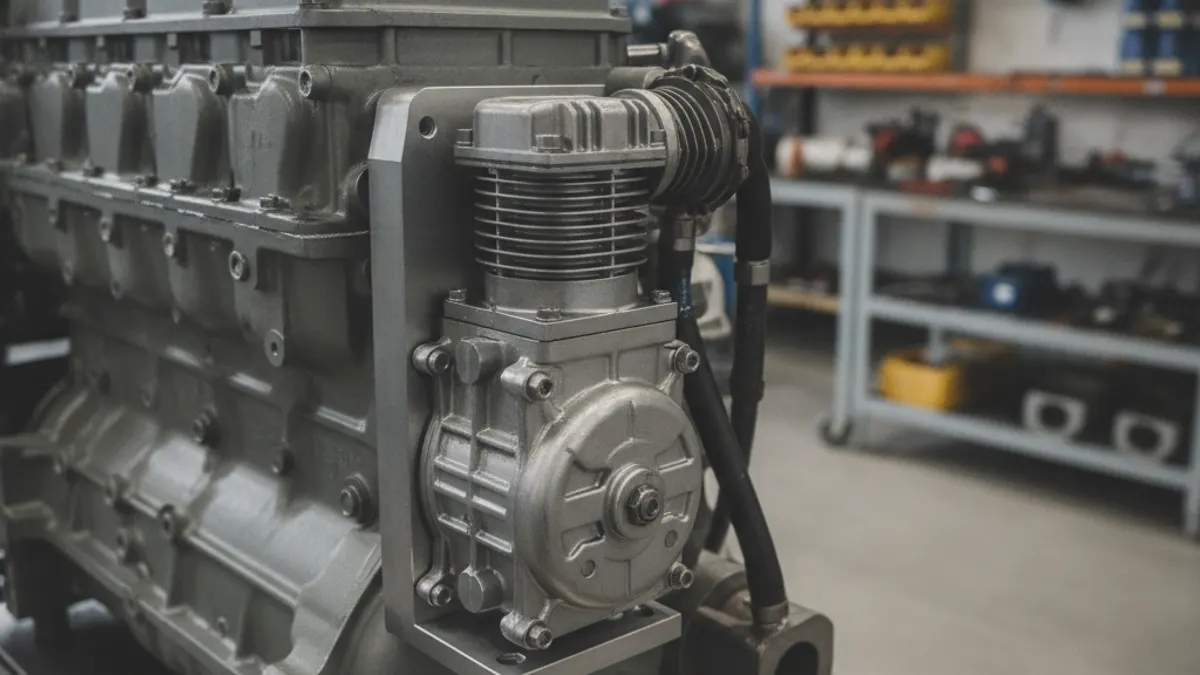
On a Cummins-powered truck, the "Cummins air compressor" is the engine-mounted, gear-driven air brake compressor that charges the vehicle's air system. It is not a standalone shop compressor and it is not part of the fuel or turbo system: it bolts to the engine block, turns whenever the engine turns, is lubricated by engine oil, and on most heavy-duty applications is cooled by engine coolant. Cummins supplies these units under its own part numbers, but the pumps themselves are built by established air brake compressor manufacturers, so the same casting can appear with a Cummins number, an OE truck-builder number, and a compressor-maker number.
What is actually on the engine
The compressor is a single- or twin-cylinder reciprocating pump driven off the engine gear train. It draws air either from the engine's air cleaner (naturally aspirated inlet) or from the intake manifold downstream of the turbocharger (boost-fed inlet), compresses it, and pushes hot, wet, oil-laden air down a discharge line to the air dryer and then to the wet tank. The whole system is pneumatic — there is no hydraulic circuit involved. The governor cycles the compressor between loaded and unloaded states, typically cutting out somewhere around 120–135 psi and cutting back in around 100–110 psi, so a fully charged system normally sits near 120 psi. If you want the fundamentals of the pump itself, start with how an air brake compressor works.
A healthy installation runs loaded only a small fraction of the time — as a rule of thumb, well under about a quarter of the duty cycle on a normally loaded truck. Constant loaded running points to a leak or a sizing problem, not to a compressor that is simply "working hard."
Drive and mounting on Cummins engines
Two things vary most between Cummins families: where the gear train is, and how the compressor's drive gear attaches.
| Engine family | Typical drive location | Notes for the tech |
|---|---|---|
| B6.7 / ISB6.7 (mid-range) | Front gear train | Usually a single-cylinder unit; access is generally good, oil and coolant feed at the mounting flange |
| L9 / ISL9 / ISC | Front gear train | Single- or twin-cylinder depending on chassis air demand (buses, refuse, vocational) |
| ISM / N14 (older heavy-duty) | Front gear train | Legacy units with many reman options, so verify inlet type and discharge port orientation before ordering |
| ISX15 / X15 | Rear gear train | Rear-mounted drive; plan for tighter access and support the unit's weight during removal |
The drive gear is either supplied with the compressor or has to be transferred from the old unit. If it transfers, note the gear retention hardware and any timing marks before you pull it, and inspect the teeth — a chipped drive gear will destroy a new compressor quickly.
Lubrication and cooling
Engine oil is fed to the compressor through the mounting flange or an external line and drains back to the pan. Coolant is routed through the head on liquid-cooled units. Any restriction in the oil feed, the drain, or the coolant path shortens compressor life, and a plugged drain will push oil past the rings into the air system — the classic cause of a compressor passing oil downstream into the dryer and tanks.
Single-cylinder vs twin-cylinder
Single-cylinder units cover typical line-haul tractors with modest accessory air demand. Twin-cylinder units are specified where air consumption is high: air suspension dumps, transit and coach doors, PTO and body air, refuse packers, and multi-axle trailer combinations. A twin roughly doubles the output of a comparable single at the same drive speed, which shortens charge time and lowers duty cycle. See single vs twin-cylinder compressors for the trade-offs. Never downsize below what the chassis was built with — a compressor that cannot keep up runs loaded almost continuously, overheats, and cokes its discharge line.
Identifying the right replacement
Cummins part numbers change by engine serial number (ESN) and CPL, and a single engine model can carry several compressor variants across model years. Match by hard data, not by the badge on the valve cover.
| Item to match | Why it matters | Where to find it |
|---|---|---|
| Engine serial number / CPL | Drives the correct part number supersession | Engine dataplate |
| Existing compressor number | Cross-references to the OE-grade equivalent | Compressor body or nameplate |
| Cylinder count and output class | Determines charge time and duty cycle | Old unit / chassis spec |
| Inlet type (air cleaner vs boost-fed) | Wrong inlet causes poor output or oil carryover | Visual: hose from air cleaner or from intake manifold |
| Cooling type and coolant port location | Lines must reach without strain | Visual on the head |
| Mounting flange and drive gear | Bolt pattern, shaft type, gear supplied or transferred | Old unit / parts catalog |
| Discharge port orientation and thread | Discharge line routing to the air dryer | Old unit |
| Unloader / governor connection | Must match the existing governor plumbing | Old unit |
Choosing OE-grade over cheap replacement
The compressor is a wear item that runs at engine speed for the life of the truck, so casting quality, ring and valve plate material, and bearing spec matter more than the price on the box. Remanufactured units vary widely: a reman with a fresh valve plate, rings, bearings and seals from a controlled process is a reasonable choice, while a cleaned and painted core is not. For heavy-duty applications, OE-grade units in the air brake compressor range from VADEN Original cross-reference to common Cummins, Bendix, Wabco and Knorr-Bremse numbers, which lets you match by the number on the old body instead of guessing from the engine model.
Replacing it without a comeback
- Drain the air system completely and let the engine cool before touching coolant lines.
- Photograph the oil, coolant, inlet, discharge and governor connections before disconnecting anything.
- Inspect the discharge line and fittings for carbon. A coked line will kill a new compressor — replace or thoroughly clean it, and keep the run as short and as free of low spots as practical.
- Replace the air dryer cartridge at the same time. A compressor that failed by passing oil has already contaminated the desiccant.
- Transfer the drive gear only if the new unit does not include one; check gear backlash and timing marks per the service manual.
- Use new gaskets and O-rings, pre-lube the unit with clean engine oil, and torque the mounting and head fasteners to the values in the current Cummins service literature.
- Refill coolant, purge air from the cooling system, start the engine and verify oil pressure at the compressor and no leaks before road testing.
- Confirm build-up time and governor cut-in and cut-out, then drain the tanks after the first shift and check for oil carryover.
The full step-by-step procedure is covered in the air brake compressor replacement guide.
Torque values, backlash figures and oil feed specifications differ by engine family and model year. Use the current Cummins service manual for the specific engine serial number — the pressure and duty-cycle figures here are general ranges for orientation only.
When the compressor is not the problem
Slow build-up on a Cummins-powered truck is more often a system leak, a failed governor, a saturated air dryer, or a leaking purge valve than a worn pump. Before condemning the compressor, run a leak-down test, verify governor cut-in and cut-out at the dash gauges, and check that the dryer is purging. Remember what the driver actually sees: the low-air warning light and buzzer come on at roughly 60 psi, and the spring brakes will apply on their own if pressure keeps dropping — that is a system-pressure symptom, not proof the compressor has failed. Replacing a good compressor because the dryer was dumping air is an expensive lesson.
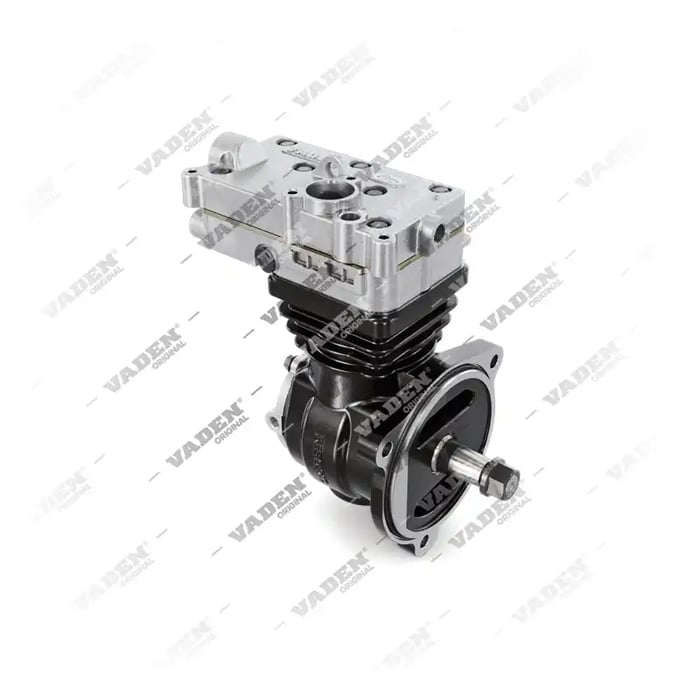
Need the part, not just the answer?
OE-grade air brake compressors and repair kits, manufactured and tested to commercial-vehicle standards.
Shop VADEN partsPublished by VADEN Original. Product links point to the manufacturer’s official catalogue. Specifications are general — always confirm figures against your vehicle’s service manual.