 airbrakecompressor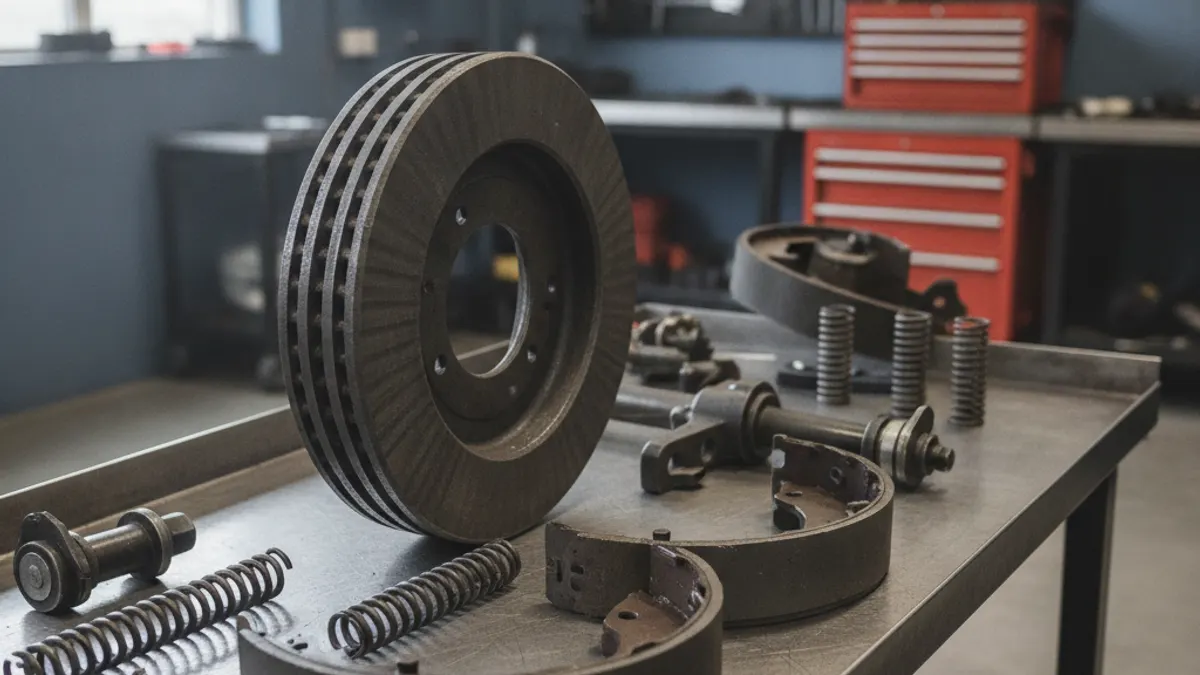
A heavy-duty drum brake is built from about a dozen serviceable parts: two brake shoes with riveted or bonded linings, two cam rollers, anchor pins and their bushings, a shoe return spring, retaining springs and clips, the S-cam shaft, the cam tube with its bushings and seals, a slack adjuster, and the brake drum. Everything except the drum mounts to the spider, the cast bracket bolted to the axle housing. Almost all of it wears together: the parts are cheap individually, the labor to open a wheel end is not, so they get replaced as a group.
This is an air-actuated brake, not a hydraulic one, so there is no wheel cylinder and no brake fluid. A pushrod from the air brake chamber swings the slack adjuster, the slack adjuster rotates the S-cam, and the cam spreads the shoes against the drum. The governor holds the supply in the usual heavy-duty band, cutting out around 120-135 psi and cutting back in near 100-110 psi, with the low-air warning at roughly 60 psi.
The complete drum brake parts list
| Part | What it does | Typical service life |
|---|---|---|
| Brake shoes (steel table and web) | Carry the lining and transfer force to the drum | Reused unless cracked, distorted or worn at the bores |
| Brake linings and rivets | The wear surface that generates stopping force | Wear out first; replace at minimum thickness or as a rivet head nears the drum, with new rivets every time |
| Cam rollers | Ride the S-cam profile and push the shoes outward | Every reline; they flat-spot and score |
| Anchor pins | Pivot point at the bottom of each shoe | Every reline if grooved, corroded or undersize |
| Anchor pin bushings | Bearing surface in the shoe web | Every reline on bushed designs |
| Shoe return spring | Pulls the shoes off the drum on release | Every reline; tension fades with heat cycles |
| Retaining springs, clips, washers, retainers | Hold the shoes and rollers in position | Every reline; this is the hardware kit |
| S-cam shaft | Rotates to spread the shoes apart | Long life; replace if scalloped, splines worn or shaft bent |
| Cam tube bushings | Support the shaft in the spider and support bracket | Often every second reline, sooner with radial play |
| Cam and grease seals | Keep grease in and water, salt and grit out | Whenever the bushings are disturbed |
| Slack adjuster | Turns pushrod travel into cam rotation and holds lining clearance | Inspect every reline; replace if it will not hold adjustment |
| Camshaft support bracket | Locates the cam tube outboard of the spider | Inspect for elongation and cracking |
| Brake drum | The rotating friction surface | Often two lining sets; governed by discard diameter, cracks and hard spots |
Friction: shoes and linings
The lining is the consumable; everything else in the assembly exists to hold it, move it, or spin against it. Riveted linings are the norm in North American fleet service and are easy to inspect and reline; bonded linings, common on European and bus applications, give slightly more usable material for a given block height.
Two things govern lining choice. The first is the friction rating stamped as an edge code, the letter pair describing normal and hot friction coefficients. One code must run across both wheel ends of an axle; mixing codes left to right is a reliable way to make a truck pull under braking. The second is the vehicle's brake certification: replacement friction should be equivalent to what the chassis was certified with. A supplier that publishes edge codes and application data, such as a catalogued heavy-duty brake lining range, removes the guesswork.
Replace linings at the brake manufacturer's minimum thickness, when a rivet head is approaching the drum surface, when the block is cracked through to the shoe, or when the material is contaminated with oil or grease. Contaminated linings cannot be cleaned back into service, because the oil is inside the material.
Shoe condition
Steel shoes are usually reused, relined in-house or exchanged as remanufactured assemblies. Scrap a shoe with a cracked web, a heat-distorted table that will not let the lining sit flat, or elongated anchor and roller bores; a worn bore prevents even lining contact however good the friction is.
Motion parts: rollers, anchors, springs, cam
These are the parts skipped to save twenty dollars, and they are why a brake job comes back.
- Cam rollers develop flats where they sit against the cam under parked load. Once flat-spotted they drag the shoe rather than rolling it out. New rollers every reline.
- Anchor pins and bushings take the whole braking reaction at the bottom of the shoe. A grooved pin lets the shoe cock in the drum, which shows up as tapered lining wear from one end of the block to the other.
- Return springs lose tension after thousands of heat cycles. A weak spring gives brakes that are slow to release and linings that run hot for no obvious reason.
- Retaining hardware (clips, washers, retainer plates, felt seals) is sold as a kit for a reason. Buy the kit.
- The S-cam shaft is directional; left and right cams are not interchangeable on most designs. Check the profile for scalloping where the roller rides, and check the splines that mate to the slack adjuster.
Cam tube bushings and seals, the commonly missed items
The cam shaft rides in two bushings, one in the spider and one in the outboard support bracket, with a seal at each end. Water and road salt get past tired seals, the bushings corrode, and the shaft develops radial play. The symptoms are subtle: uneven lining wear across the block, a slack adjuster that will not stay in adjustment, lazy release on that wheel end. Grab the shaft near the slack adjuster and move it up and down; noticeable play means bushings. Reaching them takes the same teardown as a reline, so leaving them books a second visit.
The drum
Every drum carries a maximum discard diameter cast or stamped into it. Measure the inside diameter at several points; at or past discard, the drum is finished. Also scrap drums with cracks reaching the friction surface, blue hard spots standing proud of the machined face, or a wear step deep enough that new linings would contact only part of the width. Fit drums in matched pairs per axle so both wheel ends see the same heat capacity. More on sizing and inspection in the truck brake drums guide.
What to buy together
Order a brake job as an axle set, not a wheel-end set:
- Four relined or new shoe assemblies, or four lining sets plus rivets
- Two hardware kits covering rollers, anchor pins, bushings, springs, clips and retainers
- Cam bushing and seal kits for both wheel ends if there is play
- Two matched brake drums
- Two slack adjusters if the existing ones will not hold adjustment
- Wheel seals and a wheel bearing kit, since the hub is coming off anyway
Torque values, minimum lining thickness and drum discard diameters vary by axle and brake size. Work to the current service manual for that axle, and treat the figures cast into the part as the authority rather than a generic chart.
After assembly
Grease the cam tube and slack adjuster until fresh grease shows at the seal, but do not over-pump a cam tube on a design where excess grease can reach the lining. Set the initial adjustment per the slack adjuster manufacturer's procedure, then check pushrod stroke against the applicable limit before the vehicle returns to service; a perfect parts list means nothing if the stroke is long. Bed the friction in with light-to-moderate stops rather than one hard drag, and re-check adjustment after the first few hundred miles. The S-cam foundation brake walkthrough covers how the pieces fit together on the axle.
Need the part, not just the answer?
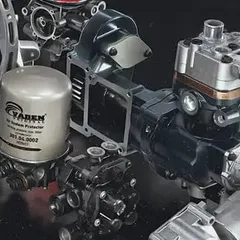
OE-grade air brake compressors and repair kits, manufactured and tested to commercial-vehicle standards.
Shop VADEN partsPublished by VADEN Original. Product links point to the manufacturer’s official catalogue. Specifications are general — always confirm figures against your vehicle’s service manual.